


Premier Lin Chuan (林全) yesterday said that actors and actresses should be judged on their acting, not their politics, after Taiwanese director-actor Leon Dai (戴立忍) was replaced in a Chinese movie over his “unclear” political stance.
“People in the entertainment business should be evaluated for their professional performance, not their political stance,” Lin said. “In any society, it is more important for people in the entertainment industry to do their best in performing.”
“I hope this will not become a regular occurrence,” he said.
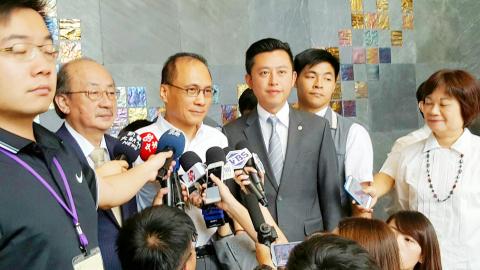
Photo: Tsai Chang-sheng, Taipei Times
Lin said that the Ministry of Culture had launched policies to improve the entertainment industry so actors and actresses could develop their careers more fully.
Lin made the remarks in response to reporters’ questions on the replacement of Dai in the film No Other Love (沒有別的愛) directed by Chinese actress Zhao Wei (趙薇).
Dai was accused of supporting “Taiwanese independence” because of his participation in social movements in Taiwan — including campaigns against nuclear power, the Sunflower movement and a campaign by high-school students against changes to history curriculum guidelines — and his support of a call by Hong Kong’s pro-democracy advocates for the direct election of the territory’s chief executive.
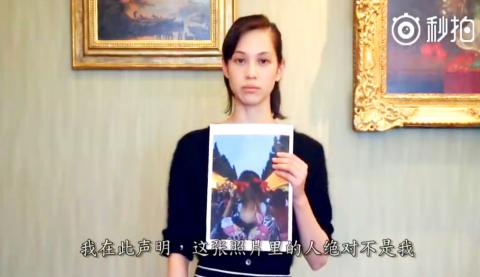
Screengrab from the Internet
After his removal was announced, Dai issued a 3,000-word statement denying the accusations.
In a post on Sina Weibo (新浪微博) on Friday evening, Dai detailed his family background, saying he was born to a father who fled to Taiwan amid the Chinese Civil War in the 1940s and a mother whose family has been in Taiwan for generations.
He said both Taiwan and China are his roots, adding that he believes he is an authentic Chinese, while stressing that he never supported or campaigned for Taiwanese independence.
He said he spoke during the Sunflower movement, not because he was opposed to the cross-strait trade pact, which the protests were aimed at, but because he did not want to see the movement end in bloodshed.
He said that a picture of him holding a placard supporting the direct election of Hong Kong’s chief executive emerged because someone came to him with the placard and asked for a photograph together and that he agreed without giving it a second thought.
Dai said that he criticized then-minister of education Wu Se-hwa’s (吳思華) changes to high-school curriculum guidelines because a student committed suicide.
“My participation in civil movements was not political,” Dai said.
Dai said he understood the decision to replace him in the movie and he apologized to investors in the film and the crew for the controversy surrounding his past.
Another actor in the movie issued an apology and responded to criticism that she was anti-China.
In an video posted online on Friday night, Japan-based model/actress Kiko Mizuhara responded to three recent incidents that were at the center of criticism against her among the online community.
Chinese netizens said a photograph at Tokyo’s Yasukuni Shrine, which honors people who died fighting on behalf of the Japanese emperor, including 30,304 Taiwanese soldiers killed in World War II, showed Mizuhara visiting the site, which is seen by many as a symbol of Japan’s wartime militarism.
She denied being in the photograph.
Regarding another image, she said she was accused of “posing offensively in front of a flag.”
However, “I am not in the picture,” Daniel said.
Netizens in China also said she “liked” a photograph posted on Instagram in 2013 by a friend of hers that showed a man gesturing toward a structure at Tiananmen Square in Beijing.
Mizuhara said that she “liked” the photo to encourage her friend to make more use of social media.
Mizuhara’s father is American and her mother is a Japan-born South Korean. Mizuhara was born in the US and moved to Japan at age two.
Additional reporting by CNA


RESILIENCE: Taiwan plays a key role in semiconductors, energy, information infrastructure and advanced manufacturing, AIT Director Raymond Greene said Taiwan’s continued investment in deterrence and resilience remains vital, especially in uncrewed systems and other emerging technologies, American Institute in Taiwan (AIT) Director Raymond Greene said yesterday. Greene made the remarks at the annual National Strategic Summit on Supply Chain Resilience held by the Research Institute for Democracy, Society and Emerging Technology (DSET), a government-backed think tank. As Taiwan last year became the US’ fourth-largest trading partner and supply chain security is becoming more important, cooperation in emerging technologies continues to deepen between the two countries, he said. The US is committed to accelerating innovation, building key infrastructure, strengthening cooperation

The National Chungshan Institute of Science and Technology yesterday showcased its locally developed variants of the Vision 60 robotic patrol dog, which it plans to deploy on the nation’s outlying territories in the South China Sea. The variants were produced under the Joint Lab project — created by the institute and domestic companies — and assembled with domestically produced motors, lenses and artificial intelligence (AI) systems alongside licensed tech from the US, Missile and Rocket Systems Research Division deputy director Jen Kuo-kang (任國光) told the media event at a military base in Taipei’s Dazhi (大直) area. Taiwan has built up its strengths

RIGHT DIRECTION: Taiwan’s efforts to prevent forced labor include a proposal to ‘fully prohibit’ employers from withholding workers’ documents, an official said Taiwan is to establish a mechanism to restrict imports of goods linked to forced labor, the Executive Yuan said yesterday, after the US proposed imposing additional tariffs on Taiwanese goods over labor concerns. “The Ministry of Labor and the Ministry of Economic Affairs are to establish an interministerial review procedure,” Executive Yuan spokesperson Michelle Lee (李慧芝) said at a news briefing in Taipei. “The government is to use the Foreign Trade Act [貿易法] as the legal basis to restrict imports of goods produced with forced labor” and bring its supply chain governance more in line with international standards on human rights, resilience

NOT IMMEDIATE: Taiwan has a chance to appeal the proposed 10 percent tariff before it starts, while other countries face a 12.5 percent tariff from the trade office Taiwan is among 60 economies determined by the US to have failed to impose or enforce a ban on the importation of goods produced with forced labor, according to a notice released on Tuesday by the Office of the US Trade Representative (USTR), which proposed imposing an additional 10 percent or more tariff on them. The USTR in a statement said that following an investigation, it had determined under Section 301 of the Trade Act of 1974 that the failure of the 60 economies to impose and effectively enforce a prohibition on the importation of goods produced with forced labor is


 RSS
RSS