


Prosecutors wrapped up their investigation into the building collapse disaster in Tainan by bringing charges of professional negligence causing death against five suspects, including the main figure in the case, developer Lin Ming-hui (林明輝), and the two architects in charge of building design and carrying out the construction.
Officials at the Tainan District Prosecutors’ Office yesterday said the five suspects were responsible for the disaster on Feb. 6, in which the Weiguan Jinlong residential complex collapsed during an earthquake, leaving 115 people dead and 96 injured, and they are requesting the maximum sentence.
In addition to the 64-year-old Lin, the others charged were Cheng Chin-kuei (鄭進貴), 63, and Chang Kuei-pao (張魁寶), 63, the building’s architects, along with Hung Hsian-han (洪仙汗), 58, head of the building design division at Lin’s company, and Cheng Tung-hsu (鄭東旭), 52, a structural design technician hired for the building project.

Photo: CNA
Lin and the two architects, who have been detained without bail since Feb. 9, were transferred to the custody of the Tainan District Court after yesterday’s indictment, and the court judge is to decide at a bail hearing whether to continue to detain them.
Prosecutors said Lin and Hung made shortcuts and alterations during the project’s design and construction process with the aim of cutting expenditure, and also skimmed on building materials, which affected the structural safety and stability of the residential complex.
The indictment statement alleged that Lin and Hung did not follow proper construction procedures and reduced the amount of steel rebar and connecting bars, as well as the diameter of the pillars, and engaged in other shoddy practices.
The two architects were hired by Lin as designer and supervisor for the construction, but the building’s design blueprint and its structural safety were not certified by licensed architectural firms, prosecutors said.
They also alleged that Lin borrowed a building construction license from another firm, and had no safety supervisor or certified technicians at the construction site to oversee the progress of the project.
The presiding judge last night denied bail to Lin and continued to hold him incommunicado, citing possible flight risk and tampering with evidence, while the two architects were granted bail of NT$2 million (US$61,725) each.
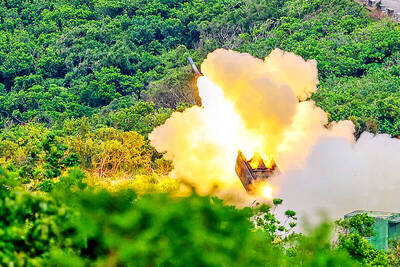
PRECISION STRIKES: The most significant reason to deploy HIMARS to outlying islands is to establish a ‘dead zone’ that the PLA would not dare enter, a source said A High Mobility Artillery Rocket System (HIMARS) would be deployed to Penghu County and Dongyin Island (東引) in Lienchiang County (Matsu) to force the Chinese military to retreat at least 100km from the coastline, a military source said yesterday. Taiwan has been procuring HIMARS and Army Tactical Missile Systems (ATACMS) from the US in batches. Once all batches have been delivered, Taiwan would possess 111 HIMARS units and 504 ATACMS, which have a range of 300km. Considering that “offense is the best defense,” the military plans to forward-deploy the systems to outlying islands such as Penghu and Dongyin so that
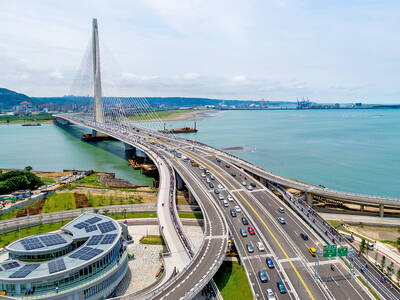
The Ministry of Transportation and Communications yesterday inaugurated the Danjiang Bridge across the Tamsui River in New Taipei City, saying that the structure would be an architectural icon and traffic artery for Taiwan. Feted as a major engineering achievement, the Danjiang Bridge is 920m long, 211m tall at the top of its pylon, and is the longest single-pylon asymmetric cable-stayed bridge in the world, the government’s Web site for the structure said. It was designed by late Iraqi-British architect Zaha Hadid. The structure, with a maximum deck of 70m, accommodates road and light rail traffic, and affords a 200m navigation channel for boats,

WHAT WAS ALL THAT FOR? Jaw Shaw-kong said that Cheng Li-wen had pushed for more drastic cuts and attacked him, just for the outcome to be nearly identical to his bill The legislature yesterday passed a supplementary budget bill to fund the purchase of separate packages of US military equipment, with the combined amount of spending capped at NT$780 billion (US$24.8 billion). The Chinese Nationalist Party (KMT) and Taiwan People’s Party (TPP) used their legislative majority to pass the bill, which runs until 2033 and has two main funding provisions. One was for NT$300 billion of arms sales already approved by the US for Taiwan on Dec. 17 last year, the other was for NT$480 billion for another arms package expected to be announced by Washington. The bill, which fell short of the NT$1.25

‘CLEAR MESSAGE’: The bill would set up an interagency ‘tiger team’ to review sanctions tools and other economic options to help deter any Chinese aggression toward Taiwan US Representative Young Kim has introduced a bill to deter Chinese aggression against Taiwan, calling for an interagency “tiger team” to preplan coordinated sanctions and economic measures in response to possible Chinese military or political action against Taiwan. “[Chinese President] Xi Jinping [習近平] has directed the People’s Liberation Army to be ready to invade Taiwan by 2027. China has a plan. America should have one too,” Kim said in a news release on Thursday last week. She introduced the “Deter PRC [People’s Republic of China] aggression against Taiwan act” to “ensure the US has a coordinated sanctions strategy ready should


 RSS
RSS