


Chinese Nationalist Party (KMT) presidential candidate Eric Chu (朱立倫) yesterday urged his supporters to cling to their faith and cast their party votes for the KMT, amid growing competition from other pan-blue parties.
Chu made the remarks when canvassing for votes in Changhua County yesterday morning, in response to reporters’ inquiries on how he planned to respond to growing calls for KMT supporters to give their party vote to the New Party.
“Such a practice is bound to spark huge controversy, which I believe could be avoided if everyone just supports Eric Chu,” Chu said.

Photo: Olivia Harris, Reuters
Chu also dismissed allegations made by media personality Clara Chou (周玉蔻) during a political talk show on Sunday that a senior KMT member who had served in the Cabinet was mulling launching a campaign urging pan-blue supporters to abandon Chu and vote for People First Party presidential candidate James Soong (宋楚瑜).
“I have never heard of such a plan. There are all sorts of false rumors during the final stage of an election campaign, but I believe all our supporters will vote for me,” Chu said.
There have been grave concerns that the KMT could lose chunks of the party vote to other pan-blue parties in Saturday’s legislative election, primarily due to its lackluster approval ratings and the record-high number of 18 political parties on the legislator-at-large ballot.

Photo: Chien Jung-fong, Taipei Times
To make matters worse, a number of KMT members have urged their supporters to cast their party votes for the New Party.
On Saturday, KMT Legislator Alex Tsai (蔡正元) listed on Facebook four reasons why pan-blue supporters should cast their party votes for the New Party, such as allowing another pan-blue party to form a legislative caucus to check the pan-green parties.
Last month, former premier Hau Pei-tsun (郝柏村) of the KMT also called on supporters to cast their party votes for the New Party, calling it the “legitimate KMT.”
Legislator-at-large seats are awarded to parties that garner at least 5 percent of the party votes in the election and in proportion to the number of votes each party gains.
At a separate event in Nantou County yesterday, Chu said DPP presidential candidate Tsai Ing-wen’s (蔡英文) “failure to elaborate” on her cross-strait policies has unnerved many foreign reporters and academics, as well as the “silent majority” in Taiwan.
“That is why I must urge the public to come out on Saturday and vote in favor of Eric Chu,” Chu said.
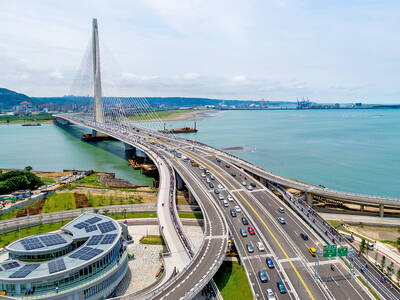
The Ministry of Transportation and Communications yesterday inaugurated the Danjiang Bridge across the Tamsui River in New Taipei City, saying that the structure would be an architectural icon and traffic artery for Taiwan. Feted as a major engineering achievement, the Danjiang Bridge is 920m long, 211m tall at the top of its pylon, and is the longest single-pylon asymmetric cable-stayed bridge in the world, the government’s Web site for the structure said. It was designed by late Iraqi-British architect Zaha Hadid. The structure, with a maximum deck of 70m, accommodates road and light rail traffic, and affords a 200m navigation channel for boats,
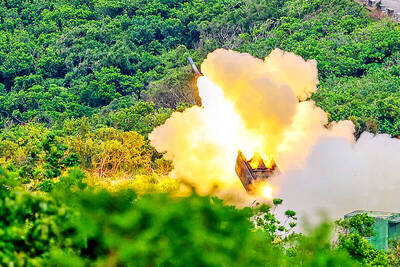
PRECISION STRIKES: The most significant reason to deploy HIMARS to outlying islands is to establish a ‘dead zone’ that the PLA would not dare enter, a source said A High Mobility Artillery Rocket System (HIMARS) would be deployed to Penghu County and Dongyin Island (東引) in Lienchiang County (Matsu) to force the Chinese military to retreat at least 100km from the coastline, a military source said yesterday. Taiwan has been procuring HIMARS and Army Tactical Missile Systems (ATACMS) from the US in batches. Once all batches have been delivered, Taiwan would possess 111 HIMARS units and 504 ATACMS, which have a range of 300km. Considering that “offense is the best defense,” the military plans to forward-deploy the systems to outlying islands such as Penghu and Dongyin so that

WHAT WAS ALL THAT FOR? Jaw Shaw-kong said that Cheng Li-wen had pushed for more drastic cuts and attacked him, just for the outcome to be nearly identical to his bill The legislature yesterday passed a supplementary budget bill to fund the purchase of separate packages of US military equipment, with the combined amount of spending capped at NT$780 billion (US$24.8 billion). The Chinese Nationalist Party (KMT) and Taiwan People’s Party (TPP) used their legislative majority to pass the bill, which runs until 2033 and has two main funding provisions. One was for NT$300 billion of arms sales already approved by the US for Taiwan on Dec. 17 last year, the other was for NT$480 billion for another arms package expected to be announced by Washington. The bill, which fell short of the NT$1.25

‘CLEAR MESSAGE’: The bill would set up an interagency ‘tiger team’ to review sanctions tools and other economic options to help deter any Chinese aggression toward Taiwan US Representative Young Kim has introduced a bill to deter Chinese aggression against Taiwan, calling for an interagency “tiger team” to preplan coordinated sanctions and economic measures in response to possible Chinese military or political action against Taiwan. “[Chinese President] Xi Jinping [習近平] has directed the People’s Liberation Army to be ready to invade Taiwan by 2027. China has a plan. America should have one too,” Kim said in a news release on Thursday last week. She introduced the “Deter PRC [People’s Republic of China] aggression against Taiwan act” to “ensure the US has a coordinated sanctions strategy ready should


 RSS
RSS