


Former British prime minister Tony Blair was committed to joining the US in the Iraq war a year before the 2003 invasion, documents obtained by a Sunday newspaper suggested.
The revelations focus on a memo allegedly written by former US secretary of state Colin Powell on March 28, 2002 to then-US president George W. Bush a week before the US leader’s meeting with Blair at his ranch in Crawford, Texas.
“On Iraq, Blair will be with us should military operations be necessary,” the Mail on Sunday said in a report on its Web site, citing a document written by Powell.
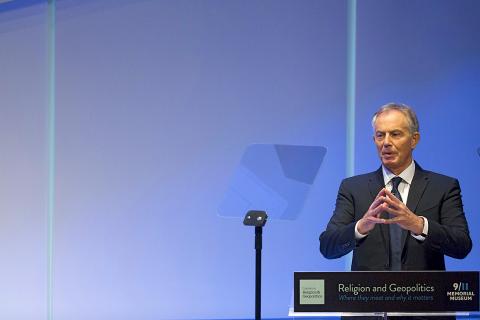
Photo: Reuters
“He is convinced on two points: the threat is real; and success against Saddam will yield more regional success,” Powell said, referring to then-Iraqi president Saddam Hussein, who was eventually ousted in the 2003 US-led invasion.
The Mail on Sunday said that the memo and other sensitive documents were part of a batch of secret e-mails held on the private server of Democratic US presidential hopeful Hillary Rodham Clinton, which US courts have forced her to reveal.
A separate quote from Powell assured Bush “the UK will follow our lead in the Middle East,” while other statements suggest Blair’s willingness to present “strategic, tactical and public affairs lines” to boost support among the public for the Iraq war.
Blair, who served as prime minister from 1997 to 2007, has repeatedly denied rushing to war.
Under his leadership, Britain made the second-biggest troop contribution to the Iraq invasion, and British forces were stationed in the nation until 2011.
The decision to back the invasion is now deeply unpopular in Britain and has haunted the Labour Party ever since.
A controversial inquiry by former civil servant John Chilcot into the decisions leading up to the war was expected to take a year to report, but is still not public despite being announced by the government six years ago.
“This story is nothing new. The memo is consistent with what Mr Blair was saying publicly at the time and with Mr Blair’s evidence given to the Chilcot Inquiry,” a spokesperson for Blair’s office said.
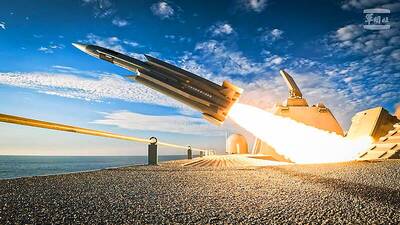
DETERRENCE: With 1,000 indigenous Hsiung Feng II and III missiles and 400 Harpoon missiles, the nation would boast the highest anti-ship missile density in the world With Taiwan wrapping up mass production of Hsiung Feng II and III missiles by December and an influx of Harpoon missiles from the US, Taiwan would have the highest density of anti-ship missiles in the world, a source said yesterday. Taiwan is to wrap up mass production of the indigenous anti-ship missiles by the end of year, as the Chungshan Institute of Science and Technology has been meeting production targets ahead of schedule, a defense official with knowledge of the matter said. Combined with the 400 Harpoon anti-ship missiles Taiwan expects to receive from the US by 2028, the nation would have
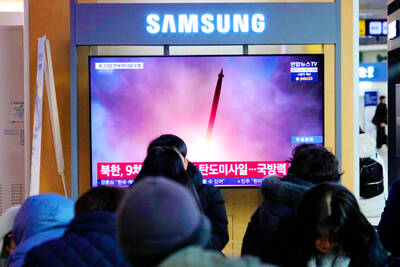
North Korea yesterday fired about 10 ballistic missiles to the sea toward Japan, the South Korean Joint Chiefs of Staff (JCS) said, days after Pyongyang warned of “terrible consequences” over ongoing South Korea-US military drills. Pyongyang recently dashed hopes of a diplomatic thaw with Seoul, Washington’s security ally, describing its latest peace efforts as a “clumsy, deceptive farce.” Seoul’s military detected “around 10 ballistic missiles launched from the Sunan area in North Korea toward the East Sea [Sea of Japan] at around 1:20pm,” JCS said in a statement, referring to South Korea’s name for the body of water. The missiles

‘UNWAVERING FRIENDSHIP’: A representative of a Japanese group that co-organized a memorial, said he hopes Japanese never forget Taiwan’s kindness President William Lai (賴清德) yesterday marked the 15th anniversary of the Tohoku earthquake and tsunami, urging continued cooperation between Taiwan and Japan on disaster prevention and humanitarian assistance. Lai wrote on social media that Taiwan and Japan have always helped each other in the aftermath of major disasters. The magnitude 9 earthquake struck northeastern Japan on March 11, 2011, triggering a massive tsunami that claimed more than 19,000 lives, according to data from Japanese authorities. Following the disaster, Taiwan donated more than US$240 million in aid, making it one of the largest contributors of financial assistance to Japan. In addition to cash donations and
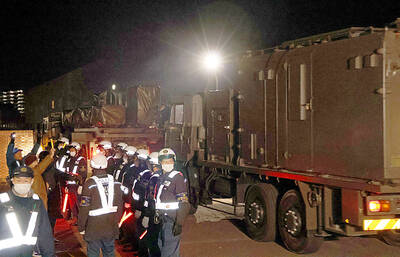
CLOSER TO CHINA: The upgraded Type-12 missile has a range of about 1,000km, compared with the original model’s range of 200km, and can reach mainland China Japan is preparing to deploy its first batch of domestically developed long-range missiles, with their launchers arriving at an army camp yesterday, as the country accelerates its offensive capability in response to rising challenges in the region. The upgraded Type-12 land-to-ship missiles are to be deployed at Camp Kengun in Japan’s southwestern prefecture of Kumamoto by the end of this month, completing the process of deployment, Japanese Chief Cabinet Secretary Minoru Kihara said without giving details. Army vehicles carrying the launchers and other equipment arrived past midnight in a highly secretive mission criticized by residents. Dozens of people stood outside of the


 RSS
RSS