


More than 4,000 people were evacuated yesterday in areas of northern and eastern Taiwan as Typhoon Dujuan approached the nation, gathering strength as it bore down on the east coast.
The military, working with local governments, evacuated people from areas vulnerable to falling rocks, mudslides and flooding in 39 townships and districts in Yilan, Hualien, Taitung, Hsinchu and Nantou counties and Taipei and New Taipei City.
New Taipei City Mayor Eric Chu (朱立倫) said the vulnerable areas include Wulai District (烏來), which was hit hard by Typhoon Soudelor last month, with some residents unable to return home for weeks. Most shops and hotels in the hot springs town remain closed as roads and flood damage are yet to be fully repaired.
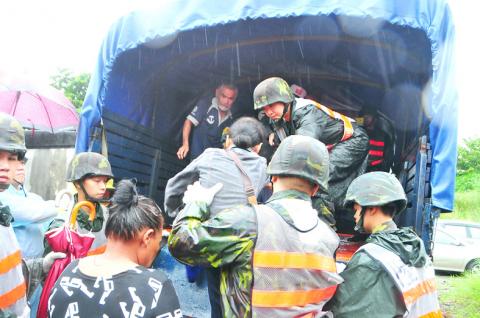
Photo: Hua Meng-ching, Taipei Times
“To be honest, we all feel very depressed. Any damage might further prolong the time needed for reconstruction,” said Chou Chih-kang, an Wulai neighborhood leader.
Television footage showed fast-moving flood waters swamping roads just outside Taipei and huge waves crashing against the northeast coastline.
Taipei 101 also reported that one of the glass doors to the underground portion of its mall was damaged by a strong gust of wind, but it had been repaired by the evening.
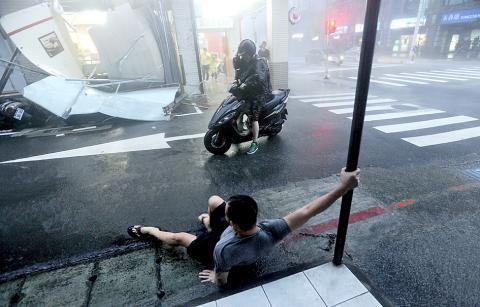
Photo: Lin Cheng-kung, Taipei Times
As of 7pm last night, the Central Emergency Operation Center said no injuries had been reported.
A total of 937,900 households nationwide lost power at some point during the day and as of 7:20pm, 532,800 households were still waiting for power to be restored, mostly in Yilan County and Taichung.
The Central Weather Bureau (CWB) said Dujuan made landfall at Suao Township (蘇澳) in Yilan County at 5:40pm. Suao brought gusts of wind reaching 243.7kph, the second-highest on record since a weather station was established in the township 34 years ago, the bureau said.
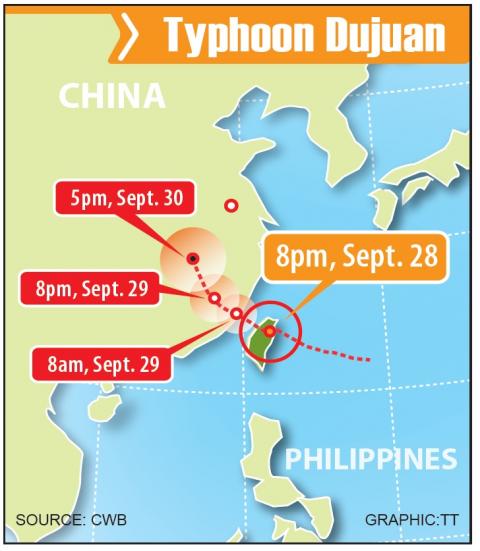
The strongest gusts ever experienced in Suao occurred during Typhoon Gladys in 1994, when wind speeds hit 246.9kph, the bureau said.
As of 9pm, the storm was centered 30km northeast of Taichung, moving at 20kph west-northwest, the bureau said.
With a radius of 220km, the storm’s strongest winds were estimated to be 184kph.
A super flood tide was due yesterday evening, and this, coupled with heavy tides brought by Dujuan, could inundate low-lying areas along the west coast of Taiwan proper, as well as riversides in the area.
Authorities said coastal areas could be particularly dangerous as tides are affected by the “supermoon” — a rare astrological event in which the moon appears brighter and larger — because it has reached its closest orbital point to Earth, resulting in its gravitational pull being stronger than usual.
According to the Ministry of National Defense, more than 24,000 personnel are on standby for disaster relief and evacuations, with 100 shelters set up.
At 8pm last night, Taipei, New Taipei City and Keelung had declared a half-typhoon day today, canceling work and classes this morning. However, at 10pm the three cities announced that the whole day would be a typhoon day.
Chuanghua, Nantou, Penghu, Yilan and Lienchiang counties and Taichung also declared a typhoon day for the full day. Taitung County and Tainan City are to operate as normal working days. Kaohsiung City, and Pingtung and Hualien Counties were yet to make announcements.
A Bon Jovi concert scheduled to take place last night at the Taipei World Trade Center Nangang Exhibition Hall was canceled because of the typhoon. The event promoter yesterday afternoon said that tickets for last night’s show could be exchanged or refunded at the exhibition hall starting at noon today. It also said that 90 percent of the tickets would be able to be exchanged.
The weather bureau said the typhoon would move away from Taiwan by noon today, but that rain and wind would only ease up after it made landfall in China.

RESILIENCE: Taiwan plays a key role in semiconductors, energy, information infrastructure and advanced manufacturing, AIT Director Raymond Greene said Taiwan’s continued investment in deterrence and resilience remains vital, especially in uncrewed systems and other emerging technologies, American Institute in Taiwan (AIT) Director Raymond Greene said yesterday. Greene made the remarks at the annual National Strategic Summit on Supply Chain Resilience held by the Research Institute for Democracy, Society and Emerging Technology (DSET), a government-backed think tank. As Taiwan last year became the US’ fourth-largest trading partner and supply chain security is becoming more important, cooperation in emerging technologies continues to deepen between the two countries, he said. The US is committed to accelerating innovation, building key infrastructure, strengthening cooperation

The National Chungshan Institute of Science and Technology yesterday showcased its locally developed variants of the Vision 60 robotic patrol dog, which it plans to deploy on the nation’s outlying territories in the South China Sea. The variants were produced under the Joint Lab project — created by the institute and domestic companies — and assembled with domestically produced motors, lenses and artificial intelligence (AI) systems alongside licensed tech from the US, Missile and Rocket Systems Research Division deputy director Jen Kuo-kang (任國光) told the media event at a military base in Taipei’s Dazhi (大直) area. Taiwan has built up its strengths

RIGHT DIRECTION: Taiwan’s efforts to prevent forced labor include a proposal to ‘fully prohibit’ employers from withholding workers’ documents, an official said Taiwan is to establish a mechanism to restrict imports of goods linked to forced labor, the Executive Yuan said yesterday, after the US proposed imposing additional tariffs on Taiwanese goods over labor concerns. “The Ministry of Labor and the Ministry of Economic Affairs are to establish an interministerial review procedure,” Executive Yuan spokesperson Michelle Lee (李慧芝) said at a news briefing in Taipei. “The government is to use the Foreign Trade Act [貿易法] as the legal basis to restrict imports of goods produced with forced labor” and bring its supply chain governance more in line with international standards on human rights, resilience

NOT IMMEDIATE: Taiwan has a chance to appeal the proposed 10 percent tariff before it starts, while other countries face a 12.5 percent tariff from the trade office Taiwan is among 60 economies determined by the US to have failed to impose or enforce a ban on the importation of goods produced with forced labor, according to a notice released on Tuesday by the Office of the US Trade Representative (USTR), which proposed imposing an additional 10 percent or more tariff on them. The USTR in a statement said that following an investigation, it had determined under Section 301 of the Trade Act of 1974 that the failure of the 60 economies to impose and effectively enforce a prohibition on the importation of goods produced with forced labor is


 RSS
RSS