


The Civil Aeronautics Administration (CAA) said it is investigating whether TransAsia Airways has been maintaining its aircraft properly after a flight to Magong Airport in Penghu yesterday landed with only one engine operating.
The airline said that Flight GE505 took off from Taipei International Airport (Songshan airport) at 7:55am. However, at 8:36am, an indicator showed that the ATR 72-500 aircraft’s No. 2 engine’s lubricant was not functioning properly.
Following standard procedures, the pilot shut down the No. 2 engine before landing the aircraft safely at Magong Airport at 8:55am, the airline said.
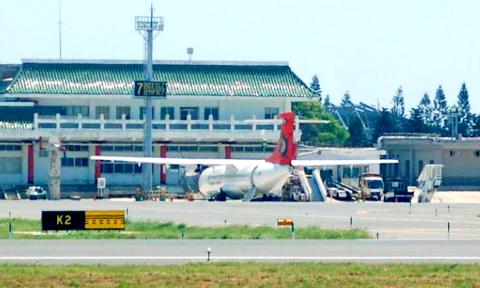
Photo: CNA
The airline canceled Flight GE2113 from Magong to Kaohsiung and Flight GE2114 from Kaohsiung to Magong after the incident. The CAA said it was informed of the incident before the aircraft landed on Penghu and immediately sent staff to examine the engine.
A preliminary investigation showed that the engine leaked lubricant because a pipe was broken, the agency said, adding that it would determine through further investigation if the airline had failed to properly maintain the aircraft.
CAA statistics showed that the airline has experienced a total of eight engine shutdowns in the past five years, including three this year. Three of them were related to problems with engine lubricant.
CAA Flight Standards Division director Clark Lin (林俊良) said continued leaking of lubricant could cause an engine to catch fire or damage to the propellers.
Lin said the pilot of Flight GE505 did the right thing in shutting down the No. 2 engine after identifying that lubricant was leaking from it.
Potential problems relating to the ATR aircraft engines have come under scrutiny after TransAsia Airways Flight GE235 crashed in the Keelung River on Feb. 4, killing 43 people onboard.
An Aviation Safety Council investigation showed that Flight GE235’s No. 1 engine — which was functioning normally — was shut down, while a warning indicated the No. 2 engine should have been switched off instead.
However, examination of Flight GE235’s data recorder showed that the No. 2 engine’s oil pressure, temperature and fuel flow was normal and the engine was still running.
Further testing of the No. 2 engine showed that signals were not transmitted to the cockpit in a reliable manner.

‘NO SECURITY RISK’: The Railway Bureau reassured the public that the technicians’ activities were limited to technical guidance and did not involve sensitive systems The Railway Bureau yesterday said it had invited eight Chinese technicians to assist with an airport MRT construction project. The bureau issued the confirmation after an Internet user said Chinese nationals had entered the construction zone of Taiwan Taoyuan International Airport’s Terminal 3 project. They asked why “individuals from an enemy state” were allowed access to such a major national infrastructure project, which raised serious concerns over Taiwan’s industrial safety, sensitive systems and information security. The bureau’s Northern Region Engineering Branch Office said subcontractor Taiwan Handle Industrial Co (台灣手把工業) of the Taoyuan airport MRT’s “Contract No. CU05 Project A14 Station Civil, MEP &

The National Chungshan Institute of Science and Technology yesterday showcased its locally developed variants of the Vision 60 robotic patrol dog, which it plans to deploy on the nation’s outlying territories in the South China Sea. The variants were produced under the Joint Lab project — created by the institute and domestic companies — and assembled with domestically produced motors, lenses and artificial intelligence (AI) systems alongside licensed tech from the US, Missile and Rocket Systems Research Division deputy director Jen Kuo-kang (任國光) told the media event at a military base in Taipei’s Dazhi (大直) area. Taiwan has built up its strengths

NOT IMMEDIATE: Taiwan has a chance to appeal the proposed 10 percent tariff before it starts, while other countries face a 12.5 percent tariff from the trade office Taiwan is among 60 economies determined by the US to have failed to impose or enforce a ban on the importation of goods produced with forced labor, according to a notice released on Tuesday by the Office of the US Trade Representative (USTR), which proposed imposing an additional 10 percent or more tariff on them. The USTR in a statement said that following an investigation, it had determined under Section 301 of the Trade Act of 1974 that the failure of the 60 economies to impose and effectively enforce a prohibition on the importation of goods produced with forced labor is

RIGHT DIRECTION: Taiwan’s efforts to prevent forced labor include a proposal to ‘fully prohibit’ employers from withholding workers’ documents, an official said Taiwan is to establish a mechanism to restrict imports of goods linked to forced labor, the Executive Yuan said yesterday, after the US proposed imposing additional tariffs on Taiwanese goods over labor concerns. “The Ministry of Labor and the Ministry of Economic Affairs are to establish an interministerial review procedure,” Executive Yuan spokesperson Michelle Lee (李慧芝) said at a news briefing in Taipei. “The government is to use the Foreign Trade Act [貿易法] as the legal basis to restrict imports of goods produced with forced labor” and bring its supply chain governance more in line with international standards on human rights, resilience


 RSS
RSS