


The Taipei City Government should dissolve its contract with Farglory Land Development Co (遠雄建設) for the construction of the Taipei Dome, the Taipei Clean Government Committee recommended yesterday.
“We discovered that there was serious illegal profiteering and also that Farglory polluted the selection process by engaging in influence-peddling involving city officials,” committee member and lawyer Cheng Wen-lung (鄭文龍) said. “We believe the city has a sufficient legal foundation to dissolve the contract in accordance with the Government Procurement Act (政府採購法) and Administrative Procedure Act (行政程序法).”
He said that the administration of then-Taipei mayor Ma Ying-jeou (馬英九) had repeatedly agreed to contract revisions out of line with the original “public notice” inviting bids for the build-operate-transfer (BOT) construction contract, in defiance of the Act for Promotion of Private Participation in Infrastructure Projects (促進民間參與公共建設法).
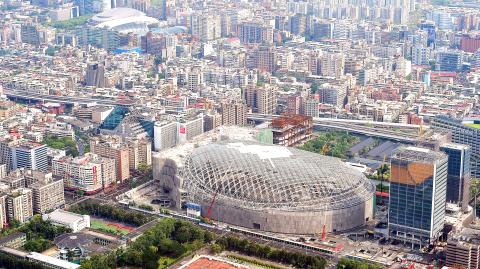
Photo: Fang Pin-chao, Taipei Times
Cheng singled out revenue royalties as the most prominent example of “illegal profiteering” allowed by Ma’s administration.
City negotiators agreed to allow the firm to pay zero royalties for using the site following a secret 2006 meeting between Ma and Farglory chairman Chao Teng-hsiung (趙藤雄).
Cheng said the city’s concession violated royalty payment requirements in both its original public notice and the Act for Promotion of Private Participation in Infrastructure Projects.
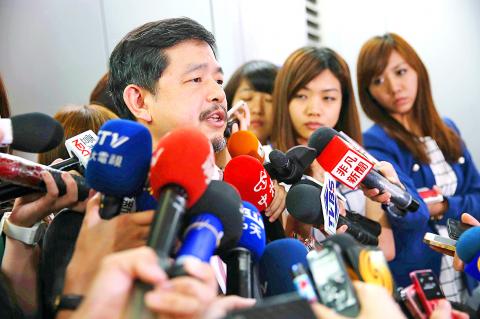
Photo: CNA
Farglory profit estimates submitted to the city in 2006 put the firm’s profits at NT$117 billion (US$3.8 billion at current exchange rates) over its 50-year contract, he said, adding that the city conceded about NT$2.8 billion in royalties assuming it would have received 1 percent of the revenue.
Even without direct evidence that Ma or Lee Sush-der (李述德) — the city’s then-finance commissioner who headed the negotiation team — had personally benefited, allowing Farglory’s illegal profiteering was enough to establish legal culpability, he said.
City promises to conduct rezoning to allow Farglory to construct housing on the Dome site were also cited in the committee’s report as an example of illegal profiteering.
Other examples cited included contract revisions allowing Farglory to rent out or transfer ownership of site properties, along with the removal of requirements that profits from “subsidiary industries” be used to balance any losses by the Dome itself.
In addition, during the controversy in 2005 and 2006 over Farglory switching design contractors, Chao had twice feted city committee members, one of whom received an anonymous NT$2.9 million money transfer shortly afterwards, Cheng said.
The committee recommended that the Taipei City Government report both Ma and Lee to the Ministry of Justice for a formal investigation, also recommending that the city government increase citizen participation in future BOT contracts through referendums and public hearings.
Reacting to the committee’s conclusions, Ma expressed his “strong regret” through Presidential Office spokesperson Charles Chen (陳以信), saying that what he had done during his term as Taipei mayor was all aimed at enhancing the welfare of Taipei residents and that he was never involved in illegally profiting any private enterprise.
Quoting Ma, Chen accused the committee of “political repression” and questioned how the committee had come to such a conclusion after Taipei Mayor Ko Wen-je (柯文哲) had said that the project was “legal.”
Lee also insisted that he had acted according to the law and was not involved in anything illegal.
Additional reporting by Loa Iok-sin
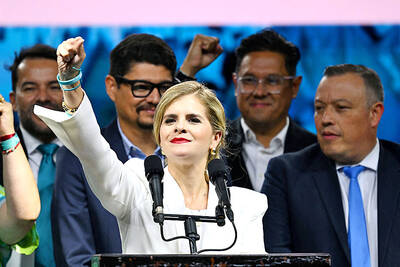
Right-wing political scientist Laura Fernandez on Sunday won Costa Rica’s presidential election by a landslide, after promising to crack down on rising violence linked to the cocaine trade. Fernandez’s nearest rival, economist Alvaro Ramos, conceded defeat as results showed the ruling party far exceeding the threshold of 40 percent needed to avoid a runoff. With 94 percent of polling stations counted, the political heir of outgoing Costa Rican President Rodrigo Chaves had captured 48.3 percent of the vote compared with Ramos’ 33.4 percent, the Supreme Electoral Tribunal said. As soon as the first results were announced, members of Fernandez’s Sovereign People’s Party
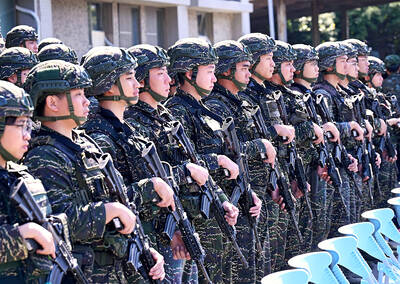
MORE RESPONSIBILITY: Draftees would be expected to fight alongside professional soldiers, likely requiring the transformation of some training brigades into combat units The armed forces are to start incorporating new conscripts into combined arms brigades this year to enhance combat readiness, the Executive Yuan’s latest policy report said. The new policy would affect Taiwanese men entering the military for their compulsory service, which was extended to one year under reforms by then-president Tsai Ing-wen (蔡英文) in 2022. The conscripts would be trained to operate machine guns, uncrewed aerial vehicles, anti-tank guided missile launchers and Stinger air defense systems, the report said, adding that the basic training would be lengthened to eight weeks. After basic training, conscripts would be sorted into infantry battalions that would take

GROWING AMBITIONS: The scale and tempo of the operations show that the Strait has become the core theater for China to expand its security interests, the report said Chinese military aircraft incursions around Taiwan have surged nearly 15-fold over the past five years, according to a report released yesterday by the Democratic Progressive Party’s (DPP) Department of China Affairs. Sorties in the Taiwan Strait were previously irregular, totaling 380 in 2020, but have since evolved into routine operations, the report showed. “This demonstrates that the Taiwan Strait has become both the starting point and testing ground for Beijing’s expansionist ambitions,” it said. Driven by military expansionism, China is systematically pursuing actions aimed at altering the regional “status quo,” the department said, adding that Taiwan represents the most critical link in China’s
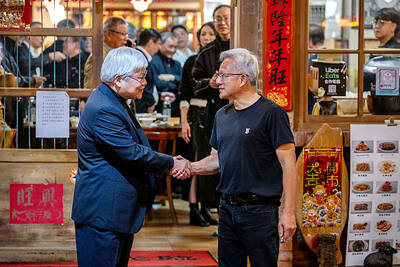
‘REALLY PROUD’: Nvidia would not be possible without Taiwan, Huang said, adding that TSMC would be increasing its capacity by 100 percent Nvidia Corp CEO Jensen Huang (黃仁勳) on Saturday praised and lightly cajoled his major Taiwanese suppliers to produce more to help power strong demand for artificial intelligence (AI), capping a visit to the country of his birth, where he has been mobbed by adoring fans at every step. Speaking at an impromptu press conference in the rain outside a Taipei restaurant, where he had hosted suppliers for a “trillion-dollar dinner,” named after the market capitalization of those firms attending, Huang said this would be another good year for business. “TSMC needs to work very hard this year because I need a lot


 RSS
RSS