


The National Security Bureau (NSB) yesterday acknowledged lapses in the handling of security for President Ma Ying-jeou (馬英九) after he was hit by a book thrown by a political activist a day earlier.
The bureau said security lapses have been found among its staff and military police officers, who were responsible for the safety of the president as he attended a reception for international franchise chains in Taipei’s Neihu District (內湖).
The bureau said it would take punitive action against those responsible for the oversights, according to a statement it issued after an internal meeting on the incident.
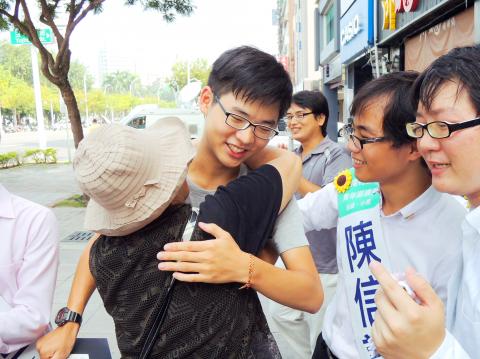
Photo: Wang Jung-hsiang, Taipei Times
Local media outlets reported that up to 10 people were being disciplined.
Although the bureau had gone over Friday’s security arrangements on site and possessed related intelligence, it still failed to prevent the protester from throwing the book, it said.
A group of NSB personnel who failed to protect the president have been replaced, the bureau said, adding that it would improve measures to ensure the president’s safety.
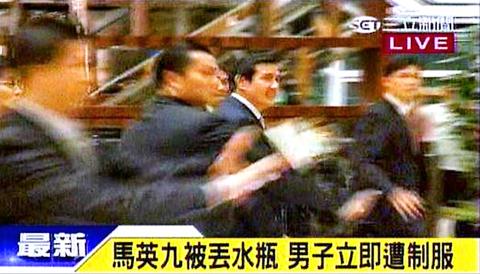
Photo: CNA
The bureau said that it respects the public’s right to peacefully express their opinions, but people must not break the law and resort to illegal acts.
When Ma arrived at a Denwell banquet venue on Friday for an event hosted by the International Franchise Association, several hundred people were at a fundraiser for the pro-independence Northern Taiwan Society downstairs.
The incident occurred as Ma was preparing to leave the building after the reception.
A group of reporters were waiting to ask him for his response to Chinese President Xi Jinping’s (習近平) advocacy of a “one country, two systems” formula when a man in a black shirt threw a book from the media area.
Shouting: “Taiwan and China, one country on each side,” he hurled the book Formosa Betrayed, hitting Ma in the torso.
Several security agents immediately pinned a man later identified as Yen Ming-wei (顏銘緯) to the ground. Yen was heard continuing to yell: “Taiwan and China, one country on each side,” while being tackled.
Police asked him to leave the venue after identifying him.
Yen is a freshman at National Sun Yat-sen University and director of Greater Kaohsiung-based activist group Flanc Radical’s electoral campaign in Greater Kaohsiung.
“This is my way of responding to what Ma said [in] the Deutsche Welle [report],” Yen said, referring to Ma’s misreported praise of German unification as a possible model for China-Taiwan relations in a recent report by the German radio station.
The station has since corrected its erroneous report and clarified what the president said.
Yen threw Formosa Betrayed, written by former US diplomat George Kerr about Taiwan’s transition from Japanese rule as well as the 228 Incident and the White Terror era during Taiwan’s authoritarian period under the Chinese Nationalist Party (KMT).
Yen first gained attention after he mobilized a large number of students from southern Taiwan to join the Sunflower movement in Taipei earlier this year.
At 18, he is also thought to be the youngest election campaign director in Taiwan.
Yen said he was visiting friends at the Northern Taiwan Society fundraiser when he found out that Ma was in the same building.
“I did not come here with a plan. I just bought the book on the spot from an NTS stand,” he said.
Police later dragged Yen away from Ma and cornered the student near the entrance of a restroom. Seeking help, Yen called his friends at the NTS event downstairs, who sent legal experts to his aid.
Lai Chung-chiang (賴中強), lawyer and member of the Democratic Front Against the Cross-Strait Trade in Services Agreement, and Democratic Progressive Party spokesperson Huang Di-ying (黃帝穎), who is also a lawyer, happened to be at the NTS event and immediately offered legal advice to Yen.
“The police were threatening Yen by saying that he had already been arrested, which simply could not be true,” Lai said.
Regarding the legality of hurling a book at the president, Lai said: “If the book actually hurt someone, it would be an offense of causing injury (傷害罪). However, such a case would require the victim to press charges before police action can be taken.”
Lai said the group was about to leave with Yen, but several police refused to let them go.
Jostling between the two parties ensued.
Lai’s secretary, Chen Guan-yu (陳冠宇), said he was trying to help Lai and Yen leave when he was pinned to the ground by a police officer who accused him of “assaulting police.”
“I really did not hit anybody. I was just trying to stand between the police and lawyer Lai,” Chen said, adding that he received minor injuries on his neck.
Taiwan Association of University Professors president Lu Chung-chin (呂忠津) also joined negotiations at the scene.
“In the end, everybody just realized the need to calm down,” Lu said. “They probably also thought the incident was not worth all the fuss. They just asked Yen to leave some identification information and let him go.”
After the incident, Presidential Office spokeswoman Ma Wei-kuo (馬瑋國) said the president respects the rights of the public to express their views rationally, but any form of violence should be condemned.
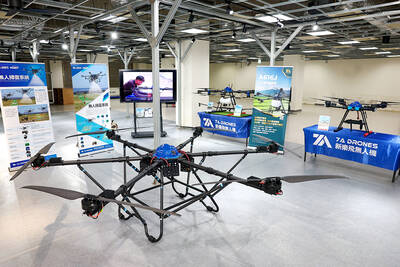
DRONE CENTRAL: Taiwan aims to become Asia’s democratic hub for drones, with most exports focused on high-quality military-grade models, an official said Taiwan’s drone industry is expected to expand significantly by 2030, producing 100,000 units per month and exporting half of them, the Ministry of Economic Affairs said yesterday. Current drone production capacity is about 15,000 units per month, but the industry can quickly scale up as demand increases, Industrial Development Administration Director-General Chiou Chyou-huey (邱求慧) told a news conference in Taipei. Taiwan’s drone output grew 2.5-fold last year to NT$12.9 billion (US$408.3 million) under a government program to develop the uncrewed vehicle sector, he said. The Executive Yuan in October last year approved plans to invest NT$44.2 billion into domestic production of uncrewed aerial
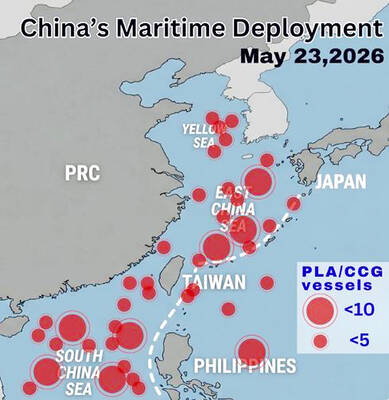
WARNING: China should stop engaging in actions that undermine regional peace and stability, as it would only build resentment among people across the Strait, the CGA said China has deployed more than 100 navy, coast guard and other vessels in waters from the Yellow Sea to the South China Sea and the western Pacific since US President Donald Trump and Chinese President Xi Jinping (習近平) met in Beijing, National Security Council Secretary-General Joseph Wu (吳釗燮) said yesterday. “In this part of the world, #China is the one & only PROBLEM wrecking the #StatusQuo & threatening regional peace & stability,” Wu wrote on X. In a separate post, he said Beijing was coercing Taiwan’s maritime domain, calling it illegal and provocative, after the Coast Guard Administration (CGA) expelled a

VERBOSE VESSELS: A CGA cutter and a China Coast Guard exchanged verbal barbs for more than a day in Taiwanese-controlled waters before the Chinese vessel left The Taiwanese and Chinese coast guards had a standoff near the strategically located Pratas Islands (Dongsha Islands, 東沙群島) in the north of the South China Sea, the Coast Guard Administration (CGA) said yesterday. The two sides engaged in intense radio exchanges over sovereignty claims during the 33-hour standoff. China Coast Guard vessel 3501 eventually left the restricted waters, 26.6 nautical miles (49.2km) west of the Pratas Islands, at 5pm yesterday, the CGA said. Lying approximately between southern Taiwan and Hong Kong, the Taiwan-controlled Pratas are seen by some security experts as vulnerable to Chinese attack due to their distance — more than
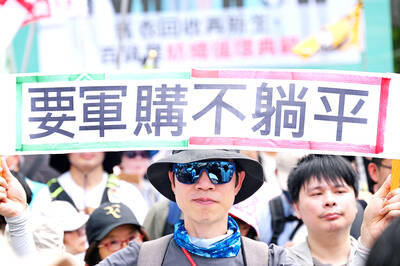
More than 8,000 people took part in a rally in Taipei yesterday to express support for more defense spending, after the opposition slashed the Cabinet’s proposed NT$1.25 trillion (US$39.6 billion) special defense budget and capped it at NT$780 billion. The demonstrators urged the Cabinet to propose another bill. Taiwan Economic Democracy Union convener Lai Chung-chiang (賴中強) said the main problem of the passed budget plan is the removal of funding for critical items, not just that the total amount is smaller. Critical budget items included purchasing or developing uncrewed vehicles, Strong Bow (強弓) missile systems, additional ammunition, artificial intelligence-powered combat systems and Taiwan-US


 RSS
RSS