


Under a heavy police presence and with more than 100 demonstrators calling on him to resign, Premier Jiang Yi-huah (江宜樺) yesterday afternoon appeared in court to face charges of attempted murder filed against him and high-ranking police officers in a private prosecution over the violent crackdown on protesters who briefly took over the Executive Yuan in March.
“Mastermind behind the violence. Abuser of democracy. Face the trial. Jiang Yi-huah, step down,” more than 100 demonstrators affiliated with several civic groups, including Taiwan March and the Black Island Youth Front, shouted as Jiang, as well as National Police Agency Director-General Wang Cho-chiun (王卓鈞), Taipei City Police Department Commissioner Huang Sheng-yung (黃昇勇) and Zhongzheng First Police Precinct Chief Fang Yang-ning (方仰寧), arrived at the Taipei District Court as defendants.
More than 300 officers were deployed to maintain security, and the street in front of the courthouse was closed off since the morning, even though the court appearances did not start until 2:30pm.
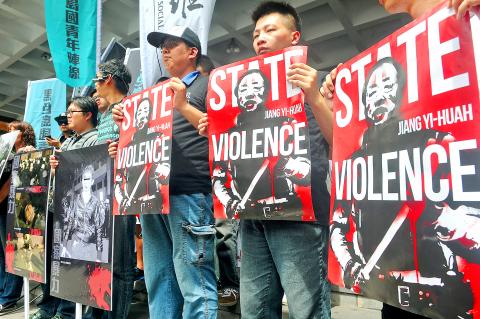
Photo: Liao Chen-huei, Taipei Times
A total of 23 demonstrators who took part in the occupation of the Executive Yuan compound from the evening of March 23 to the early hours of the morning on March 24 and were injured during a crackdown by the police filed charges against the officials.
The occupation of the executive compound took place while the legislative floor was also occupied.
Under orders from the premier to clear the executive compound and the streets around it before the morning rush hour, police used water cannons and truncheons against demonstrators, who were mostly engaged in peaceful sit-ins, resulting in bloodshed.
“I understand that the judge must be under tremendous pressure as he or she decided to summon government officials to appear in court,” said Chen Wei-ting (陳為廷), one of the Sunflower movement’s student leaders. “I would like to call on Jiang to be a man and shoulder his responsibilities. He should tell nothing but the truth in court, and shoulder any political and legal responsibilities that he may have.”
“I would also like to call on the judge to review the case from a constitutional point of view. This court meeting is only the first step; our ultimate goal is to have Jiang step down,” he added.
Unlike a public prosecution, in which prosecutors lay charges, in a private prosecution, the court hears cases directly filed by the accusers.
The hearing held yesterday was part of preliminary proceedings in which the judges are questioning the officials about their decisionmaking process and handling of the Sunflower movement protests. In line with the Code of Criminal Procedure (刑事訴訟法), preliminary hearings are held behind closed doors. Only if judges decide that the evidence is sufficient to warrant a trial would subsequent legal proceeding continue and the court be open.
Jiang was questioned for about two hours.
Facing questions from the media, Jiang refused to comment, both when he arrived and when he left the court.
Wang said in response to media queries that he would “respect the judiciary.”
Meanwhile, Fang again drew fire because he was serving as the commander of the police maintaining security at the scene even though he was appearing in court as a defendant.
“How can a defendant in a manslaughter lawsuit serve as commander of 300 police officers outside the courthouse while he is in court at the same time?” asked attorney Cheng Wen-lung (鄭文龍), who was among the protesters. “This is an abuse of power.”
However, Fang said that he had transferred authority to his deputy chief when he was in the court.
Additional reporting by staff writer
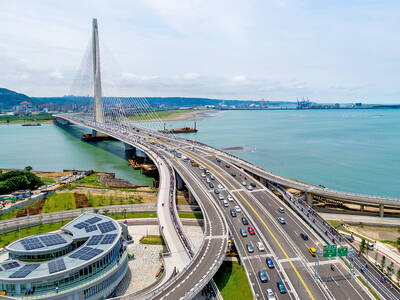
The Ministry of Transportation and Communications yesterday inaugurated the Danjiang Bridge across the Tamsui River in New Taipei City, saying that the structure would be an architectural icon and traffic artery for Taiwan. Feted as a major engineering achievement, the Danjiang Bridge is 920m long, 211m tall at the top of its pylon, and is the longest single-pylon asymmetric cable-stayed bridge in the world, the government’s Web site for the structure said. It was designed by late Iraqi-British architect Zaha Hadid. The structure, with a maximum deck of 70m, accommodates road and light rail traffic, and affords a 200m navigation channel for boats,
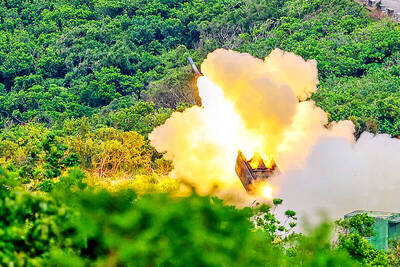
PRECISION STRIKES: The most significant reason to deploy HIMARS to outlying islands is to establish a ‘dead zone’ that the PLA would not dare enter, a source said A High Mobility Artillery Rocket System (HIMARS) would be deployed to Penghu County and Dongyin Island (東引) in Lienchiang County (Matsu) to force the Chinese military to retreat at least 100km from the coastline, a military source said yesterday. Taiwan has been procuring HIMARS and Army Tactical Missile Systems (ATACMS) from the US in batches. Once all batches have been delivered, Taiwan would possess 111 HIMARS units and 504 ATACMS, which have a range of 300km. Considering that “offense is the best defense,” the military plans to forward-deploy the systems to outlying islands such as Penghu and Dongyin so that

Taiwan Semiconductor Manufacturing Co (TSMC, 台積電), the world’s largest foundry service provider, yesterday said that global semiconductor revenue is projected to hit US$1.5 trillion in 2030, after the figure exceeds US$1 trillion this year, as artificial intelligence (AI) demand boosts consumption of token and compute power. “We are still at the beginning of the AI revolution, but we already see a significant impact across the whole semiconductor ecosystem,” TSMC deputy cochief operating officer Kevin Zhang (張曉強) said at the company’s annual technology symposium in Hsinchu City. “It is fair to say that in the past decade, smartphones and other mobile devices were
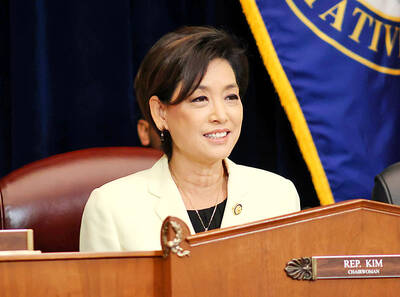
‘CLEAR MESSAGE’: The bill would set up an interagency ‘tiger team’ to review sanctions tools and other economic options to help deter any Chinese aggression toward Taiwan US Representative Young Kim has introduced a bill to deter Chinese aggression against Taiwan, calling for an interagency “tiger team” to preplan coordinated sanctions and economic measures in response to possible Chinese military or political action against Taiwan. “[Chinese President] Xi Jinping [習近平] has directed the People’s Liberation Army to be ready to invade Taiwan by 2027. China has a plan. America should have one too,” Kim said in a news release on Thursday last week. She introduced the “Deter PRC [People’s Republic of China] aggression against Taiwan act” to “ensure the US has a coordinated sanctions strategy ready should


 RSS
RSS