


Greater Tainan Mayor William Lai (賴清德) yesterday caused jitters among an audience of Chinese politicians and academics with talk about Taiwanese independence and the politically sensitive Tiananmen Square student movement on the second day of his trip to China.
Lai, a member of the Democratic Progressive Party (DPP), made his remarks at a Fudan University discussion session in Shanghai.
Regarding cross-strait exchanges, Lai said that since the Taiwanese consciousness of independence preceded the establishment of the DPP, getting rid of the “Taiwan independence clause” in its party charter would not make the society’s call for independence disappear.
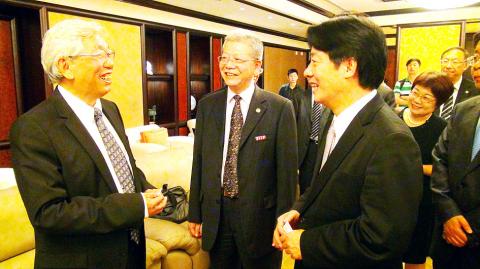
Photo: CNA
According to Greater Tainan Department of Information and International Relations Director and delegation member Chao Ching-hui (趙卿惠), Lai spoke in response to a Chinese professor’s comment on what the professor described as the stalled cross-strait relationship.
Fudan University professor Jiang Yihua (姜義華) reportedly blamed the DPP’s independence platform for the alleged stall, saying that despite cross-strait exchanges over the past years, this particular problem has been little recognized and should now be faced squarely.
Lai said that the DPP’s Taiwan independence clause and its Resolution on Taiwan’s Future are part of the trajectory of the development of Taiwan’s history.
“Taiwanese independence is a cause held by the DPP, which completely respects Taiwanese people’s self-determination in terms of procedure. It has enjoyed a clear consensus in Taiwan, as [former president] Chen Shui-bian (陳水扁) was elected as president on the party’s platform,” Lai said.
“It is important to understand whether the DPP made the cause of independence arise in society, or whether it was society’s call for independence that brought the DPP into existence. Removing the DPP’s Taiwanese independence party platform would not do away with Taiwan’s call for independence,” he said.
Lai said that no problem could be solved before China understands this historical trajectory and he called on the two sides to seek common ground, but also treasure their differences through understanding and reconciliation.
The mayor also mentioned the 1989 Tiananmen Square student movement.
“Fudan University students answered to the cause of the student movement that took place after the death of [reformist Chinese Communist Party] secretary-general Hu Yaobang (胡耀邦) in 1989. And there were more than 400 professors who signed the petition urging the government to recognize the student movement as a patriotic movement,” he said.
The issue of whether Beijing would change its no-contact policy toward the DPP has again come to the forefront amid Lai’s first visit to China on Friday.
Separately yesterday, Beijing reiterated its opposition to Taiwanese independence, but said that it welcomes exchanges with people from all quarters of Taiwan — provided they support advancing cross-strait ties.
The Chinese government maintains a “clear and consistent” policy toward the DPP and stands firmly against Taiwanese independence, China’s Taiwan Affairs Office spokesperson Fan Liqing (范麗青) said when asked about whether Beijing has begun to engage with the DPP.
“We welcome anyone as long as he or she favors, supports and participates in the peaceful development of cross-strait relations, no matter what he or she has advocated in the past,” she said.
Additional reporting by CNA

‘NO SECURITY RISK’: The Railway Bureau reassured the public that the technicians’ activities were limited to technical guidance and did not involve sensitive systems The Railway Bureau yesterday said it had invited eight Chinese technicians to assist with an airport MRT construction project. The bureau issued the confirmation after an Internet user said Chinese nationals had entered the construction zone of Taiwan Taoyuan International Airport’s Terminal 3 project. They asked why “individuals from an enemy state” were allowed access to such a major national infrastructure project, which raised serious concerns over Taiwan’s industrial safety, sensitive systems and information security. The bureau’s Northern Region Engineering Branch Office said subcontractor Taiwan Handle Industrial Co (台灣手把工業) of the Taoyuan airport MRT’s “Contract No. CU05 Project A14 Station Civil, MEP &

A US uncrewed surface vessel (USV) encountered multiple Chinese warships during an autonomous transit of the Taiwan Strait, US defense company Seasats said in a statement on Wednesday. Seasats announced that a Lightfish USV had completed the first autonomous transit of the Taiwan Strait. Over five days, the USV traversed the entire length of the Strait while constantly monitoring surface vessel traffic, the company said. The Lightfish encountered multiple Chinese warships, one of which was a Chinese People’s Liberation Army Navy (PLAN) Type 056 corvette, it said. The Chinese vessels were operating “well within Taiwan’s exclusive economic zone without transmitting their identity via the
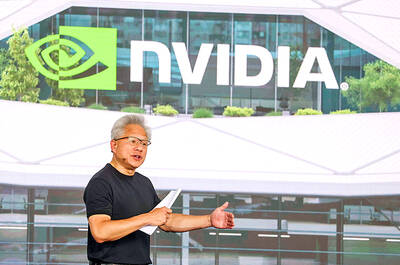
‘BOOMING’: ’ The number of partners we have here is incredible. You can see from their stock prices. They’re doing so well, they’re so happy,’ Jensen Huang said Nvidia Corp’s spending in Taiwan has ballooned to about US$150 billion a year, 10 times the US$10 billion to US$15 billion the company spent five years ago, Nvidia chief executive officer Jensen Huang (黃仁勳) said yesterday, suggesting Taiwan’s strategic importance in the global artificial intelligence (AI) supply chain. “Taiwan is the epicenter of the AI revolution. This is where the chips come, packaging comes. This is where the systems are made. This is where AI supercomputers were created,” Huang said at a meeting for the company’s employees in Beitou-Shilin Technology Park (北投士林科技園區) in Taipei, the planned site of Nvidia’s Taipei headquarters. “Taiwan
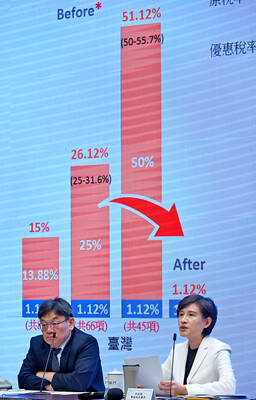
GREATER REACH? Auto parts and wood products would face tariffs of up to 15%, matching those targeting the EU, Japan and South Korea, Vice Premier said The US has announced that preferential tariff treatment for Taiwan’s non-semiconductor Section 232 goods would take effect retroactively from May 1, the Executive Yuan said yesterday. The US government yesterday posted a notice on the Federal Register’s public inspection Web site previewing tariff concessions for Taiwan under a memorandum of understanding (MOU) on Taiwan-US investment after two months of negotiations. The MOU signed on Jan. 15 stipulated three major preferential tariff arrangements: a 15 percent “reciprocal” tariff rate for Taiwan without stacking most-favored nation (MFN) rates; preferential Section 232 treatment for semiconductors and related products; and preferential Section 232 treatment for non-semiconductor


 RSS
RSS