


China deployed its vast security apparatus yesterday to snuff out commemoration of the suppression of pro-democracy protests around Tiananmen Square 25 years ago, flooding the streets with police as censors scrubbed the Internet clean of any mention of the crackdown.
Several governments, including the US, urged China to account for what happened on June 4, 1989, comments that riled Beijing, which has said the protest movement was “counter-revolutionary.”
Exiled Tibetan spiritual leader the Dalai Lama used the anniversary to call on China to embrace democracy.
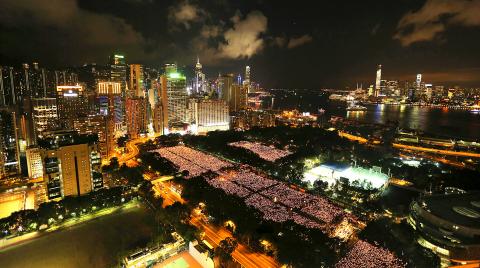
Photo: Reuters
China has never released a death toll for the crackdown, but estimates from human rights groups and witnesses range from several hundred to several thousand.
Taking no chances yesterday, police, soldiers and plainclothes security personnel enveloped Tiananmen Square, checking identity cards and rummaging through bags looking for any hint that people might try and sneak onto the square to commemorate the day.
Police escorted a Reuters reporter off the square, which was thronged with tourists, saying it was closed to foreign media. Police also detained another Reuters journalist for trying to report on the anniversary in one of Beijing’s university districts, releasing him after a few hours.
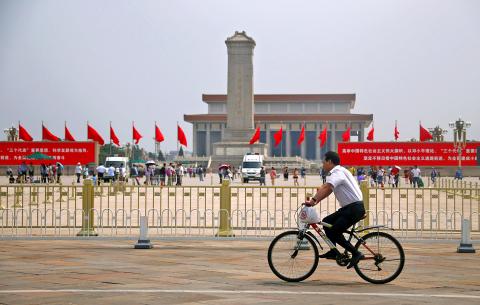
Photo: Reuters
Public discussion of the crackdown is off-limits in China. Many young people are unaware of what happened because of years of government efforts to banish memories of the People’s Liberation Army shooting Chinese citizens.
Meanwhile, tens of thousands gathered in Hong Kong yesterday to remember the Tiananmen dead.
“Vindicate 6/4,” crowds shouted, waving banners, as the somber candle-lit vigil began in Victoria Park.

Photo: AFP
Lights were turned out as elderly and young alike raised their candles in the dark.
The names of those who died in Beijing on June 4, 1989, were read out over loudspeakers.
People bowed to pay their respects as film footage of the event was shown on large screens.
“This event must be instilled in everyone’s heart, we can’t let time dilute this event,” said Anna Lau, a 19-year-old student.
Among the crowds packing Victoria Park were many from China.
“I came here to take part in this vigil, because in China we don’t have any rights or freedoms ... so to express my views I have to come to Hong Kong,” said Huang Waicheng, a 35-year-old engineer from Shenzhen. “In China, there are too few people that know about [the crackdown].”
A 52-year-old businessman from Guangdong Province brought his son to the vigil.
“Freedom for the whole Chinese nation ought to be the country’s ultimate goal. It’s a good thing that some people still remember [the movement],” said the man, surnamed Li, who declined to give his full name.
Meanwhile, about 80 academics from 12 countries penned an open letter to Chinese President Xi Jinping (習近平) yesterday, pressing for the release of five people taken away in China last month after attending a private seminar discussing the crackdown, including prominent human rights lawyer Pu Zhiqiang (浦志強).
Additional reporting by AFP

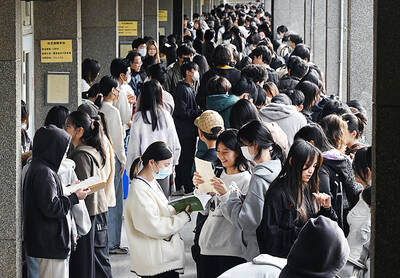
A global survey showed that 60 percent of Taiwanese had attained higher education, second only to Canada, the Ministry of the Interior said. Taiwan easily surpassed the global average of 43 percent and ranked ahead of major economies, including Japan, South Korea and the US, data from the Organisation for Economic Co-operation and Development (OECD) for 2024 showed. Taiwan has a high literacy rate, data released by the ministry showed. As of the end of last year, Taiwan had 20.617 million people aged 15 or older, accounting for 88.5 percent of the total population, with a literacy rate of 99.4 percent, the data

NEW LOW: The council in 2024 based predictions on a pessimistic estimate for the nation’s total fertility rate of 0.84, but last year that rate was 0.69, 17 percent lower An expected National Development Council (NDC) report expects the nation’s population to drop below 12 million by 2065, with the old-age dependency ratio to top 100 percent sooner than 2070, sources said yesterday. The council is slated to release its latest population projections in August, using an ultra-low fertility model, the sources said. The previous report projected that Taiwan’s population would fall to 14.37 million by 2070, but based on a new estimate of the total fertility rate (TFR) — the average number of children born to a woman over her lifetime — the population is expected to reach 12 million by
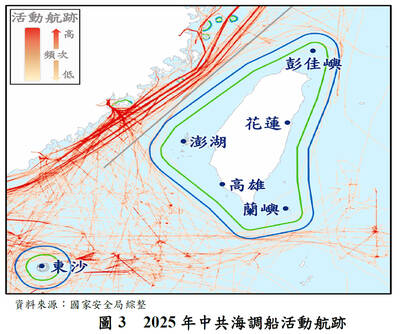
INTENSIFYING THREATS: Beijing’s tactics include massive attacks on the government service network, aircraft and naval vessel incursions and damaging undersea cables China is prepared to interfere in November’s nine-in-one local elections by launching massive attacks on the Taiwanese government’s service network (GSN), a report published by the National Security Bureau showed. The report was submitted to the Legislative Yuan ahead of the bureau’s scheduled briefing at the Foreign Affairs and National Defense Committee tomorrow. The national security team has identified about 13,000 suspicious Internet accounts and 860,000 disputed messages, the bureau said of China’s cognitive warfare against Taiwan. The disputed messages focus on major foreign affairs, national defense and economic issues, which were produced using generative artificial intelligence (AI) and distributed through Chinese

COUNTERING HOSTILITY: The draft bill would require the US to increase diplomatic pressure on China and would impose sanctions on those who sabotage undersea cable networks US lawmakers on Thursday introduced a bipartisan bill to bolster the resilience of Taiwan’s submarine cables to counter China’s hostile activities. The proposal, titled the critical undersea infrastructure resilience initiative act, was cosponsored by Republican representatives Mike Lawler and Greg Stanton, and Democratic Representative Dave Min. US Senators John Curtis and Jacky Rosen also introduced a companion bill in the US Senate, which has passed markup at the chamber’s Committee on Foreign Relations. The House’s version of the bill would prioritize the deployment of sensors to detect disruptions or potential sabotage in real-time and enhance early warning capabilities through global intelligence sharing frameworks,


 RSS
RSS