


More than a dozen groups yesterday protested outside the Straits Exchange Foundation’s (SEF) headquarters in Taipei’s Dazhi (大直) area against a visit by Chen Yunlin (陳雲林), a former chairman of China’s Association for Relations Across the Taiwan Straits (ARATS).
Chen arrived on Monday for a “cultural exchange” visit, leading a group called ARATS Chinese Arts Exchange, but the protesters said Beijing should release dissident artists before talking about exchanges in the arts.
The Chinese group yesterday attended a conference at the foundation’s headquarters about cross-strait cultural communication that featured artists from the two nations.
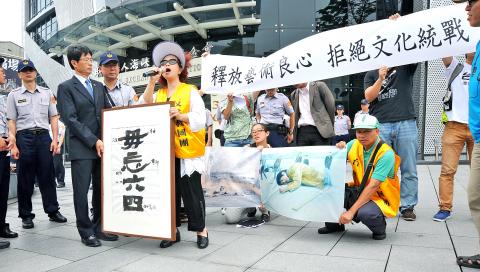
Photo: Liu Hsin-de, Taipei Times
Also at the conference was Mainland Affairs Council Deputy Minister Chang Hsien-yao (張顯耀), who also serves as vice chairman of the foundation, and former premier Liu Chao-shiuan (劉兆玄), who is president of the General Association of Chinese Culture.
The protesters held up banners that read: “Release the conscience of the arts; [we] refuse political efforts aimed at unification in the name of culture,” as well as two paintings by Chinese artist Chen Guang (陳光).
The groups said that while Chen Yunlin and his delegation were taking part in an cultural exchange, many Chinese activists, such as Chen Guang, have been detained ahead of the 25th anniversary of the Tiananmen Square Massacre on June 4.
“Chen Guang is a soldier turned artist. He was one of the ones who had to clear the square in those days and has been creating art using that experience as inspiration,” New School for Democracy secretary-general Wang Hsing-chung (王興中) said.
“Many believe Chen Guang was detained because of a performance art piece that he staged privately in his studio,” Wang said.
“As a democratic country with human rights as one of its key values, Taiwan will not tolerate the Chinese Communist government’s double-faced tactics: Throwing artists into prison without hesitation [in China] on the one hand, while trumpeting its ‘one Chinese nation’ stance [in Taipei] in the name of arts on the other,” the alliance said.
Representatives of Taiwan Friends of Uighurs (TFU) and Students for a Free Tibet Taiwan (SFT) were among the protesters, with TFU chairman Paul Lin (林保華) and SFT chairman Fong Jyun-shan (奉君山) both raising concerns about the Chinese government’s efforts to marginalize and eventually eradicate minority groups’ cultures.
Art cannot bloom where fear abounds, and “fear is a ruler’s most powerful tool,” Fong said.
He criticized the announcement by Taiwan’s government that it would compile a list of people or groups with “the highest potential to commit crimes.”
“This is the blacklist of our age. The authorities could easily detain people who hold different political views, excusing such actions by evoking public fear, just like they are doing with pre-emptive detentions,” Fong said.
Pro-independence group Flanc Radical, which is largely made up of young people, said Chen Yunlin’s claim to be on a “purely cultural exchange visit” was not believable.
They criticized his framing of the exchange as one among members of the “Chinese nation” — a term the group said was “racial-political” — and his ignoring that Taiwan and China are two nations with different histories, cultural progression and political-economic systems.
The groups left a piece of calligraphy by Taiwanese calligrapher Chen Shih-hsien (陳世憲) — which reads “Remembering Tiananmen. Without Freedom, No Art” — as a gift for Chen Yunlin.
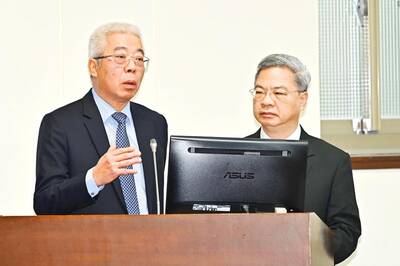
Taiwan has arranged for about 8 million barrels of crude oil, or about one-third of its monthly needs, to be shipped from the Red Sea this month to bypass the Strait of Hormuz and ease domestic supply pressures, CPC Corp, Taiwan (CPC, 台灣中油) said yesterday. The state-run oil company has worked with Middle Eastern suppliers to secure routes other than the Strait of Hormuz, through which about 20 percent of the world’s oil and liquefied natural gas typically passes, CPC chairman Fang Jeng-zen (方振仁) said at a meeting of the legislature’s Economics Committee in Taipei. Suppliers in Saudi Arabia have indicated they
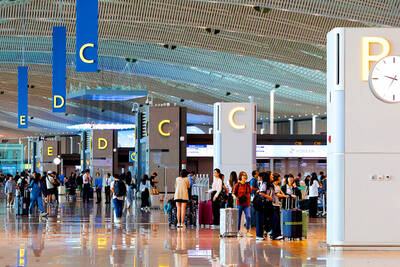
South Korea has adjusted its electronic arrival card system to no longer list Taiwan as a part of China, a move that the Ministry of Foreign Affairs said would help facilitate exchanges between the two sides. South Korea previously listed “Taiwan” as “Taiwan (China)” in the drop-down menus of its online arrival card system, where people had to fill out where they came from and their next destination. The ministry had requested South Korea make a revision and said it would change South Korea’s name on Taiwan’s online immigration system from “Republic of Korea” to “Korea (South),” should the issue not be

CCP ‘PAWN’? Beijing could use the KMT chairwoman’s visit to signal to the world that many people in Taiwan support the ‘one China’ principle, an academic said Chinese Nationalist Party (KMT) Chairwoman Cheng Li-wun (鄭麗文) yesterday arrived in China for a “peace” mission and potential meeting with Chinese President Xi Jinping (習近平), while a Taiwanese minister detailed the number of Chinese warships currently deployed around the nation. Cheng is visiting at a time of increased Chinese military pressure on Taiwan, as the opposition-dominated Legislative Yuan stalls a government plan for US$40 billion in extra defense spending. Speaking to reporters before going to the airport, Cheng said she was going on a “historic journey for peace,” but added that some people felt uneasy about her trip. “If you truly love Taiwan,
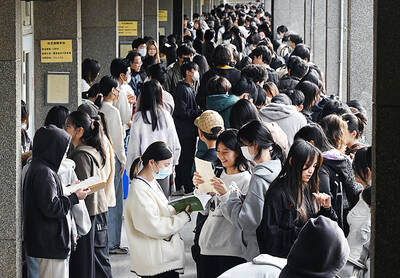
A global survey showed that 60 percent of Taiwanese had attained higher education, second only to Canada, the Ministry of the Interior said. Taiwan easily surpassed the global average of 43 percent and ranked ahead of major economies, including Japan, South Korea and the US, data from the Organisation for Economic Co-operation and Development (OECD) for 2024 showed. Taiwan has a high literacy rate, data released by the ministry showed. As of the end of last year, Taiwan had 20.617 million people aged 15 or older, accounting for 88.5 percent of the total population, with a literacy rate of 99.4 percent, the data


 RSS
RSS