


Wang Mei-yu (王美玉), president of Chinese-language newspaper the China Times, was appointed to a six-year term as a Control Yuan member yesterday, the first acting media professional to be tapped for the job.
The Presidential Office yesterday unveiled its list of 29 members of the fifth-term Control Yuan. It was the second time President Ma Ying-jeou (馬英九) has made the appointments during his presidency.
Wang was the third veteran journalist appointed to the position, following Huang Chao-heng (黃肇珩), who was general manager of Cheng Chung Book Co when nominated in 1993, and incumbent Control Yuan member Wu Feng-shan (吳豐山), who was previously a minister without portfolio.
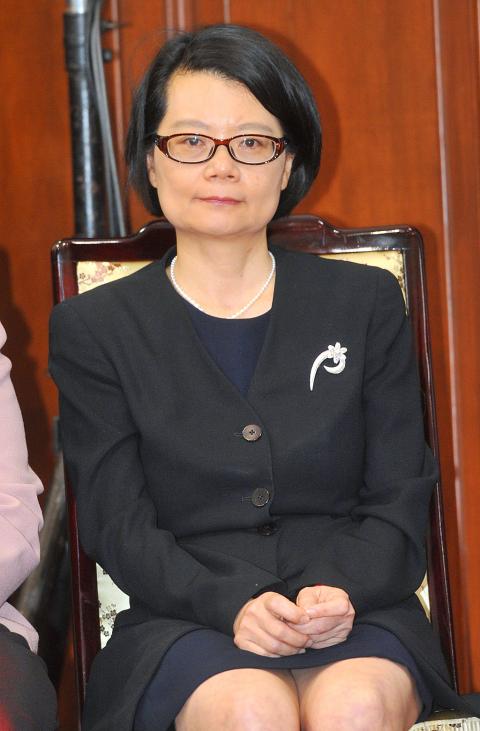
Photo: Liu Hsin-de, Taipei Times
“My 32-year career in journalism came to an end today,” Wang said.
Wang said she accepted the nomination and immediately resigned as president of the China Times, part of the Want Want China Times Group (旺旺中時集團) owned by Tsai Eng-meng (蔡衍明).
Democratic Progressive Party Legislator Huang Wei-cher (黃偉哲) yesterday questioned Wang’s qualifications for the position.
“A member of the Control Yuan must be above partisanship and apolitical, but Wang has long worked with a media outlet that holds strong political views,” he said.
Among the 29 nominees, including Election Commission Chairperson Chang Po-ya (張博雅) being appointed president of the Control Yuan and former Council of Indigenous Peoples minister Sun Ta-chuan (孫大川) being nominated as vice president, only seven were incumbent members.
Liao Pen-chuan (廖本全), an associate professor at National Taipei University’s Department of Real Estate and Built Environment, was disappointed with the appointment of Shih Hung-chih (施鴻志), a retired professor of urban planning, because of Shih’s record handling controversial land expropriations.
Shih had demanded that reporters be excluded from a review of the Taoyuan Aerotropolis, one of the government’s flagship urban renewal projects that covers more than 3,000 hectares of land and affects more than 7,000 households, last year when he chaired a meeting as a member of the Ministry of the Interior’s urban planning commission.
The reason Shih then cited for the ejection order was that public interest was not a factor being considered by the commission.
As a professional expert whom the government has long consulted with on urban renewal and planning issues over the years, Shih has overlooked the importance of public participation in the decisionmaking process, Liao said.
The way he handled the review of the Taoyuan Aerotropolis project showed Shih disregarded the values of democracy, human rights, justice and sustainability, which are all vital to ensure that such projects are in the best interests of the public, Liao said.
With the departure of Control Yuan members Ma Yi-kung (馬以工), Liu Yuh-san (劉玉山) and Huang Huang-hsiung (黃煌雄), who have identified several major flaws in land expropriation cases over the years, and the appointment of Shih, the only candidate among the 29 with a background in urban planning, people facing eviction from their homes as urban renewal efforts mushroom could be left helpless when they turn to the Control Yuan for help, Liao said.
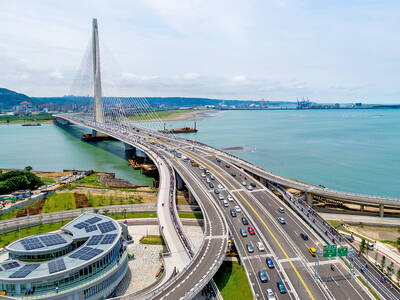
The Ministry of Transportation and Communications yesterday inaugurated the Danjiang Bridge across the Tamsui River in New Taipei City, saying that the structure would be an architectural icon and traffic artery for Taiwan. Feted as a major engineering achievement, the Danjiang Bridge is 920m long, 211m tall at the top of its pylon, and is the longest single-pylon asymmetric cable-stayed bridge in the world, the government’s Web site for the structure said. It was designed by late Iraqi-British architect Zaha Hadid. The structure, with a maximum deck of 70m, accommodates road and light rail traffic, and affords a 200m navigation channel for boats,
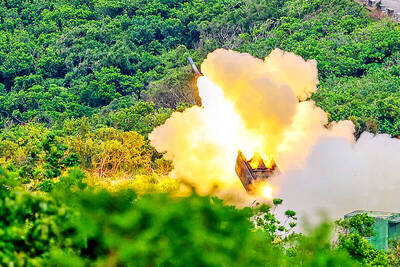
PRECISION STRIKES: The most significant reason to deploy HIMARS to outlying islands is to establish a ‘dead zone’ that the PLA would not dare enter, a source said A High Mobility Artillery Rocket System (HIMARS) would be deployed to Penghu County and Dongyin Island (東引) in Lienchiang County (Matsu) to force the Chinese military to retreat at least 100km from the coastline, a military source said yesterday. Taiwan has been procuring HIMARS and Army Tactical Missile Systems (ATACMS) from the US in batches. Once all batches have been delivered, Taiwan would possess 111 HIMARS units and 504 ATACMS, which have a range of 300km. Considering that “offense is the best defense,” the military plans to forward-deploy the systems to outlying islands such as Penghu and Dongyin so that

Taiwan Semiconductor Manufacturing Co (TSMC, 台積電), the world’s largest foundry service provider, yesterday said that global semiconductor revenue is projected to hit US$1.5 trillion in 2030, after the figure exceeds US$1 trillion this year, as artificial intelligence (AI) demand boosts consumption of token and compute power. “We are still at the beginning of the AI revolution, but we already see a significant impact across the whole semiconductor ecosystem,” TSMC deputy cochief operating officer Kevin Zhang (張曉強) said at the company’s annual technology symposium in Hsinchu City. “It is fair to say that in the past decade, smartphones and other mobile devices were
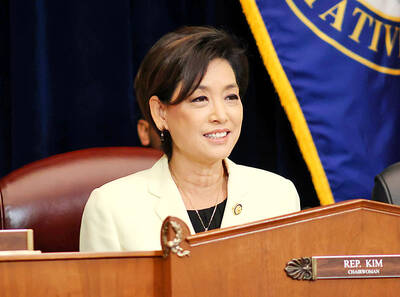
‘CLEAR MESSAGE’: The bill would set up an interagency ‘tiger team’ to review sanctions tools and other economic options to help deter any Chinese aggression toward Taiwan US Representative Young Kim has introduced a bill to deter Chinese aggression against Taiwan, calling for an interagency “tiger team” to preplan coordinated sanctions and economic measures in response to possible Chinese military or political action against Taiwan. “[Chinese President] Xi Jinping [習近平] has directed the People’s Liberation Army to be ready to invade Taiwan by 2027. China has a plan. America should have one too,” Kim said in a news release on Thursday last week. She introduced the “Deter PRC [People’s Republic of China] aggression against Taiwan act” to “ensure the US has a coordinated sanctions strategy ready should


 RSS
RSS