


Taiwan High Speed Rail Corp (THSRC) chairman Ou Chin-der’s (歐晉德) surprise resignation drew criticism yesterday from lawmakers on the legislature’s Transportation Committee, who said the Ministry of Transportation and Communications (MOTC) must not try to keep him and he should also be removed as chief executive of the company.
Ou, who resigned as chairman late on Wednesday night, had been scheduled to brief the committee yesterday morning about how the company handled a series of operational incidents over the past year.
He did not show up, on the grounds that he was no longer the company’s chairman.
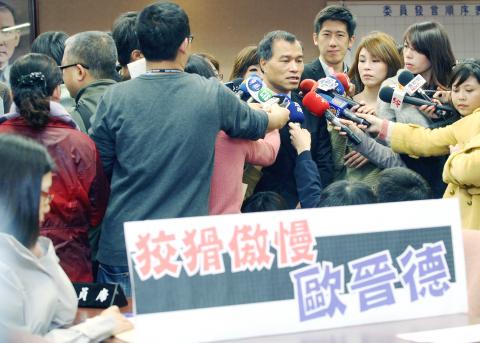
Photo: CNA
THSRC spokesperson Ted Chia (賈先德) was sent by Ou to represent the company instead.
Democratic Progressive Party (DPP) Legislator Tsai Chi-chang (蔡奇昌), the committee’s chairperson, said that Ou should still have come to the meeting and ordered a one-hour recess to give him time to arrive.
Minister of Transportation and Communications Yeh Kuang-shih (葉匡時) said that he was “shocked” to hear of Ou’s resignation.
He said that he knew that Ou had met with President Ma Ying-jeou (馬英九) on Wednesday evening and had called Vice Premier Mao Chi-kuo (毛治國) about resigning, but Yeh said he did not receive confirmation that Ou was stepping down until 10:45pm on Wednesday, when MOTC Deputy Minister Chen Jian-yu (陳建宇) told him he had received a faxed resignation letter from Ou.
“Despite his resignation, Ou is still the chief executive officer,” Yeh said. “He would be disrespecting the Legislative Yuan as well as his supervisors if he does not show up.”
However, Ou did not show up at the committee meeting, triggering a joint condemnation from lawmakers who said he had shown contempt for the legislature and was trying to avoid governmental supervision.
“He had the nerve to raise ticket prices, but did not dare to come and answer questions from us,” DPP Legislator Kuan Bi-ling (管碧玲) said.
“I suggest he come to the meeting as long as he is still the CEO of the company,” Kuan said.
DPP Legislator Yeh Yi-jin (葉宜津) said the fact that Ou spoke to Ma and the vice premier about resigning first showed that he had completely ignored the transportation minister and that his resignation right before yesterday’s meeting was a “slap in the face” to Yeh Kuang-shih.
Ou insisted upon raising ticket prices last year, against Yeh Kuang-shih’s advice.
Commenting on the series of problems the rail system had suffered after the price hike, Yeh Kuang-shih described the company’s performance as “disappointing” and “intolerable.”
Ou’s announcement last week that he would be acting as a general consultant to Chinese Nationalist Party (KMT) Taipei mayoral hopeful Sean Lien’s (連勝文) campaign drew a reminder from Yeh Kuang-shih that he should focus on managing the rail company and needed to ask permission from the THSRC’s board of directors before he assumed other positions.
Yeh Kuang-shih denied media speculation at the time that he intended to force Ou to resign, adding that he was simply reminding Ou of his priorities.
Chia said Ou had denied that his resignation had anything with his role in Lien’s campaign.
“Mr Ou simply said that the incidents occurred with the high speed rail recently had caused inconvenience to passengers and felt he should take full responsibility for it. Even though he is the company’s CEO, he had indicated that he would leave as soon as the board of directors found his replacement,” the THSRC spokesman said, adding that Ou’s decision just happened to be made on Wednesday night.
The ministry and the rail company also disagreed yesterday about Ou’s resignation.
Chia said that Ou is the legal representative of the China Aviation Development Foundation, a major THSRC shareholder, on the company’s board of directors. Ou’s resignation took effect when he indicated his intention to the foundation’s chairman, Chen Jian-yu, the spokesman said.
However, the transportation minister said that his understanding was that Ou’s resignation must be approved by the foundation’s board before it becomes effective.
Meanwhile, a Presidential Office official, who asked to be remain anonymous, told reporters that Ma had urged Ou to stay on when he met with Ou on Wednesday evening.
Ma had suggested that Ou should present himself at the committee meeting to explain issues related to the rail corporation and his role in Lien’s campaign to quash doubts about his performance, the official said.
Before meeting with Ou, Ma had contacted Premier Jiang Yi-huah (江宜樺) and the transportation minister to ask them to persuade Ou not to resign as THSRC chairman, the official said.
During an interview on UFO radio yesterday morning, Lien said had been shocked by Ou’s decision to resign when he learned about it from Ou on Wednesday night.
Ou had telephoned him hours before he made the announcement, Lien said.
Lien said he felt “sad and regretful” that having Ou on his campaign team might have been “the final straw” that led Ou to quit THSRC.
Lien said he expected Ou to be more of a private advisor for his campaign, not someone involved in the campaign’s publicity efforts.
Additional reporting by Shih Hsiu-chuan

‘NO SECURITY RISK’: The Railway Bureau reassured the public that the technicians’ activities were limited to technical guidance and did not involve sensitive systems The Railway Bureau yesterday said it had invited eight Chinese technicians to assist with an airport MRT construction project. The bureau issued the confirmation after an Internet user said Chinese nationals had entered the construction zone of Taiwan Taoyuan International Airport’s Terminal 3 project. They asked why “individuals from an enemy state” were allowed access to such a major national infrastructure project, which raised serious concerns over Taiwan’s industrial safety, sensitive systems and information security. The bureau’s Northern Region Engineering Branch Office said subcontractor Taiwan Handle Industrial Co (台灣手把工業) of the Taoyuan airport MRT’s “Contract No. CU05 Project A14 Station Civil, MEP &

The National Chungshan Institute of Science and Technology yesterday showcased its locally developed variants of the Vision 60 robotic patrol dog, which it plans to deploy on the nation’s outlying territories in the South China Sea. The variants were produced under the Joint Lab project — created by the institute and domestic companies — and assembled with domestically produced motors, lenses and artificial intelligence (AI) systems alongside licensed tech from the US, Missile and Rocket Systems Research Division deputy director Jen Kuo-kang (任國光) told the media event at a military base in Taipei’s Dazhi (大直) area. Taiwan has built up its strengths

NOT IMMEDIATE: Taiwan has a chance to appeal the proposed 10 percent tariff before it starts, while other countries face a 12.5 percent tariff from the trade office Taiwan is among 60 economies determined by the US to have failed to impose or enforce a ban on the importation of goods produced with forced labor, according to a notice released on Tuesday by the Office of the US Trade Representative (USTR), which proposed imposing an additional 10 percent or more tariff on them. The USTR in a statement said that following an investigation, it had determined under Section 301 of the Trade Act of 1974 that the failure of the 60 economies to impose and effectively enforce a prohibition on the importation of goods produced with forced labor is

TIT-FOR-TAT: The US allegedly revoked the visa of a Chinese national working at Xinhua News Agency in the US in response to Beijing’s expulsion of Vivian Wang The Presidential Office yesterday condemned China for expelling a New York Times correspondent from Beijing following the newspaper’s interview with President William Lai (賴清德), saying the move highlighted Beijing’s suppression of press freedom and its threat to international news media. Taiwan has noted a series of recent incidents in which Beijing used similar tactics to “threaten and pressure international media outlets and journalists,” Presidential Office spokeswoman Karen Kuo (郭雅慧) said in a statement. “This concerns not only press freedom and freedom of expression, but also the safety of journalists, and Taiwan and relevant partners are paying close attention to the situation,” she


 RSS
RSS