


The state-run Central News Agency (CNA) and the Public Television Service (PTS) have come under fire for what opposition lawmakers say is their degeneration into Beijing mouthpieces after the agencies issued a joint call with Chinese media for the establishment of reciprocal media offices on either side of the Taiwan Strait.
The call was listed in a six-point proposal jointly issued by the representatives of more than 70 Chinese and Taiwanese media outlets after they attended a forum organized by China Central Television (CCTV) in Beijing on Sunday last week.
Among the Taiwanese representatives attending the forum were CNA chairman Chen Kuo-hsiang (陳國祥), PTS chairman Shao Yu-ming (邵玉銘) and Want Want China Times Group (旺旺中時集團) president Tsai Shao-chung (蔡紹中).
The proposal also called for the inking of a cross-strait cultural cooperation agreement; a concerted effort between Chinese and Taiwanese media to promote the “Zhonghua culture” (中華文化); and the normalization and formalization of cross-strait media exchanges.
Democratic Progressive Party (DPP) Legislator Chiu Chih-wei (邱志偉) said CNA appears to have reduced itself to China’s mouthpiece.
“Is CNA Taiwan’s state news agency or China’s? The demands listed in the proposal do not conform with the Mainland Affairs Council’s policies, yet the news outlet still danced along with China anyway. I think the agency is confused about its role,” Chiu said.
Chiu, who is the convener of the legislature’s Education and Culture Committee, said that since CNA’s overseeing authority, the Ministry of Culture, had ostensibly failed in its duty to supervise the outlet, he would demand that it deliver a report to the committee soon.
The CNA and the PTS receive about NT$300 million and NT$900 million (US$9.9 million and US$29.9 million) in government funding each year respectively. There are also plans to allocate an extra NT$130 million to the latter next year.
DPP Legislator Chen Chi-mai (陳其邁) said the proposal’s failure to make any mention of press freedom proved that cross-strait media exchanges would only subject local media to the negative impacts of China, rather than helping it exert a positive influence on the latter.
DPP Legislator Lee Chun-yi (李俊俋) said it was absurd for Taiwanese media to try to pressure the government into allowing the establishment of cross-strait media offices when what they are supposed to be doing is urging China to refrain from suppressing press freedom.
DPP Legislator Kuan Bi-ling (管碧玲) said that as agencies that enjoy government resources, CNA and the PTS’ cross-strait stance should be in sync with government policies.
“I am fine with these representatives attending forums and seminars [in China], but issuing a proposal telling their government what to do is [out of line],” Kuan said, adding that Minister of Culture Lung Ying-tai (龍應台) needed to state her view on the matter.
Chen Kuo-hsiang said he did not acknowledge the “joint statement” issued by the forum, since it was unilateral and had therefore not being properly discussed.
Shao said he attended the forum in his capacity as a media professional in a bid to better understand the development of the sector on the other side of the Strait.
The Mainland Affairs Council said CNA falls under the Ministry of Culture, but remains an autonomous news outlet and “since the agency’s managers informed the ministry of their plan to attend the Beijing forum in advance, the council will respect [their behavior] as long as no laws are broken.”

South Korea has adjusted its electronic arrival card system to no longer list Taiwan as a part of China, a move that the Ministry of Foreign Affairs said would help facilitate exchanges between the two sides. South Korea previously listed “Taiwan” as “Taiwan (China)” in the drop-down menus of its online arrival card system, where people had to fill out where they came from and their next destination. The ministry had requested South Korea make a revision and said it would change South Korea’s name on Taiwan’s online immigration system from “Republic of Korea” to “Korea (South),” should the issue not be

Tainan, Taipei and New Taipei City recorded the highest fines nationwide for illegal accommodations in the first quarter of this year, with fines issued in the three cities each exceeding NT$7 million (US$220,639), Tourism Administration data showed. Among them, Taipei had the highest number of illegal short-term rental units, with 410. There were 3,280 legally registered hotels nationwide in the first quarter, down by 14 properties, or 0.43 percent, from a year earlier, likely indicating operators exiting the market, the agency said. However, the number of unregistered properties rose to 1,174, including 314 illegal hotels and 860 illegal short-term rental
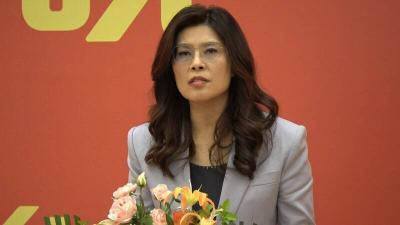
Both sides of the Taiwan Strait share a political foundation based on the “1992 consensus” and opposition to Taiwanese independence, Chinese Nationalist Party (KMT) Chairwoman Cheng Li-wun (鄭麗文) today said during her meeting with Chinese President Xi Jinping (習近平). Both sides of the Strait should plan and build institutionalized and sustainable mechanisms for dialogue and cooperation based on that foundation to make peaceful development across the Strait irreversible, she said. Peace is a shared moral value across the Strait, and both sides should move beyond political confrontation to seek institutionalized solutions to prevent war, she said. Mutually beneficial cross-strait relations are what the
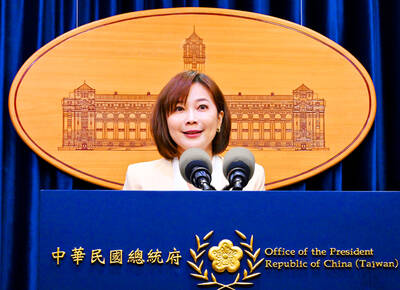
ECONOMIC COERCION: Such actions are often inconsistently applied, sometimes resumed, and sometimes just halted, the Presidential Office spokeswoman said The government backs healthy and orderly cross-strait exchanges, but such arrangements should not be made with political conditions attached and never be used as leverage for political maneuvering or partisan agendas, Presidential Office spokeswoman Karen Kuo (郭雅慧) said yesterday. Kuo made the remarks after China earlier in the day announced 10 new “incentive measures” for Taiwan, following a landmark meeting between Chinese President Xi Jinping (習近平) and Chinese Nationalist Party (KMT) Chairwoman Cheng Li-wun (鄭麗文) in Beijing on Friday. The measures, unveiled by China’s Xinhua news agency, include plans to resume individual travel by residents of Shanghai and China’s Fujian


 RSS
RSS