


Unable to overcome a horrendous second quarter in which they were held scoreless for six-and-a-half minutes in a 17-0 run by Iran, Taiwan squandered a nine-point first-quarter lead to lose 79-60 in the semi-finals of the FIBA Asia Championship in Manila last night.
The defeat sent Taiwan into this afternoon’s bronze medal game against the Philippines, losers in their 86-79 semi-final match against South Korea yesterday, ending Taiwan’s hope for the title.
The loss followed a stunning 96-78 victory over defending champions China the night before in a cross-strait duel that stirred the entire nation into a frenzy.

Photo: AFP
“The 17-0 run was the decisive factor in today’s loss, it really exposed some of our weaknesses in ball-handling and our inability to deal with pressure in a high-tension situations,” famed commentator Yen Hsing-shu (顏行書) said after the game.
His words fittingly summed up the game for Taiwan, who lost starting point guard Lee Hsueh-lin to an injury earlier in the week and were forced to play with only two guards on the lineup.
Lee’s absence clearly played the Islanders right into the hands of an in-your-face pressuring defense from Iran that forced seven deadly turnovers in the second quarter alone.

Photo: CNA
Even though Taiwan are guaranteed a fourth-place finish in this year’s tournament — their best result since 1999 — and are one win away from the bronze medal which would qualify them for next year’s FIBA World Cup in Spain, there was no denying the agony on the players faces after the bitter loss.
Carrying the momentum from the win over China into yesterday’s game, Taiwan opened the contest with a bang as they shot 10-for-15 (67 percent) from the field in a stellar first quarter to enjoy a surprising 23-14 lead against the three-time champions.
However, with Iran heightening their intensity on defense and Taiwan’s perimeter unable to connect from mid-range for a good part of the second quarter, the Islanders quickly found themselves trailing Iran by a dozen in the second quarter.
An 8-2 run late in the quarter helped keep the deficit at six at the half.
That was as close as Taiwan got to victrory as Iran sustained their pressure on defense to hold their opponents to a tournament-low four points in the third quarter while widening the lead to more than 20, determining the outcome of the game long before the final buzzer.
Four different players scored in double-digits for Iran, led by Mahdi Kamrany with a game-high 19, while Quincy Davis was the lone Taiwan player to come away with double-digit points, netting 16 on the night.

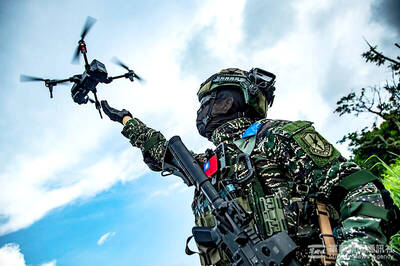
RESILIENCE: Taiwan plays a key role in semiconductors, energy, information infrastructure and advanced manufacturing, AIT Director Raymond Greene said Taiwan’s continued investment in deterrence and resilience remains vital, especially in uncrewed systems and other emerging technologies, American Institute in Taiwan (AIT) Director Raymond Greene said yesterday. Greene made the remarks at the annual National Strategic Summit on Supply Chain Resilience held by the Research Institute for Democracy, Society and Emerging Technology (DSET), a government-backed think tank. As Taiwan last year became the US’ fourth-largest trading partner and supply chain security is becoming more important, cooperation in emerging technologies continues to deepen between the two countries, he said. The US is committed to accelerating innovation, building key infrastructure, strengthening cooperation

The National Chungshan Institute of Science and Technology yesterday showcased its locally developed variants of the Vision 60 robotic patrol dog, which it plans to deploy on the nation’s outlying territories in the South China Sea. The variants were produced under the Joint Lab project — created by the institute and domestic companies — and assembled with domestically produced motors, lenses and artificial intelligence (AI) systems alongside licensed tech from the US, Missile and Rocket Systems Research Division deputy director Jen Kuo-kang (任國光) told the media event at a military base in Taipei’s Dazhi (大直) area. Taiwan has built up its strengths

RIGHT DIRECTION: Taiwan’s efforts to prevent forced labor include a proposal to ‘fully prohibit’ employers from withholding workers’ documents, an official said Taiwan is to establish a mechanism to restrict imports of goods linked to forced labor, the Executive Yuan said yesterday, after the US proposed imposing additional tariffs on Taiwanese goods over labor concerns. “The Ministry of Labor and the Ministry of Economic Affairs are to establish an interministerial review procedure,” Executive Yuan spokesperson Michelle Lee (李慧芝) said at a news briefing in Taipei. “The government is to use the Foreign Trade Act [貿易法] as the legal basis to restrict imports of goods produced with forced labor” and bring its supply chain governance more in line with international standards on human rights, resilience
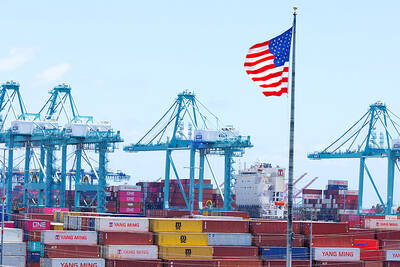
NOT IMMEDIATE: Taiwan has a chance to appeal the proposed 10 percent tariff before it starts, while other countries face a 12.5 percent tariff from the trade office Taiwan is among 60 economies determined by the US to have failed to impose or enforce a ban on the importation of goods produced with forced labor, according to a notice released on Tuesday by the Office of the US Trade Representative (USTR), which proposed imposing an additional 10 percent or more tariff on them. The USTR in a statement said that following an investigation, it had determined under Section 301 of the Trade Act of 1974 that the failure of the 60 economies to impose and effectively enforce a prohibition on the importation of goods produced with forced labor is


 RSS
RSS