


A wrecked Philippine navy transport ship perched on a remote coral reef could be the next flashpoint in the South China Sea, where Taiwan, China and four other claimants bitterly dispute territory, officials say.
The Philippines is accusing China of encroachment after three Chinese ships, including a naval frigate, converged just 5 nautical miles (9 km) from an old transport ship that Manila ran aground on a reef in 1999 to mark its territory.
Philippine officials say they fear the Chinese ships will block supplies to about a dozen Filipino marines stationed in abject conditions on the rusting ship, raising tensions over one of Asia’s biggest security issues.
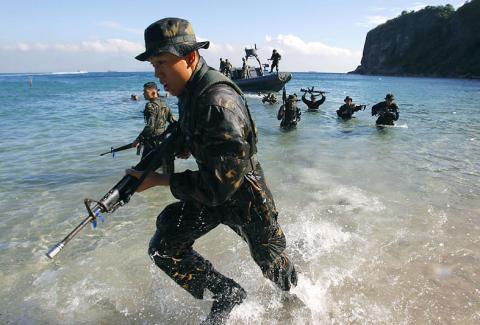
Photo: Reuters
The area, known as Second Thomas Shoal (Renai Shoal, 仁愛暗沙), is a strategic gateway to Reed Bank (Lile Bank, 禮樂灘), believed to be rich in oil and natural gas. In 2010, Manila awarded a consortium a licence to explore for gas on the Reed Bank, but drilling stalled last year due to the presence of Chinese ships.
The shoal is one of several possible flashpoints in the South China Sea that could force the US to intervene in defense of its Southeast Asian allies.
Manila says the Reed Bank, about 148km west of Palawan Island at the southwestern end of the Philippine archipelago, is within the country’s 200 nautical mile (370.4km) exclusive economic zone.
Beijing says it is part of the Spratly Islands (Nansha Islands, 南沙群島), a group of 250 uninhabitable islets, claimed entirely by Taiwan, China and Vietnam, and in part by Malaysia, Brunei and the Philippines.
“China should pull out of the area because under international law, they do not have the right to be there,” Philippine Department of Foreign Affairs spokesman Raul Hernandez said. He added that the Chinese ships were a “provocation and illegal presence.”
Chinese Foreign Ministry spokesman Hong Lei (洪磊) said on Tuesday that the Second Thomas Shoal was part of the Spratly Islands, over which China had “indisputable sovereignty.”
“It is beyond reproach for Chinese boats to carry out patrols in these waters,” Hong said, adding that China called on all parties to “refrain from taking actions that complicate the situation.”
A report issued on Tuesday by Chinese military think tank the Center for National Defense Policy said it was the US’ “pivot” back to Asia which had “shattered” the relative calm of the South China Sea, warning of a crisis ahead.

South Korea has adjusted its electronic arrival card system to no longer list Taiwan as a part of China, a move that the Ministry of Foreign Affairs said would help facilitate exchanges between the two sides. South Korea previously listed “Taiwan” as “Taiwan (China)” in the drop-down menus of its online arrival card system, where people had to fill out where they came from and their next destination. The ministry had requested South Korea make a revision and said it would change South Korea’s name on Taiwan’s online immigration system from “Republic of Korea” to “Korea (South),” should the issue not be

Tainan, Taipei and New Taipei City recorded the highest fines nationwide for illegal accommodations in the first quarter of this year, with fines issued in the three cities each exceeding NT$7 million (US$220,639), Tourism Administration data showed. Among them, Taipei had the highest number of illegal short-term rental units, with 410. There were 3,280 legally registered hotels nationwide in the first quarter, down by 14 properties, or 0.43 percent, from a year earlier, likely indicating operators exiting the market, the agency said. However, the number of unregistered properties rose to 1,174, including 314 illegal hotels and 860 illegal short-term rental
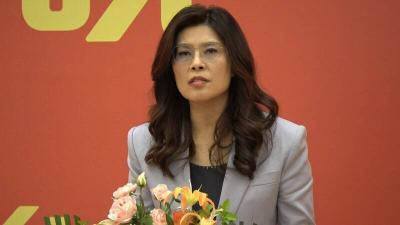
Both sides of the Taiwan Strait share a political foundation based on the “1992 consensus” and opposition to Taiwanese independence, Chinese Nationalist Party (KMT) Chairwoman Cheng Li-wun (鄭麗文) today said during her meeting with Chinese President Xi Jinping (習近平). Both sides of the Strait should plan and build institutionalized and sustainable mechanisms for dialogue and cooperation based on that foundation to make peaceful development across the Strait irreversible, she said. Peace is a shared moral value across the Strait, and both sides should move beyond political confrontation to seek institutionalized solutions to prevent war, she said. Mutually beneficial cross-strait relations are what the
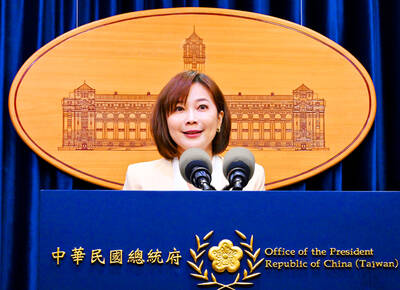
ECONOMIC COERCION: Such actions are often inconsistently applied, sometimes resumed, and sometimes just halted, the Presidential Office spokeswoman said The government backs healthy and orderly cross-strait exchanges, but such arrangements should not be made with political conditions attached and never be used as leverage for political maneuvering or partisan agendas, Presidential Office spokeswoman Karen Kuo (郭雅慧) said yesterday. Kuo made the remarks after China earlier in the day announced 10 new “incentive measures” for Taiwan, following a landmark meeting between Chinese President Xi Jinping (習近平) and Chinese Nationalist Party (KMT) Chairwoman Cheng Li-wun (鄭麗文) in Beijing on Friday. The measures, unveiled by China’s Xinhua news agency, include plans to resume individual travel by residents of Shanghai and China’s Fujian


 RSS
RSS