


Wang Chien-ming (王建民) tossed six innings of shutout ball and Peng “Chia Chia” Cheng-min (彭政閔) homered on a two-RBI effort as Taiwan defeated Australia 4-1 at the Taichung Intercontinental Baseball Stadium yesterday afternoon to win the opener of Pool B play in the first round of the World Baseball Classic.
It was the first game that Wang had played in Taiwan in more than 10 years, and the former New York Yankees ace was at his very best as he silenced the Aussie hitters with a stunning sinker that led to three double plays over six innings of four-hit ball to give the home team an auspicious start in a tournament in which it had not fared so well previously.
“Getting ahead of the hitters was very important for me, then it becomes a matter of keeping them off-balance because they are behind in the count,” a soft-spoken Wang said after the game.

Photo: Liao Yau-tung, Taipei Times
His total dominance on the mound also provided the Taiwanese coaching staff with plenty of flexibility in terms of the number of pitchers that will be available in later games.
“[Wang] was definitely the key to our success today; being able to go six innings under the pitch count really made it easier on us in terms of who we can put on the mound later on,” a very pleased Taiwan skipper Hsieh Chang-heng (謝長亨) said after the game.
With Wang holding his ground, the home batters also made it count early in the contest as Yang Dai-kang (陽岱鋼) led off the bottom of the first with a single off Australian starter Chris Oxspring and scored two batters later on Peng’s single to right to give Taiwan a quick 1-0 lead.

Photo: Reuters
Taiwan added to their advantage by a couple in the third, when Lin Chih-sheng (林智勝) drilled a double to deep-left with men on first and second for his team’s second run, before Chou Si-chi (周思齊) followed with an RBI groundout to first that scored the runner from third to make it 3-0.
After a scoreless fourth against Aussie reliever Warwick Saupold, the home team were able to strike again on offense, this time with Peng going deep against the righty from Darwin for a solo blast to the opposite-field in a 4-0 game.
“The scouting report says [Saupold] likes to pitch near the plate, so I just wanted to make good contact on the ball early in the count,” Peng said of his at-bat.
Trailing by four and running out of time, Australia managed to get a run back in the seventh on the strength of a solo blast by Stefan Welch off Taiwanese reliever Yang Yao-hsun (陽耀勳). The run proved to be the only offense that Australia could muster against their hosts as Yang promptly retired the next batter he faced on an inning-ending strikeout before Kuo Hong-chih (郭泓志) and Chen Hung-wen (陳鴻文) combined for a perfect eighth and ninth respectively to preserve the victory for Wang.
Next up for Taiwan is a tough game against the Netherlands with the opening pitch scheduled for 2:30pm this afternoon.
Wang Yao-lin (王躍霖) was named the starter for today’s game by Hsieh right after the win over Australia yesterday afternoon.

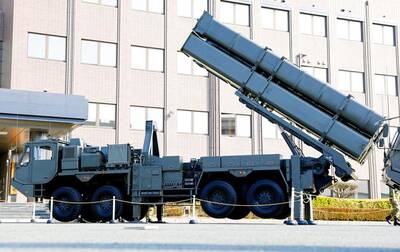
Japan has deployed long-range missiles in a southwestern region near China, the Japanese defense minister said yesterday, at a time when ties with Beijing are at their lowest in recent years. The missiles were installed in Kumamoto in the southern region of Kyushu, as Japan is attempting to shore up its military capacity as China steps up naval activity in the East China Sea. “Standoff defense capabilities enable us to counter the threat of enemy forces attempting to invade our country ... while ensuring the safety of our personnel,” Japanese Minister of Defense Shinjiro Koizumi said. “This is an extremely important initiative for
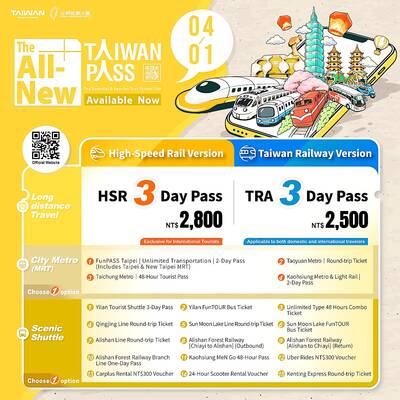
MORE POPULAR: Taiwan Pass sales increased by 59 percent during the first quarter compared with the same period last year, the Tourism Administration said The Tourism Administration yesterday said that it has streamlined the Taiwan Pass, with two versions available for purchase beginning today. The tourism agency has made the pass available to international tourists since 2024, allowing them to access the high-speed rail, Taiwan Railway Corp services, four MRT systems and four Taiwan Tourist Shuttles. Previously, five types of Taiwan Pass were available, but some tourists have said that the offerings were too complicated. The agency said only two types of Taiwan Pass would be available, starting from a three-day pass with the high-speed rail and a three-day pass with Taiwan Railway Corp. The former costs NT$2,800

NEW LOW: The council in 2024 based predictions on a pessimistic estimate for the nation’s total fertility rate of 0.84, but last year that rate was 0.69, 17 percent lower An expected National Development Council (NDC) report expects the nation’s population to drop below 12 million by 2065, with the old-age dependency ratio to top 100 percent sooner than 2070, sources said yesterday. The council is slated to release its latest population projections in August, using an ultra-low fertility model, the sources said. The previous report projected that Taiwan’s population would fall to 14.37 million by 2070, but based on a new estimate of the total fertility rate (TFR) — the average number of children born to a woman over her lifetime — the population is expected to reach 12 million by

COUNTERING HOSTILITY: The draft bill would require the US to increase diplomatic pressure on China and would impose sanctions on those who sabotage undersea cable networks US lawmakers on Thursday introduced a bipartisan bill to bolster the resilience of Taiwan’s submarine cables to counter China’s hostile activities. The proposal, titled the critical undersea infrastructure resilience initiative act, was cosponsored by Republican representatives Mike Lawler and Greg Stanton, and Democratic Representative Dave Min. US Senators John Curtis and Jacky Rosen also introduced a companion bill in the US Senate, which has passed markup at the chamber’s Committee on Foreign Relations. The House’s version of the bill would prioritize the deployment of sensors to detect disruptions or potential sabotage in real-time and enhance early warning capabilities through global intelligence sharing frameworks,


 RSS
RSS