


The National Communications Commission yesterday reiterated it had already given conditional approval to Want Want-China Times Group’s (旺旺中時集團) acquisition of the cable TV services owned by China Network Systems (CNS, 中嘉網路), adding that the approval would not take effect until Want Want had fulfilled each and every one of the three conditions outlined by the commission.
The commission announced its ruling on the deal on Wednesday after reviewing the case for 18 months. Based on the ruling, Want Want-China Times Group must fulfill three main conditions: Group chairman Tsai Eng-meng (蔡衍明) and his family members must completely dissociate themselves from the operations of the CTiTV (中天新聞台) news channel; the operational plan for the China Television (CTV, 中視) digital news channel must be changed to make it a non-news channel; and CTV must establish an independent editorial system.
Aside from the three conditions, Want Want also agreed to 25 “commitments” listed by the commissioners. Some of the important ones included giving two free set-top boxes to each household that subscribes to its cable service; providing a monthly subscription fee below the national average; making high-speed Internet services with a bandwidth of 100Mbps available by June next year; and reaching a 100 percent penetration rate for the digital cable TV service by 2014. The group is also banned from establishing new news channels, financial news channels and home shopping channels.
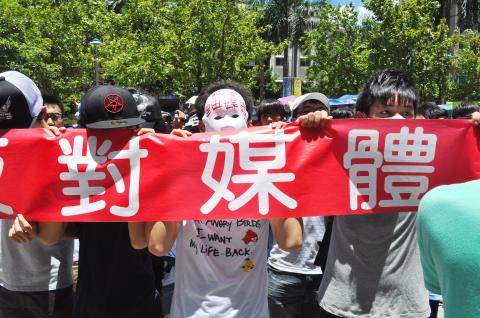
Photo: Liu Li-jen, Taipei Times
Andy Shieh (謝煥乾), director of the commission’s legal department, said the conditional approval was an administrative ruling issued by the commission and was an unilateral administrative decision, which did not need the approval of the persons involved in the case. Though Want Want said through the media it did not agree to the conditions, Shieh said this did not affect the effectiveness of the ruling.
The three main conditions were set to tackle problems associated with concentration of media ownership and Want Want Group can decide how it wants to fulfill those conditions, he said.
“If they do not accept those conditions, we respect that as well,” he said.
Shieh said the group was clearly informed about the conditions during its interview with commissioners on Wednesday and the group told the commissioners it would have a problem fulfilling those conditions.
Each of those three conditions must be met, or the approval will not take effect, Hsieh said, adding that the commission would follow administrative procedures if the group wanted to reapply.
“If the conditions are not fulfilled, the result will be the same as a rejection of the bid,” he added.
Want Want China Broadband (旺中寬頻), a subsidiary of the group that launched the bid for CNS, said in a statement that it can only evaluate how it might enact the ruling after it receives the official document from the commission, adding that doing so would require the approval of shareholders.
“Mr Tsai Eng-meng, as the largest shareholder [in CTiTV and CTV], cannot sacrifice the interests of other shareholders because of his personal investment in Want Want China Broadband, or they could file lawsuits against him,” the statement said.
In related news, activists opposing the takeover denied they paid students to protest.
"I absolutely did not pay any student to come to the protest [on Wednesday],” said Huang Kuo-chang (黃國昌), an associate researcher at Academia Sinica’s Institutum Iurisprudentiae. “I have absolutely no idea who did this.”
Huang and several other college professors submitted a petition to the commission on Wednesday, urging the media regulator to reject the deal. About 200 students later appeared to protest against the merger.
The China Times and China Times Weekly — two publications under the Want Want China Times Group — showed pictures of the students allegedly receiving cash from an anonymous woman.
The stories then implied that Huang had mobilized the students for the protest.
Huang said that he only sent e-mails on Tuesday night and asked other college professors who also opposed the Want Want-CNS deal to come to the commission on Wednesday, as he had heard the commission would very likely approve the deal.
Huang also said he did not know that a group of students would also show up and remain after he had left the premises.
Asked if he should investigate who had allegedly paid the students, Huang said that such matters should only be handled by prosecutors and the police.
National Communications Commission chairperson Su Herng (蘇蘅) weighed in on the controversy yesterday, saying in an interview with the Chinese-language United Evening News that the Want Want China Times Group had used the media to express its dissatisfaction with the ruling on the CNS deal, behavior which she said was not worth emulating.
The Want Want China Times Group may have its own considerations or decide not to accept the three conditions.
"The decision is theirs either way,” she said.


RESILIENCE: Taiwan plays a key role in semiconductors, energy, information infrastructure and advanced manufacturing, AIT Director Raymond Greene said Taiwan’s continued investment in deterrence and resilience remains vital, especially in uncrewed systems and other emerging technologies, American Institute in Taiwan (AIT) Director Raymond Greene said yesterday. Greene made the remarks at the annual National Strategic Summit on Supply Chain Resilience held by the Research Institute for Democracy, Society and Emerging Technology (DSET), a government-backed think tank. As Taiwan last year became the US’ fourth-largest trading partner and supply chain security is becoming more important, cooperation in emerging technologies continues to deepen between the two countries, he said. The US is committed to accelerating innovation, building key infrastructure, strengthening cooperation

The National Chungshan Institute of Science and Technology yesterday showcased its locally developed variants of the Vision 60 robotic patrol dog, which it plans to deploy on the nation’s outlying territories in the South China Sea. The variants were produced under the Joint Lab project — created by the institute and domestic companies — and assembled with domestically produced motors, lenses and artificial intelligence (AI) systems alongside licensed tech from the US, Missile and Rocket Systems Research Division deputy director Jen Kuo-kang (任國光) told the media event at a military base in Taipei’s Dazhi (大直) area. Taiwan has built up its strengths

RIGHT DIRECTION: Taiwan’s efforts to prevent forced labor include a proposal to ‘fully prohibit’ employers from withholding workers’ documents, an official said Taiwan is to establish a mechanism to restrict imports of goods linked to forced labor, the Executive Yuan said yesterday, after the US proposed imposing additional tariffs on Taiwanese goods over labor concerns. “The Ministry of Labor and the Ministry of Economic Affairs are to establish an interministerial review procedure,” Executive Yuan spokesperson Michelle Lee (李慧芝) said at a news briefing in Taipei. “The government is to use the Foreign Trade Act [貿易法] as the legal basis to restrict imports of goods produced with forced labor” and bring its supply chain governance more in line with international standards on human rights, resilience

NOT IMMEDIATE: Taiwan has a chance to appeal the proposed 10 percent tariff before it starts, while other countries face a 12.5 percent tariff from the trade office Taiwan is among 60 economies determined by the US to have failed to impose or enforce a ban on the importation of goods produced with forced labor, according to a notice released on Tuesday by the Office of the US Trade Representative (USTR), which proposed imposing an additional 10 percent or more tariff on them. The USTR in a statement said that following an investigation, it had determined under Section 301 of the Trade Act of 1974 that the failure of the 60 economies to impose and effectively enforce a prohibition on the importation of goods produced with forced labor is


 RSS
RSS