


Two surveys of commodity prices yesterday revealed that the prices of four kinds of household goods have increased slightly following the government’s announcement in April of increases in fuel and electricity rates.
Consumers’ Foundation chairwoman Joann Su (蘇錦霞) said her group’s collaboration with the Executive Yuan’s Consumer Protection Commission in conducting the surveys aimed to examine whether prices of household goods have risen because of the fuel price hike on April 2.
Among the 10 kinds of household goods surveyed, the average prices of washing powder, shower gel, toothpaste and tissues sold at major hypermarkets and supermarkets were found to have increased slightly between March and last month.
According to survey results from the commission and foundation respectively, the average prices of washing powder increased by 5.4 percent and 2.8 percent; those for shower gel rose 3.5 percent and 5.2 percent; toothpaste by 2.9 percent and 2.5 percent; and tissues by 2.5 percent and 6.5 percent.
Commission Director-General Liu Ching-fang (劉清芳) said the long-term price trend of the 10 kinds of household goods was still stable and reasonable and the increases could not be directly attributed to the rise in fuel and electricity prices.
However, Liu said there were three cases that aroused suspicion in the surveys.
The first suspect case was the sudden increase in the price of a brand of tissues sold at a hypermarket from NT$149 per pack in March to NT$176 per pack last month, which will be reported to the Fair Trade Commission for further examination.
The second case was a brand of eggs that remained at the same price of NT$57 a box for 16 months, with only one promotional price of NT$54 in June last year.
Liu said it was suspected that the lengthy sales promotion was used to deceive consumers about its original price.
“It’s like a store attracting consumers who seek a good bargain by claiming it is having a clearance sale, but the store is still there after two years, and the promotional price is actually the original price,” Su said.
The third case concerned whether the slightly reduced price of milk powder (an average price drop of between 0.1 percent and 1.8 percent between March and last month) was in line with the reduction on import duties on milk powder from 5 percent to 2.5 percent, Su said.
Commission Deputy Director-General Wu Cheng-hsueh (吳政學) said that although the survey results of the commission and the foundation showed similar patterns of roughly stable prices, consumers should compare prices of the same commodity between brands when shopping instead of always relying on the same brands, to save more money.
The commission has a toll-free line, 0800-007-007 for the public to report price gouging, while the Consumers’ Foundation welcomes such reports on its Facebook page, www.facebook.com/price0601.
Additional reporting by CNA

PROVOCATIVE: Chinese Deputy Ambassador to the UN Sun Lei accused Japan of sending military vessels to deliberately provoke tensions in the Taiwan Strait China denounced remarks by Japan and the EU about the South China Sea at a UN Security Council meeting on Monday, and accused Tokyo of provocative behavior in the Taiwan Strait and planning military expansion. Ayano Kunimitsu, a Japanese vice foreign minister, told the Council meeting on maritime security that Tokyo was seriously concerned about the situation in the East China and South China seas, and reiterated Japan’s opposition to any attempt to change the “status quo” by force, and obstruction of freedom of navigation and overflight. Stavros Lambrinidis, head of the EU delegation to the UN, also highlighted South China Sea

SILENCING CRITICS: In addition to blocking Taiwan, China aimed to prevent rights activists from speaking out against authoritarian states, a Cabinet department said The Ministry of Foreign Affairs (MOFA) yesterday condemned transnational repression by Beijing after RightsCon, a major digital human rights conference scheduled to be held in Zambia this week, was abruptly canceled due to Chinese pressure over Taiwanese participation. This year’s RightsCon, the world’s largest conference discussing issues “at the intersection of human rights and technology,” was scheduled to take place from tomorrow to Friday in Lusaka, and expected to draw 2,600 in-person attendees from 150 countries, along with 1,100 online participants. However, organizers were forced to cancel the event due to behind-the-scenes pressure from China, the ministry said, expressing its “strongest condemnation”
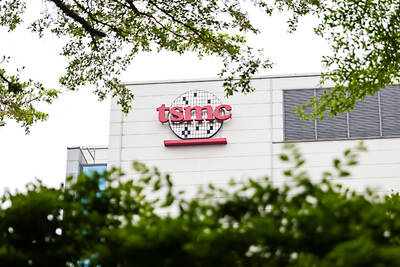
Taiwan Semiconductor Manufacturing Co (TSMC, 台積電), the world’s largest contract chipmaker, said it expects its 2-nanometer (2nm) chip capacity to grow at a compound annual rate of 70 percent from this year to 2028. The projection comes as five fabs begin volume production of 2-nanometer chips this year — two in Hsinchu and three in Kaohsiung — TSMC senior vice president and deputy cochief operating officer Cliff Hou (侯永清) said at the company’s annual technology symposium in Silicon Valley, California, last week. Output in the first year of 2-nanometer production, which began in the fourth quarter of last year, is expected to
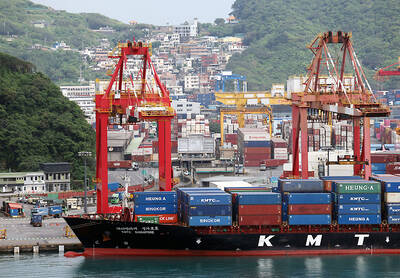
Taiwan’s economy grew far faster than expected in the first quarter, as booming demand for artificial intelligence (AI) applications drove a surge in exports, spilling over into investment and consumption, the Directorate-General of Budget, Accounting and Statistics (DGBAS) said yesterday. GDP growth was 13.69 percent year-on-year during the January-to-March period, beating the DGBAS’ February forecast by 2.23 percentage points and marking the most robust growth in nearly four decades, DGBAS senior official Chiang Hsin-yi (江心怡) told a news conference in Taipei. The result was powered by exports, which remain the backbone of Taiwan’s economy, Chiang said. Outbound shipments jumped 51.12 percent year-on-year to


 RSS
RSS