


Seven legislators from across the political spectrum flew to the Dongsha Islands (東沙群島, known as the Pratas Islands in English) in the South China Sea yesterday as part of efforts to highlight Taiwan’s sovereignty amid growing tensions in the disputed area.
The trip came on the heels of a visit late last month by several other lawmakers to Taiping Island (太平島), the main island of the Spratley Islands in the simmering region, for a similar purpose.
The latest trip was led by Democratic Progressive Party (DPP) Legislator Mark Chen (陳唐山), a co-convener of the legislature’s Foreign and National Defense Committee.
The other members of the group were DPP legislators Tsai Huang-liang (蔡煌瑯), Hsiao Bi-khim (蕭美琴) and Hsueh Ling (薛凌), as well as their Chinese Nationalist Party (KMT) colleagues Chan Kai-chen (詹凱臣) and Chen Cheng-hsiang (陳鎮湘), and People First Party Legislator Chang Show-foong (張曉風).
Chang said prior to the group’s departure from Taipei International Airport (Songshan airport) that she was very pleased to join the group on the tour of the Dongsha Islands, which are located about 450km off Taiwan’s southwestern coast.
“This is my first trip to Dongsha and I hope to look into the ecological and fishery protection measures in place there,” Chang said.
Tsai said the Dongsha and Taiping islands are Taiwanese sovereign territory.
“As tensions in the South China Sea have been escalating recently, we want to reassert our country’s claim to the region through our visit,” Tsai said, adding that the group would also help boost the morale of military and coast guard personnel stationed on the islands.
The South China Sea is seen as a flashpoint because Taiwan, China, the Philippines, Vietnam, Malaysia and Brunei claim all or part of the 3.5 million square kilometer area, which includes the Spratly, Paracel and Pratas islands, the Macclesfield Bank and the Scarborough Shoal.
A standoff between armed Chinese and Philippine vessels has continued since April 10 near the Scarborough Shoal, known as Huangyan Island (黃岩島) in Taiwan, over conflicting sovereignty claims.
Taiwan occupies Dongsha, the largest island in the South China Sea, as well as Taiping Island, the largest island in the Spratlys.

PROVOCATIVE: Chinese Deputy Ambassador to the UN Sun Lei accused Japan of sending military vessels to deliberately provoke tensions in the Taiwan Strait China denounced remarks by Japan and the EU about the South China Sea at a UN Security Council meeting on Monday, and accused Tokyo of provocative behavior in the Taiwan Strait and planning military expansion. Ayano Kunimitsu, a Japanese vice foreign minister, told the Council meeting on maritime security that Tokyo was seriously concerned about the situation in the East China and South China seas, and reiterated Japan’s opposition to any attempt to change the “status quo” by force, and obstruction of freedom of navigation and overflight. Stavros Lambrinidis, head of the EU delegation to the UN, also highlighted South China Sea

SILENCING CRITICS: In addition to blocking Taiwan, China aimed to prevent rights activists from speaking out against authoritarian states, a Cabinet department said The Ministry of Foreign Affairs (MOFA) yesterday condemned transnational repression by Beijing after RightsCon, a major digital human rights conference scheduled to be held in Zambia this week, was abruptly canceled due to Chinese pressure over Taiwanese participation. This year’s RightsCon, the world’s largest conference discussing issues “at the intersection of human rights and technology,” was scheduled to take place from tomorrow to Friday in Lusaka, and expected to draw 2,600 in-person attendees from 150 countries, along with 1,100 online participants. However, organizers were forced to cancel the event due to behind-the-scenes pressure from China, the ministry said, expressing its “strongest condemnation”

Taiwan Semiconductor Manufacturing Co (TSMC, 台積電), the world’s largest contract chipmaker, said it expects its 2-nanometer (2nm) chip capacity to grow at a compound annual rate of 70 percent from this year to 2028. The projection comes as five fabs begin volume production of 2-nanometer chips this year — two in Hsinchu and three in Kaohsiung — TSMC senior vice president and deputy cochief operating officer Cliff Hou (侯永清) said at the company’s annual technology symposium in Silicon Valley, California, last week. Output in the first year of 2-nanometer production, which began in the fourth quarter of last year, is expected to
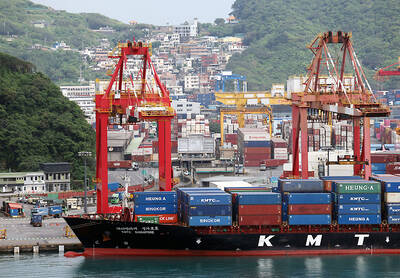
Taiwan’s economy grew far faster than expected in the first quarter, as booming demand for artificial intelligence (AI) applications drove a surge in exports, spilling over into investment and consumption, the Directorate-General of Budget, Accounting and Statistics (DGBAS) said yesterday. GDP growth was 13.69 percent year-on-year during the January-to-March period, beating the DGBAS’ February forecast by 2.23 percentage points and marking the most robust growth in nearly four decades, DGBAS senior official Chiang Hsin-yi (江心怡) told a news conference in Taipei. The result was powered by exports, which remain the backbone of Taiwan’s economy, Chiang said. Outbound shipments jumped 51.12 percent year-on-year to


 RSS
RSS