


To avoid a repeat of incidents where Chinese tourists have been able to get into Taiwan’s military bases, identification checks of visitors were stringently conducted yesterday at an air show held by the Taiwanese air force for the public at its Songshan Air Base in Taipei.
Visitors either had to present their picture ID cards at the gate or have accompanying visitors sign vouchers for them before being allowed into the base.
The precautionary measures came in the wake of an incident in May at Hualien Air Base, where several Chinese tourists entered the base on a military shuttle bus without undergoing security checks and even took some pictures of the air force’s Mirage 2000, F-16A/B and Indigenous Defense Fighter (IDF) aircraft that were on display that day.
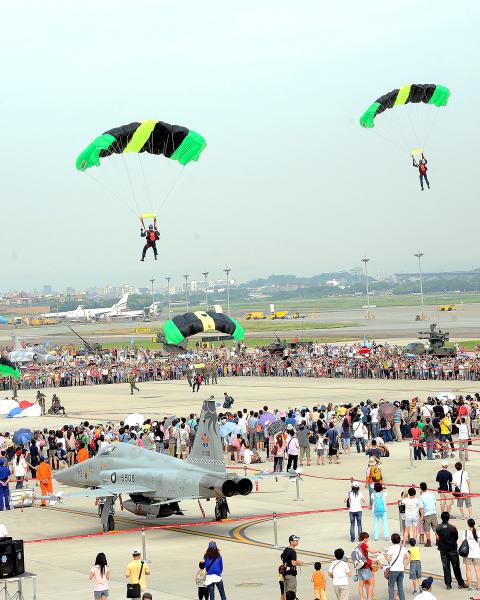
Photo: Fang Pin-chao, Taipei Times
At the air show yesterday, the air force’s Thunder Tiger Aerobatics Team launched the show with an aerobatic performance, followed by a demonstration of parachuting techniques from the Airborne Brigade Skydiving Team. Jet fighters then soared through the air in formations and emitted colored smoke ribbons in the sky.
A variety of aircraft — including the F-16, IDF, Mirage 2000, C-130 Hercules, S-70C helicopter — and armaments, such as MIM-23 Hawk missile, and others, were also on display.
There was special seating at yesterday’s show for members of the military’s former Black Bat, Red Fox and Black Cat squadrons, as well as the former army 1st Special Forces.
Black Cat was the codename for the air force’s 35th Squadron, which worked with the CIA during the Cold War on deep nighttime penetration over Chinese airspace for reconnaissance operations, usually using U-2 spy planes.
The Black Bats referred to the air force’s 34th Squadron, which flew numerous clandestine missions in the Korean and Vietnam wars in support of the US, while the Red Fox Squadron was another reconnaissance-based squadron that was founded as early as 1945.
One note of interest at yesterday’s air show was that the special seating area also included one designated for the Straits Exchange Foundation (SEF).
According to the director of the foundation’s Secretariat, Wan Ying-hao (萬英豪), SEF members — some of whom came with their families — who attended the show yesterday were all legitimate members of the foundation.
As SEF members are usually involved in work related to cross-strait negotiations, Wang said that having them watch the air show and witness the might of Taiwan’s military would help them grasp the concept of defense of national sovereignty, which Wan added could be helpful when it came to dealing with cross-strait negotiations.
Wan acknowledged there were Chinese personnel who had previously contacted the SEF and professed a keen wish to see Songshan Air Base, as well as the military show, but the SEF stood by the government’s policy and relayed that stance, as well as the nation’s military regulations, to the Chinese. They accepted it, Wan said.
TRANSLATED BY JAKE CHUNG, STAFF WRITER, WITH ADDITIONAL REPORTING BY CNA
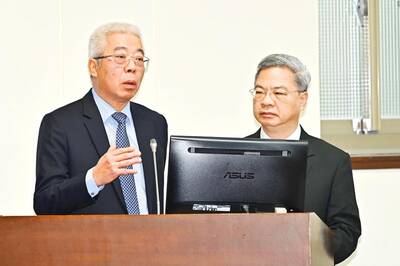
Taiwan has arranged for about 8 million barrels of crude oil, or about one-third of its monthly needs, to be shipped from the Red Sea this month to bypass the Strait of Hormuz and ease domestic supply pressures, CPC Corp, Taiwan (CPC, 台灣中油) said yesterday. The state-run oil company has worked with Middle Eastern suppliers to secure routes other than the Strait of Hormuz, through which about 20 percent of the world’s oil and liquefied natural gas typically passes, CPC chairman Fang Jeng-zen (方振仁) said at a meeting of the legislature’s Economics Committee in Taipei. Suppliers in Saudi Arabia have indicated they
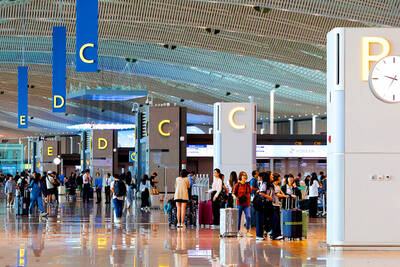
South Korea has adjusted its electronic arrival card system to no longer list Taiwan as a part of China, a move that the Ministry of Foreign Affairs said would help facilitate exchanges between the two sides. South Korea previously listed “Taiwan” as “Taiwan (China)” in the drop-down menus of its online arrival card system, where people had to fill out where they came from and their next destination. The ministry had requested South Korea make a revision and said it would change South Korea’s name on Taiwan’s online immigration system from “Republic of Korea” to “Korea (South),” should the issue not be
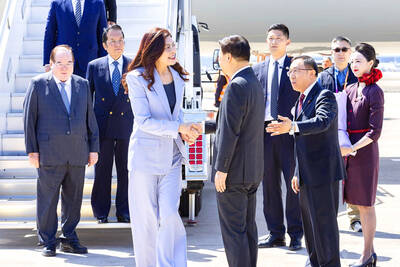
CCP ‘PAWN’? Beijing could use the KMT chairwoman’s visit to signal to the world that many people in Taiwan support the ‘one China’ principle, an academic said Chinese Nationalist Party (KMT) Chairwoman Cheng Li-wun (鄭麗文) yesterday arrived in China for a “peace” mission and potential meeting with Chinese President Xi Jinping (習近平), while a Taiwanese minister detailed the number of Chinese warships currently deployed around the nation. Cheng is visiting at a time of increased Chinese military pressure on Taiwan, as the opposition-dominated Legislative Yuan stalls a government plan for US$40 billion in extra defense spending. Speaking to reporters before going to the airport, Cheng said she was going on a “historic journey for peace,” but added that some people felt uneasy about her trip. “If you truly love Taiwan,
A global survey showed that 60 percent of Taiwanese had attained higher education, second only to Canada, the Ministry of the Interior said. Taiwan easily surpassed the global average of 43 percent and ranked ahead of major economies, including Japan, South Korea and the US, data from the Organisation for Economic Co-operation and Development (OECD) for 2024 showed. Taiwan has a high literacy rate, data released by the ministry showed. As of the end of last year, Taiwan had 20.617 million people aged 15 or older, accounting for 88.5 percent of the total population, with a literacy rate of 99.4 percent, the data


 RSS
RSS