


North Korean leader Kim Jong-il visited a development zone in eastern China yesterday, media reports said, as he pursued a trip aimed at seeking answers for his nation’s crippled economy.
Kim, on his third visit to China in just over a year, toured the economic development zone in Yangzhou City near Shanghai, South Korea’s Yonhap news agency said, citing unnamed sources.
North Korea watchers believe the latest trip by a man who rarely leaves his country reflects a dire need for help with severe economic problems and food shortages amid ongoing international sanctions over its nuclear ambitions.
Chinese Premier Wen Jiabao (溫家寶) confirmed Kim’s visit for the first time on Sunday, telling South Korean President Lee Myung-bak in Tokyo that Kim wanted to study China’s vibrant economy, according to a Seoul official.
Kim may also visit the site of a joint industrial park on North Korea’s border with China on the way home, Yonhap said.
That would likely underscore a commitment to further economic cooperation with China, North Korea’s closest ally and main benefactor, Yonhap said.
The reclusive Stalinist ruler has traversed much of eastern China aboard his personal train and the trip is also widely viewed as intended to show he is healthy and firmly in charge.
Kim, 69, suffered a stroke in 2008 and has launched a succession plan involving his youngest son and heir apparent Kim Jong-un. It was not immediately clear if his son was part of his entourage in China.
His arrival in China on Friday came just ahead of a weekend summit in Tokyo between China, South Korea and Japan, which agreed North Korea must show sincerity before stalled six-nation talks on its nuclear program can resume.

The National Chungshan Institute of Science and Technology yesterday showcased its locally developed variants of the Vision 60 robotic patrol dog, which it plans to deploy on the nation’s outlying territories in the South China Sea. The variants were produced under the Joint Lab project — created by the institute and domestic companies — and assembled with domestically produced motors, lenses and artificial intelligence (AI) systems alongside licensed tech from the US, Missile and Rocket Systems Research Division deputy director Jen Kuo-kang (任國光) told the media event at a military base in Taipei’s Dazhi (大直) area. Taiwan has built up its strengths

RIGHT DIRECTION: Taiwan’s efforts to prevent forced labor include a proposal to ‘fully prohibit’ employers from withholding workers’ documents, an official said Taiwan is to establish a mechanism to restrict imports of goods linked to forced labor, the Executive Yuan said yesterday, after the US proposed imposing additional tariffs on Taiwanese goods over labor concerns. “The Ministry of Labor and the Ministry of Economic Affairs are to establish an interministerial review procedure,” Executive Yuan spokesperson Michelle Lee (李慧芝) said at a news briefing in Taipei. “The government is to use the Foreign Trade Act [貿易法] as the legal basis to restrict imports of goods produced with forced labor” and bring its supply chain governance more in line with international standards on human rights, resilience
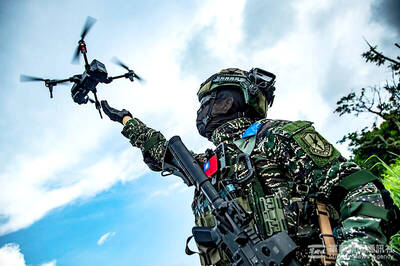
RESILIENCE: Taiwan plays a key role in semiconductors, energy, information infrastructure and advanced manufacturing, AIT Director Raymond Greene said Taiwan’s continued investment in deterrence and resilience remains vital, especially in uncrewed systems and other emerging technologies, American Institute in Taiwan (AIT) Director Raymond Greene said yesterday. Greene made the remarks at the annual National Strategic Summit on Supply Chain Resilience held by the Research Institute for Democracy, Society and Emerging Technology (DSET), a government-backed think tank. As Taiwan last year became the US’ fourth-largest trading partner and supply chain security is becoming more important, cooperation in emerging technologies continues to deepen between the two countries, he said. The US is committed to accelerating innovation, building key infrastructure, strengthening cooperation

NOT IMMEDIATE: Taiwan has a chance to appeal the proposed 10 percent tariff before it starts, while other countries face a 12.5 percent tariff from the trade office Taiwan is among 60 economies determined by the US to have failed to impose or enforce a ban on the importation of goods produced with forced labor, according to a notice released on Tuesday by the Office of the US Trade Representative (USTR), which proposed imposing an additional 10 percent or more tariff on them. The USTR in a statement said that following an investigation, it had determined under Section 301 of the Trade Act of 1974 that the failure of the 60 economies to impose and effectively enforce a prohibition on the importation of goods produced with forced labor is


 RSS
RSS