


A member of the Chinese Nationalist Party’s (KMT) Central Standing Committee recently caused a stir with his suggestion that the nation’s Aborigines should marry within their own ethnic group to preserve the purity of Aboriginal bloodlines.
The suggestion came to light when a KMT lawmaker revealed in a post on Facebook that during a committee meeting on Wednesday last week, in which Council of Indigenous Peoples Minister Sun Ta-chuan (孫大川) gave a presentation, committee member Liao Wan-lung (廖萬隆) proposed the idea to President Ma Ying-jeou (馬英九).
According to the post, Ma, who presided over the meeting in his capacity as the KMT chairman, responded by saying that “love and marriage are personal liberties,” adding: “I’m sorry, but I cannot take the suggestion.”
Liao’s proposal has nonetheless caused a stir among some netizens, who slammed the idea as “totally ridiculous.”
Commenting on the issue, Sediq KMT Legislator Kung Wen-chi (孔文吉) said he was surprised anyone would still make such a suggestion, as marriage between Aborigines and non-Aborigines helped keep the different ethnicities at peace, adding that trying to stop inter-communal marriages hinted at repression, not progress.
KMT Legislator Chien Tung-ming (簡東明), a member of the Paiwan tribe, added that it was “inhuman” to interfere in the freedom of marriage.
Protection of cultures did not necessarily need to start by avoiding marriage between Aboriginal and Han peoples, said Chien, whose view was echoed by Sun.
Other Aboriginal leaders also said it was ludicrous, laughable, an infringement of human rights and inhumane.
Independent Legislator May Chin (高金素梅), who is half-Atayal and represents an Aboriginal constituency, wondered why Liao still subscribed to the outdated concept of blood and racial purity.
Liao yesterday clarified that his intent had been to preserve Aboriginal languages and cultures. Such things cannot be forced and must be encouraged by policies, he added.
The central government’s policies on the preservation of Aboriginal culture are insufficient, causing their gradual assimilation and the loss of Aboriginal languages, Liao said.
“There might not be a pure-bred Aborigines anymore if this continues,” Liao said.
Government policies must protect the vulnerable and the central government should draw up regulations that encourage young Aborigines to return to their native homes to carry on their own cultures, which are an important part of Taiwan’s culture, he added.
According to the Aboriginal Identity Act (原住民身分法) amended in January 2001, people who are half Aborigine can obtain Aborigine status.
As a result, whereas the Aboriginal population was 420,000 in 2002, as of last month a total of 514,000 individuals nationwide were classified as Aborigines.
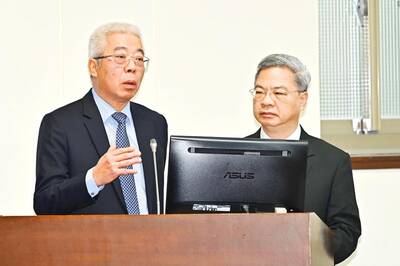
Taiwan has arranged for about 8 million barrels of crude oil, or about one-third of its monthly needs, to be shipped from the Red Sea this month to bypass the Strait of Hormuz and ease domestic supply pressures, CPC Corp, Taiwan (CPC, 台灣中油) said yesterday. The state-run oil company has worked with Middle Eastern suppliers to secure routes other than the Strait of Hormuz, through which about 20 percent of the world’s oil and liquefied natural gas typically passes, CPC chairman Fang Jeng-zen (方振仁) said at a meeting of the legislature’s Economics Committee in Taipei. Suppliers in Saudi Arabia have indicated they
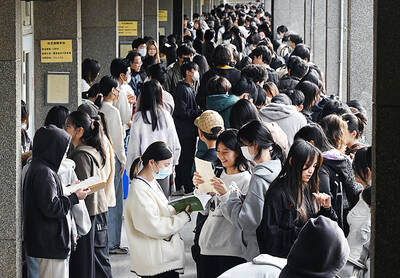
A global survey showed that 60 percent of Taiwanese had attained higher education, second only to Canada, the Ministry of the Interior said. Taiwan easily surpassed the global average of 43 percent and ranked ahead of major economies, including Japan, South Korea and the US, data from the Organisation for Economic Co-operation and Development (OECD) for 2024 showed. Taiwan has a high literacy rate, data released by the ministry showed. As of the end of last year, Taiwan had 20.617 million people aged 15 or older, accounting for 88.5 percent of the total population, with a literacy rate of 99.4 percent, the data

CCP ‘PAWN’? Beijing could use the KMT chairwoman’s visit to signal to the world that many people in Taiwan support the ‘one China’ principle, an academic said Chinese Nationalist Party (KMT) Chairwoman Cheng Li-wun (鄭麗文) yesterday arrived in China for a “peace” mission and potential meeting with Chinese President Xi Jinping (習近平), while a Taiwanese minister detailed the number of Chinese warships currently deployed around the nation. Cheng is visiting at a time of increased Chinese military pressure on Taiwan, as the opposition-dominated Legislative Yuan stalls a government plan for US$40 billion in extra defense spending. Speaking to reporters before going to the airport, Cheng said she was going on a “historic journey for peace,” but added that some people felt uneasy about her trip. “If you truly love Taiwan,

South Korea has adjusted its electronic arrival card system to no longer list Taiwan as a part of China, a move that the Ministry of Foreign Affairs said would help facilitate exchanges between the two sides. South Korea previously listed “Taiwan” as “Taiwan (China)” in the drop-down menus of its online arrival card system, where people had to fill out where they came from and their next destination. The ministry had requested South Korea make a revision and said it would change South Korea’s name on Taiwan’s online immigration system from “Republic of Korea” to “Korea (South),” should the issue not be


 RSS
RSS