


The Executive Yuan's Referendum Review Committee late last night voted down the Taiwan Solidarity Union's (TSU) request to hold a referendum on the government's proposed economic cooperation framework agreement (ECFA) with China. The vote, which was announced shortly before 11pm, was 12-4.
The TSU's application requested a referendum on the question: “Do you agree that the government should sign an ECFA with China?”
“The reason stated for the referendum proposal is to ask if the government has the right to sign an ECFA. However, the question asked in the proposal is about the contents of an ECFA, which is different from the stated reason,” Referendum Review Committee Chairman Chao Yung-mau (趙永茂) told a press conference after the five-hour meeting.
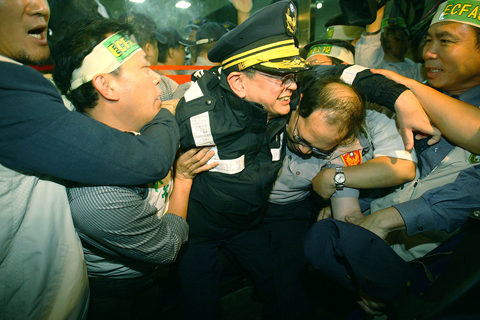
PHOTO: CNA
The committee had convened at 6pm.
Chao said a referendum proposal should be aimed at changing the status quo, but the government would not have to take any action to change its policy, even if the proposed referendum had passed, because of the wording — asking whether voters agree with the government’s plan to sign an ECFA.
“The referendum proposal, therefore, does not meet the qualification of ‘approving a government policy,’ as stated in the Referendum Act (公民投票法),” he said.
The TSU may appeal the decision, he said.
The committee has 21 members, but only 19 attended the meeting. As chairman, Chao did not vote because he presided over the meeting, while committee member Arthur Ding (丁仁方) left before the vote. Of the 17 members who voted, one cast a blank vote.
The four committee members who voted in favor of the proposal were Yang Wan-ying (楊婉瑩), Chen Tun-yuan (陳敦源), Kuo Lin-yung (郭林勇) and Chen Miao-fen (陳妙芬).
“The referendum proposal asks whether the government should sign an ECFA with China. It is certainly asking for the people’s approval on a major policy, which meets the criteria of the right to hold a referendum as granted by the Constitution,” the four said in a written statement.
The committee's rejection was immediately criticized by TSU Chairperson Huang Kun-huei (黃昆輝), who said the committee had no right to write off a referendum proposal supported by more than 200,000 people.
The TSU said it would immediately begin preparations for another referendum proposal, but gave no details.
“An ECFA has to be put to a public vote,” Huang said. “If Ma, as a popularly elected president, doesn’t listen to the public, he will pay the price politically.”
“If an ECFA would benefit Taiwan as the government says, why is Ma afraid of putting this proposal to a public vote? What is he afraid of?” Huang said.
Premier Wu Den-yih (吳敦義) had previously said the government respects the people's right to referendums, as long as they are held legally and constitutionally. However, the TSU initiative did not meet those requirements, since the content of the proposed pact has not been announced, he said.
Huang also said the TSU would prepare an initiative for a referendum asking voters to dismiss the review committee, saying the committee did not have the moral authority to make decisions about a right protected by the Constitution.
In addition, the TSU would investigate the possibility of holding a referendum on revising the Referendum Act, which sets an unfairly high threshold for referendum questions to pass, he said.
The Referendum Act stipulates that a referendum proposal, after completing the first stage of collecting signatures from 0.5 percent of the number of people who were eligible to vote in the last presidential election, must obtain approval from the Referendum Review Committee before it can proceed to the next stage of collecting signatures from 5 percent of that same number. It must then pass a second review before making it to the polling stations.
Huang also hinted at Chinese involvement in the decision. He said the committee’s decision came after the government came under pressure from Chinese authorities.
A TSU source said the party still has about 100,000 signed petition forms left over from its initial application. A total of 86,000 signatures are needed to initiate a referendum process.
TSU officials said they would try and use the remaining forms to initiate another referendum proposal. However, it was not immediately clear whether the Referendum Review Committee would accept the forms because the law says the same referendum proposal cannot be submitted twice.
Democratic Progressive Party (DPP) spokesman Lin Yu-chang (林右昌) said the committee decision was regrettable and raised concerns that the Chinese Nationalist Party (KMT) had pressured committee members over their decision.
During the committee meeting at the Joint Central Government Officers Tower in Taipei, DPP lawmakers tried to break into the venue by climbing over the fence and metal gates surrounding the building. Police officers rushed to stop the lawmakers, triggering scuffles and clashes.
The lawmakers were able to breach the police’s first line of defense, but were stopped in front of the building’s glass doors. The police shut down elevators to prevent protesters from getting into the building through the underground parking garage and reaching the room on the 10th floor where the committee was deliberating.
Prevented from reaching the committee, the DPP lawmakers held a sit-down protest outside.
Lin said the DPP would most likely hold a provisional meeting this morning and issue a formal statement after it receives a copy of the committee’s decision.
The DPP’s event in support of a referendum on an ECFA, scheduled for Kaohsiung City’s Glory Pier tomorrow, will go ahead as planned.

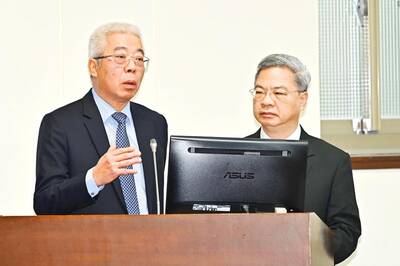
Taiwan has arranged for about 8 million barrels of crude oil, or about one-third of its monthly needs, to be shipped from the Red Sea this month to bypass the Strait of Hormuz and ease domestic supply pressures, CPC Corp, Taiwan (CPC, 台灣中油) said yesterday. The state-run oil company has worked with Middle Eastern suppliers to secure routes other than the Strait of Hormuz, through which about 20 percent of the world’s oil and liquefied natural gas typically passes, CPC chairman Fang Jeng-zen (方振仁) said at a meeting of the legislature’s Economics Committee in Taipei. Suppliers in Saudi Arabia have indicated they

South Korea has adjusted its electronic arrival card system to no longer list Taiwan as a part of China, a move that the Ministry of Foreign Affairs said would help facilitate exchanges between the two sides. South Korea previously listed “Taiwan” as “Taiwan (China)” in the drop-down menus of its online arrival card system, where people had to fill out where they came from and their next destination. The ministry had requested South Korea make a revision and said it would change South Korea’s name on Taiwan’s online immigration system from “Republic of Korea” to “Korea (South),” should the issue not be

Tainan, Taipei and New Taipei City recorded the highest fines nationwide for illegal accommodations in the first quarter of this year, with fines issued in the three cities each exceeding NT$7 million (US$220,639), Tourism Administration data showed. Among them, Taipei had the highest number of illegal short-term rental units, with 410. There were 3,280 legally registered hotels nationwide in the first quarter, down by 14 properties, or 0.43 percent, from a year earlier, likely indicating operators exiting the market, the agency said. However, the number of unregistered properties rose to 1,174, including 314 illegal hotels and 860 illegal short-term rental
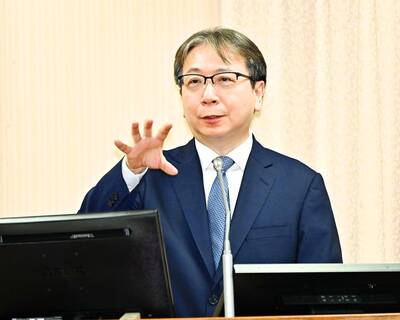
AIR ALERT: China’s reservation of airspace over the Yellow Sea and East China Sea could be an attempt to test the US’ response ahead of a Trump-Xi meeting, the NSB head said China’s attempts to infiltrate Taiwan are systematic, planned and targeted, with activity shifting from recruiting mid-level military officers to rank-and-file enlisted personnel, National Security Bureau (NSB) Director-General Tsai Ming-yen (蔡明彥) said yesterday. The Chinese Communist Party’s (CCP) integrates national security, intelligence operations and “united front” efforts into a dense network to conduct intelligence gathering and espionage in Taiwan, Tsai said at a meeting of the legislature’s Foreign Affairs and National Defense Committee. It uses specific networks to screen targets through exchange activities and recruiting local collaborators to establish intelligence-gathering organizations, he said. China is also shifting who it targets to lower-ranking military personnel,


 RSS
RSS