


Wearing headbands with the words “no to poisonous beef” and “no to deception,” thousands of people took to the streets of Taipei yesterday afternoon to voice their opposition to the government’s decision to lift a ban on US bone-in beef and beef organs, and urge the government to renegotiate the agreement.
Demonstrators from all over the country started to gather at the assembly point near Zhongxiao Fuxing MRT station hours before the official start of the march.
The demonstration was organized by the Tainan County Government and several civic groups, including the Taiwan Labour Front, the Taiwan Association of University Professors and the Foundation of Medical Professionals Alliance in Taiwan, in reaction to the lifting of the ban on imports of bone-in beef, beef organs and ground beef from the US.
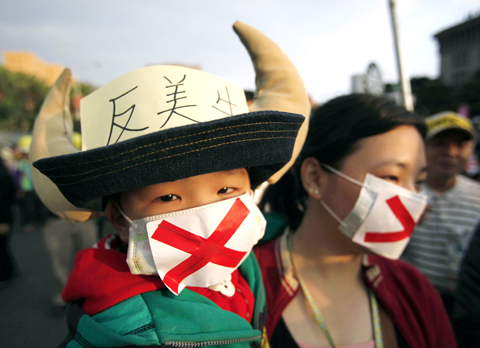
PHOTO: NICKY LOH, REUTERS
After the government had been negotiating with the US on the issue for about two years, the Department of Health announced on Oct. 23 that it had signed a protocol with the US that would allow bone-in beef, ground beef, bovine intestines, brains, spinal cords and processed beef from cattle younger than 30 months that have not been contaminated with “specific risk materials” (SRM) to be imported.
“Whether to lift the ban [on certain US beef parts] is a public health issue that should have been fully debated by the public before a decision was made,” Democratic Progressive Party (DPP) Chairperson Tsai Ing-wen (蔡英文) told the crowd before the march began at 2:30pm.
“The government never talked about it with the legislature, the opposition or the public — we only knew about it after the government had signed an agreement with the US. That violates the principles of democracy and transparency,” she said.
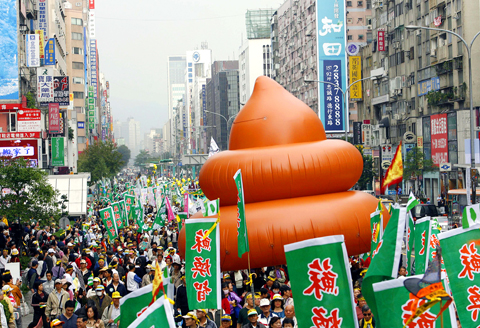
PHOTO: NICKY LOH, REUTERS
Tsai cited a resolution passed by the legislature in January 2006 stating that the government should consult with and gain approval from the legislature before lifting the ban on US beef parts.
“We are demonstrating to ask for one thing — that the beef deal be renegotiated,” Tsai said.
“If they [the government] cannot do it, they should step down and let us do it,” she said.
Since the announcement on Oct. 23, the government has faced an uphill battle persuading a skeptical public on the safety of US beef, with leading consumer groups and opposition politicians pushing for a referendum on reimposing the beef-on-the-bone import ban.
National Security Council Secretary-General Su Chi (蘇起) earlier this month apologized for poor communication before the lifting of the ban and the Executive Yuan pledged that it would tighten inspections and effectively block ground beef and bovine intestines by changing import inspection rules. Ground beef and intestine imports will have to be thawed for examination (ruining them in the process) and any shipments mixed with bone-in beef would be destroyed, the government said.
The unconvinced demonstrators shouted slogans and called for renegotiation, while march organizers explained through loudspeakers to the crowd and passers-by that they were against lifting the ban because bone-in beef and beef organs were more likely to carry prion, the infectious agent of mad cow disease that is composed mostly of protein.
“If you think you’ll be safe because you don’t eat beef, you’re wrong — when prion enters the food chain, it may also contaminate pork and even the soil,” a demonstrator said. “So you may be infected with mad cow disease even if you’re a vegetarian.”
The 32-year-old user of online social networking service Plurk.com, Lin Jung-cheng (林融政), was among a group of about a dozen plurkers from Taipei, Taichung and Tainan taking part in the march.
“Of course we’re worried about the safety of US beef, but we’re more upset that the government signed the agreement [to lift the ban] without telling the public first,” Lin said. “We’re quite suspicious about what the government has gained from the US in return.”
A woman surnamed Lai (賴) in her 50s took her 10-year-old grandson, dressed in a cow costume, with her to the march.
She said she didn’t care if she was infected with mad cow disease since she’s lived a full life, “but I must take part in the protest for the sake of my grandchildren and their grandchildren.”
Tang Kao Hsuan-feng (唐高炫風) drew a lot of attention for wearing his camouflage army uniform and holding a large Republic of China flag.
“I voted for [President] Ma Ying-jeou [馬英九] and was a big supporter, but that doesn’t mean that I should pretend that I don’t see when he makes mistakes, because I know what’s wrong and what’s right,” Tang Kao said. “Ma should renegotiate the beef agreement because US beef threatens the health of Taiwanese.”
Former DPP legislator Hsu Kuo-yung (徐國勇), on the other hand, urged the public to call on elected representatives to support a proposed amendment to the Act Governing Food Sanitation (食品衛生管理法) scheduled for review in the legislature on Thursday that would block imports of some US beef parts.
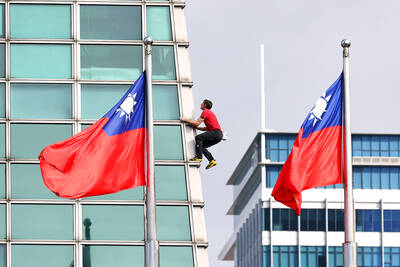
DAREDEVIL: Honnold said it had always been a dream of his to climb Taipei 101, while a Netflix producer said the skyscraper was ‘a real icon of this country’ US climber Alex Honnold yesterday took on Taiwan’s tallest building, becoming the first person to scale Taipei 101 without a rope, harness or safety net. Hundreds of spectators gathered at the base of the 101-story skyscraper to watch Honnold, 40, embark on his daredevil feat, which was also broadcast live on Netflix. Dressed in a red T-shirt and yellow custom-made climbing shoes, Honnold swiftly moved up the southeast face of the glass and steel building. At one point, he stepped onto a platform midway up to wave down at fans and onlookers who were taking photos. People watching from inside
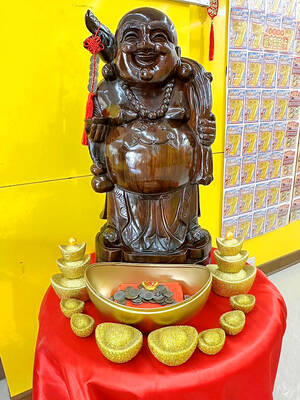
A Vietnamese migrant worker yesterday won NT$12 million (US$379,627) on a Lunar New Year scratch card in Kaohsiung as part of Taiwan Lottery Co’s (台灣彩券) “NT$12 Million Grand Fortune” (1200萬大吉利) game. The man was the first top-prize winner of the new game launched on Jan. 6 to mark the Lunar New Year. Three Vietnamese migrant workers visited a Taiwan Lottery shop on Xinyue Street in Kaohsiung’s Gangshan District (崗山), a store representative said. The player bought multiple tickets and, after winning nothing, held the final lottery ticket in one hand and rubbed the store’s statue of the Maitreya Buddha’s belly with the other,
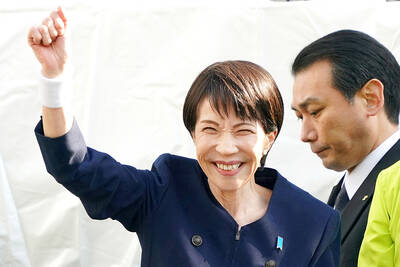
Japan’s strategic alliance with the US would collapse if Tokyo were to turn away from a conflict in Taiwan, Japanese Prime Minister Sanae Takaichi said yesterday, but distanced herself from previous comments that suggested a possible military response in such an event. Takaichi expressed her latest views on a nationally broadcast TV program late on Monday, where an opposition party leader criticized her for igniting tensions with China with the earlier remarks. Ties between Japan and China have sunk to the worst level in years after Takaichi said in November that a hypothetical Chinese attack on Taiwan could bring about a Japanese

‘COMMITTED TO DETERRENCE’: Washington would stand by its allies, but it can only help as much as countries help themselves, Raymond Greene said The US is committed to deterrence in the first island chain, but it should not bear the burden alone, as “freedom is not free,” American Institute in Taiwan Director Raymond Greene said in a speech at the Institute for National Defense and Security Research’s “Strengthening Resilience: Defense as the Engine of Development” seminar in Taipei yesterday. In the speech, titled “Investing Together and a Secure and Prosperous Future,” Greene highlighted the contributions of US President Donald Trump’s administration to Taiwan’s defense efforts, including the establishment of supply chains for drones and autonomous systems, offers of security assistance and the expansion of


 RSS
RSS