


At least 144 people were killed as Tropical Storm Ketsana battered a wide area in the Philippines, dumping record rainfall on the capital and causing the worst flooding on record in 40 years, officials said yesterday.
Rescuers plucked bodies from muddy floodwaters and saved drenched survivors from rooftops.
It was the region’s worst flooding in more than four decades. The government declared a “state of calamity” in metropolitan Manila and 25 storm-hit provinces.
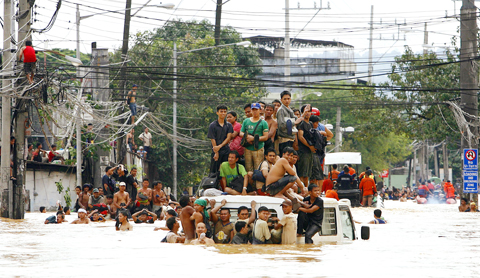
PHOTO: REUTERS
Ketsana roared across the northern Philippines on Saturday, dumping more than a month’s worth of rain in just 12 hours. The resulting landslides and flooding have left at least 83 people dead and 23 others missing, Philippine Defense Secretary Gilbert Teodoro said.
Many parts of the capital remained flooded yesterday, although waters were fast receding.
TV footage shot from military helicopter showed drenched survivors still marooned on top of half-submerged passenger buses and rooftops in the suburbs of Manila. Some dangerously clung on high-voltage power lines while others plodded through waist-high flood waters.
Authorities deployed rescue teams on boats to save survivors sighted during the aerial check.
More than 330,000 people were affected by the storm, including some 59,000 people who were brought to about 100 schools, churches and other evacuation shelters, officials said.
The “state of calamity” declaration allowed officials to utilize emergency funds for relief and rescue.
Teodoro said that so far, army troops, police and civilian volunteers have rescued more than 5,100 people.
Many residents lost all their belongings in the storm, but were thankful they were alive.
“We’re back to zero,” Marikina resident Ronald Manlangit said.
Still he expressed relief that he managed to move all his children to the second floor of his house on Saturday as floodwaters engulfed the ground floor.
Mud covered everything — cars, the road and vegetables in a public market near Manlangit’s house.
Governor Joselito Mendoza of Bulacan Province, north of the capital, said it was tragic that “people drowned in their own houses” as the storm raged.
The most recently reported fatalities included nine people in Bulacan, most of them drowned. A landslide in northern Pampanga Province killed 12 villagers. An army soldier and four militiamen drowned while trying to rescue villagers in southern Laguna Province.
In the city of Marikina near Manila, a rescuer gingerly lifted the mud-covered body of a child from a boat. Rescuers carried away four other bodies, including that of a woman found in a church, after a search in a flooded neighborhood.
Distress calls and e-mails from thousands of residents in metropolitan Manila and their worried relatives flooded TV and radio stations overnight. Ketsana swamped entire towns, set off landslides and shut down Manila’s airport for several hours.
“My son is sick and alone. He has no food and he may be waiting on the roof of his house. Please get somebody to save him,” a weeping housewife, Mary Coloma, told radio DZBB.
The sun shone briefly in Manila yesterday and showed the extent of devastation in many neighborhoods — destroyed houses, overturned vans and cars, and streets and highways covered in debris and mud.
The 42.4cm of rain that swamped metropolitan Manila in just 12 hours on Saturday exceeded the 39.2cm average for the entire month, chief government weather forecaster Nathaniel Cruz said, adding that the rainfall broke the previous record of 33.4cm in a 24-hour period in June 1967.

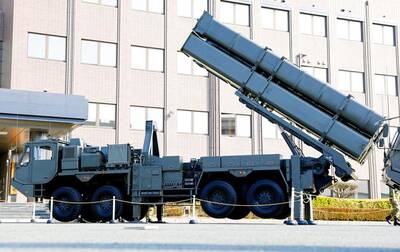
Japan has deployed long-range missiles in a southwestern region near China, the Japanese defense minister said yesterday, at a time when ties with Beijing are at their lowest in recent years. The missiles were installed in Kumamoto in the southern region of Kyushu, as Japan is attempting to shore up its military capacity as China steps up naval activity in the East China Sea. “Standoff defense capabilities enable us to counter the threat of enemy forces attempting to invade our country ... while ensuring the safety of our personnel,” Japanese Minister of Defense Shinjiro Koizumi said. “This is an extremely important initiative for

MORE POPULAR: Taiwan Pass sales increased by 59 percent during the first quarter compared with the same period last year, the Tourism Administration said The Tourism Administration yesterday said that it has streamlined the Taiwan Pass, with two versions available for purchase beginning today. The tourism agency has made the pass available to international tourists since 2024, allowing them to access the high-speed rail, Taiwan Railway Corp services, four MRT systems and four Taiwan Tourist Shuttles. Previously, five types of Taiwan Pass were available, but some tourists have said that the offerings were too complicated. The agency said only two types of Taiwan Pass would be available, starting from a three-day pass with the high-speed rail and a three-day pass with Taiwan Railway Corp. The former costs NT$2,800

NEW LOW: The council in 2024 based predictions on a pessimistic estimate for the nation’s total fertility rate of 0.84, but last year that rate was 0.69, 17 percent lower An expected National Development Council (NDC) report expects the nation’s population to drop below 12 million by 2065, with the old-age dependency ratio to top 100 percent sooner than 2070, sources said yesterday. The council is slated to release its latest population projections in August, using an ultra-low fertility model, the sources said. The previous report projected that Taiwan’s population would fall to 14.37 million by 2070, but based on a new estimate of the total fertility rate (TFR) — the average number of children born to a woman over her lifetime — the population is expected to reach 12 million by

COUNTERING HOSTILITY: The draft bill would require the US to increase diplomatic pressure on China and would impose sanctions on those who sabotage undersea cable networks US lawmakers on Thursday introduced a bipartisan bill to bolster the resilience of Taiwan’s submarine cables to counter China’s hostile activities. The proposal, titled the critical undersea infrastructure resilience initiative act, was cosponsored by Republican representatives Mike Lawler and Greg Stanton, and Democratic Representative Dave Min. US Senators John Curtis and Jacky Rosen also introduced a companion bill in the US Senate, which has passed markup at the chamber’s Committee on Foreign Relations. The House’s version of the bill would prioritize the deployment of sensors to detect disruptions or potential sabotage in real-time and enhance early warning capabilities through global intelligence sharing frameworks,


 RSS
RSS