


Taiwan was successful at the Deaflympics yesterday, winning three gold, three silver and three bronze medals.
Taiwan’s overall tally of 14 medals put it in second place in the overall standings behind Russia.
Kuo Chia-mi (郭嘉秘) won the first of yesterday’s gold medals, finishing the women’s sprint orienteering course in 17:22 minutes.
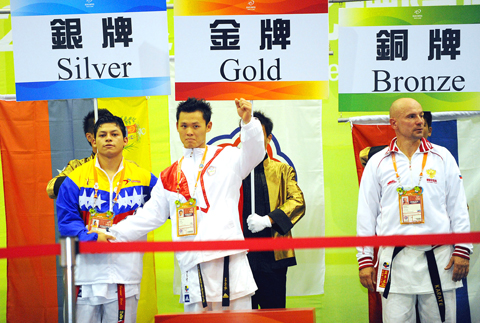
PHOTO: CNA
The all-around athlete will participate in three events in the games — orienteering, basketball and shot put.
The 30-year-old was the silver medalist in the 1997 Copenhagen Deaf World Games in the hammer throw and took home a bronze in the 2001 Rome Deaflympics.
Four years later in the Melbourne games, a back injury prevented Kuo from making her way into the top three.
“I want to dedicate the medal to my mother. I couldn’t say goodbye to her when she passed away this April because I was competing in Thailand, so this is for her,” said a teary Kuo, who recently landed a job as a sanitation worker in Taipei.
Teammate Yin Lun-hung (鄞綸宏) bagged a silver in the men’s sprint orienteering with a time of 14:46 minutes.
Taiwan also shone in karate, winning a gold in the men’s under-84kg category and a silver in the women’s under-68kg category.
Thirty-year old Lu Ching-feng (呂清峰), who advanced into the final match after knocking out Italy’s Manuel Tocchini, had wobbled off the floor after getting hit in the groin.
The blow, however, earned him two points and gave him the 9:3 victory.
The gold was secured even before going into his final match as the other semifinalists were disqualified.
Venezuelan Yorman Vega Parra was disqualified after being down for more than 10 seconds in his round against Russian Alekseev Ivanovich, but he was already ahead enough to win the silver medal.
“It is very regrettable that I did not get a chance to go against him [Vega],” said Lu, setting his eye on winning another gold in the 2013 games in Athens.
Sharing his disappointment, his coach Chuang Yu-hao (莊育豪) said after studying Vega in past matches, he felt Vega’s strength was mediocre at best and Lu could have easily taken him out.
Meanwhile, Taiwan nabbed a surprise silver in the women’s under-68kg category when Lin Wen-fang (林文芳) lost to Japan’s Saya Kurimoto in 1:30 minutes.
Lin started her final match with aggressive offense but was quickly beaten by her opponent when she failed to dodge several head punches delivered by Kurimoto, a newcomer to the sport.
The match was her final competition because of her age, Lin said.
Female bowler Chang Yao-chien (張堯茜) claimed the third gold in women’s singles with a 1,134 overall score.
Teammate Lin Hsiang-tzu (林香孜) took home the bronze.
The bronze in men’s judo under- 60kg category went to Hsu Wei-lun (徐偉倫) after he took out Adalberto Silva from Brazil using an over the shoulder throw.
The country’s top pole vaulter, An Ching-lung, (安慶隆) capped the night with another silver for his 4.55m vault.
“I am very grateful for my coach. My only goal tonight was to raise my own record [4.22m] and I am happy I did it, ” An said.
He won the men’s decathlon in the 2001 games in Rome and will attempt to repeat history on Friday.
Also bringing home a medal was Yan Kuo-cheng, who took bronze in the men’s under-80kg taekwondo category.
In other action, the men’s basketball team advanced to the final eight after flattening Hong Kong 99-39. Center Chen Wei-yu’s (陳威宇) multiple three-pointers were a major boost to the team’s morale, earning them a 46-17 lead by half time.
The men’s group table tennis will also play in the final four after beating Germany 3-1. The team will face Japan this morning.
Beating their French opponents Sophie Benard and Valerie Caillaud 6-3 and 6-2, the Ho Chiu-mei (何秋美) and Ho Chiu-hsiang (何秋香) sister combo clinched a place in the final four. They will face Reiki Kajishita and Tetsuya Matsushita today.
In related news, South Korean marksman Kim Tae-young broke the world record in the men’s 10m air pistol with a total score of 673.7.
US pole vaulter Joseph Southern won the men’s gold with a jump of 4.8m, breaking the games record at 4.78m.
Also See: DEAFLYMPIC TAIPEI 2009: Athletes to enjoy Taiwan’s cuisine
Also See: DEAFLYMPIC TAIPEI 2009: Taiwan athletes enjoy mixed fortunes

The National Chungshan Institute of Science and Technology yesterday showcased its locally developed variants of the Vision 60 robotic patrol dog, which it plans to deploy on the nation’s outlying territories in the South China Sea. The variants were produced under the Joint Lab project — created by the institute and domestic companies — and assembled with domestically produced motors, lenses and artificial intelligence (AI) systems alongside licensed tech from the US, Missile and Rocket Systems Research Division deputy director Jen Kuo-kang (任國光) told the media event at a military base in Taipei’s Dazhi (大直) area. Taiwan has built up its strengths

RIGHT DIRECTION: Taiwan’s efforts to prevent forced labor include a proposal to ‘fully prohibit’ employers from withholding workers’ documents, an official said Taiwan is to establish a mechanism to restrict imports of goods linked to forced labor, the Executive Yuan said yesterday, after the US proposed imposing additional tariffs on Taiwanese goods over labor concerns. “The Ministry of Labor and the Ministry of Economic Affairs are to establish an interministerial review procedure,” Executive Yuan spokesperson Michelle Lee (李慧芝) said at a news briefing in Taipei. “The government is to use the Foreign Trade Act [貿易法] as the legal basis to restrict imports of goods produced with forced labor” and bring its supply chain governance more in line with international standards on human rights, resilience
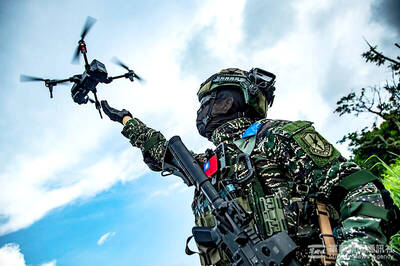
RESILIENCE: Taiwan plays a key role in semiconductors, energy, information infrastructure and advanced manufacturing, AIT Director Raymond Greene said Taiwan’s continued investment in deterrence and resilience remains vital, especially in uncrewed systems and other emerging technologies, American Institute in Taiwan (AIT) Director Raymond Greene said yesterday. Greene made the remarks at the annual National Strategic Summit on Supply Chain Resilience held by the Research Institute for Democracy, Society and Emerging Technology (DSET), a government-backed think tank. As Taiwan last year became the US’ fourth-largest trading partner and supply chain security is becoming more important, cooperation in emerging technologies continues to deepen between the two countries, he said. The US is committed to accelerating innovation, building key infrastructure, strengthening cooperation

NOT IMMEDIATE: Taiwan has a chance to appeal the proposed 10 percent tariff before it starts, while other countries face a 12.5 percent tariff from the trade office Taiwan is among 60 economies determined by the US to have failed to impose or enforce a ban on the importation of goods produced with forced labor, according to a notice released on Tuesday by the Office of the US Trade Representative (USTR), which proposed imposing an additional 10 percent or more tariff on them. The USTR in a statement said that following an investigation, it had determined under Section 301 of the Trade Act of 1974 that the failure of the 60 economies to impose and effectively enforce a prohibition on the importation of goods produced with forced labor is


 RSS
RSS