


Starting today, all marriage brokerage firms that deal with international marriages will be outlawed, the National Immigration Agency (NIA) announced yesterday, saying that the ban is part of the government’s efforts to cut down on fraudulent marriages.
The new regulations are part of a raft of amendments to the Immigration Act (出入國及移民法) enacted on Aug. 1 last year. At the time, the government offered a one-year grace period for cross-border matchmaking companies to adjust their business operations to meet new legal requirements. The one-year grace period expired yesterday.
All Taiwanese hoping to marry a foreign spouse must now go through non-profit organizations that have been approved by the NIA, said Lin Chen-chih (林振智), an NIA immigration planning division chief.
Such organizations will only collect necessary fees, such as airfare and hotel bills, and will not demand any brokering charges.
Companies found violating the ban will be fined between NT$200,000 and NT$1 million (US$6,050 to US$30,500).
Lin said the ban was designed to eliminate the practice of Taiwanese men traveling abroad, mostly to southeast Asian countries, for blind dates and on-the-spot weddings.
Taiwanese companies place ads in newspapers and on TV to take Taiwanese men on tours to Asian nations — mostly Vietnam, Cambodia, Indonesia and China — to select brides.
Some cross-border matchmakers allowed their local customers to pick their partners on TV before they go abroad to meet them, Lin said.
In some cases, the foreign brides pay a large sum of money to local brokers to marry a Taiwanese man, work in Taiwan and send money home. Some southeast Asian and Chinese women have entered Taiwan through fake marriages to work as prostitutes.
“Those spendthrift acts have caused criticism from human rights activists and undermined our national image,” Lin said.
Lin said that people who hope to find a foreign spouse can approach NIA-certified public interest organizations or foundations for matchmaking services.
At present, there are 11 NIA-accredited public interest organizations that are eligible to operate matchmaking services. Information about them is available on the NIA’s Web site.
The number of foreign brides arriving in Taiwan has increased dramatically in recent years.
The NIA said 421,475 foreign spouses — mainly brides — entered Taiwan in the first half of the year, up from 413,421 for all of last year.
In the first half of the year, a total of 268,304 Chinese spouses — mainly brides — entered Taiwan, up from 262,701 for the whole of last year.
ADDITIONAL REPORTING BY JENNY W. HSU

DRONE CENTRAL: Taiwan aims to become Asia’s democratic hub for drones, with most exports focused on high-quality military-grade models, an official said Taiwan’s drone industry is expected to expand significantly by 2030, producing 100,000 units per month and exporting half of them, the Ministry of Economic Affairs said yesterday. Current drone production capacity is about 15,000 units per month, but the industry can quickly scale up as demand increases, Industrial Development Administration Director-General Chiou Chyou-huey (邱求慧) told a news conference in Taipei. Taiwan’s drone output grew 2.5-fold last year to NT$12.9 billion (US$408.3 million) under a government program to develop the uncrewed vehicle sector, he said. The Executive Yuan in October last year approved plans to invest NT$44.2 billion into domestic production of uncrewed aerial
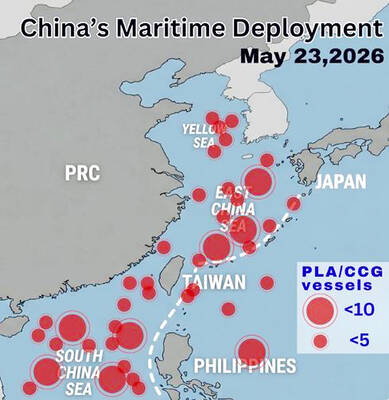
WARNING: China should stop engaging in actions that undermine regional peace and stability, as it would only build resentment among people across the Strait, the CGA said China has deployed more than 100 navy, coast guard and other vessels in waters from the Yellow Sea to the South China Sea and the western Pacific since US President Donald Trump and Chinese President Xi Jinping (習近平) met in Beijing, National Security Council Secretary-General Joseph Wu (吳釗燮) said yesterday. “In this part of the world, #China is the one & only PROBLEM wrecking the #StatusQuo & threatening regional peace & stability,” Wu wrote on X. In a separate post, he said Beijing was coercing Taiwan’s maritime domain, calling it illegal and provocative, after the Coast Guard Administration (CGA) expelled a

VERBOSE VESSELS: A CGA cutter and a China Coast Guard exchanged verbal barbs for more than a day in Taiwanese-controlled waters before the Chinese vessel left The Taiwanese and Chinese coast guards had a standoff near the strategically located Pratas Islands (Dongsha Islands, 東沙群島) in the north of the South China Sea, the Coast Guard Administration (CGA) said yesterday. The two sides engaged in intense radio exchanges over sovereignty claims during the 33-hour standoff. China Coast Guard vessel 3501 eventually left the restricted waters, 26.6 nautical miles (49.2km) west of the Pratas Islands, at 5pm yesterday, the CGA said. Lying approximately between southern Taiwan and Hong Kong, the Taiwan-controlled Pratas are seen by some security experts as vulnerable to Chinese attack due to their distance — more than

More than 8,000 people took part in a rally in Taipei yesterday to express support for more defense spending, after the opposition slashed the Cabinet’s proposed NT$1.25 trillion (US$39.6 billion) special defense budget and capped it at NT$780 billion. The demonstrators urged the Cabinet to propose another bill. Taiwan Economic Democracy Union convener Lai Chung-chiang (賴中強) said the main problem of the passed budget plan is the removal of funding for critical items, not just that the total amount is smaller. Critical budget items included purchasing or developing uncrewed vehicles, Strong Bow (強弓) missile systems, additional ammunition, artificial intelligence-powered combat systems and Taiwan-US


 RSS
RSS