


The Constitutional Court yesterday ruled that amendments to the Constitutional Court Procedure Act (憲法訴訟法) passed by the Legislative Yuan last year are unconstitutional, as they contravene due legislative process and separation of powers.
The Legislative Yuan on Dec. 20 last year passed amendments stipulating that no fewer than 10 grand justices must take part in deliberations of the Constitutional Court, and at least nine grand justices must agree to declare a law unconstitutional.
The Executive Yuan on Jan. 2 requested that lawmakers reconsider the bill, but the Legislative Yuan, under a combined majority of Chinese Nationalist Party (KMT) and Taiwan People’s Party (TPP) legislators, rejected the motion.
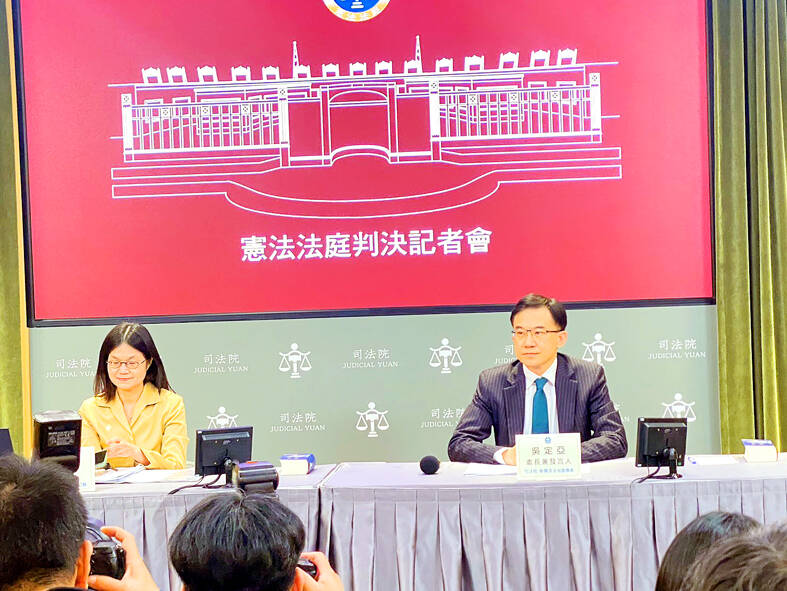
Photo: Yang Hsin-hui, Taipei Times
The Democratic Progressive Party (DPP) caucus then filed for a constitutional interpretation of the bill, and the court accepted the case on May 14.
The Constitution stipulates that the Constitutional Court shall have 15 grand justices. The terms of seven grand justices ended on Oct. 31 last year, but opposition lawmakers in July rejected all of President William Lai’s (賴清德) grand justice nominees.
Lai has not nominated a new set of nominees since.
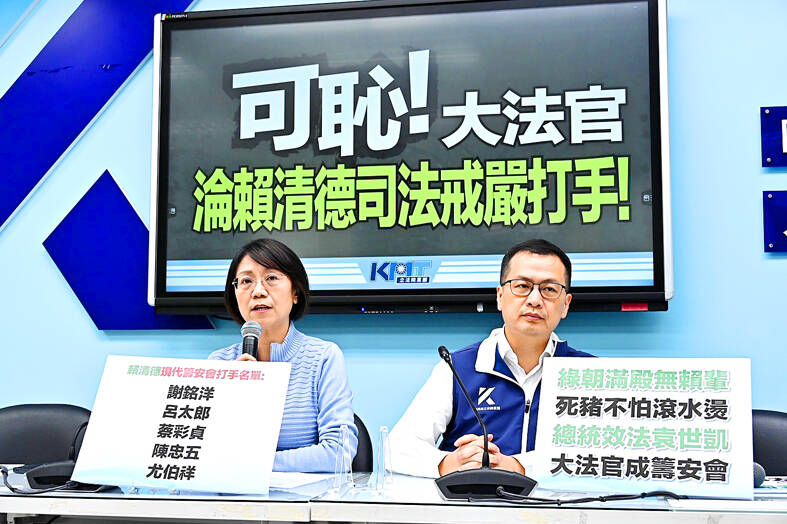
Photo: Tu Chien-jung, Taipei Times
Five of the remaining grand justices ruled the bill unconstitutional, handing down the Court’s first judgement this year.
The bill’s legislative process contained clear and serious procedural flaws, contravening the Constitution’s requirements of due legislative process, and breaks the principle of separation of powers.
The other three justices said the judgement is invalid, as amendments promulgated in January stipulate that the Court must have 10 grand justices to deliberate.
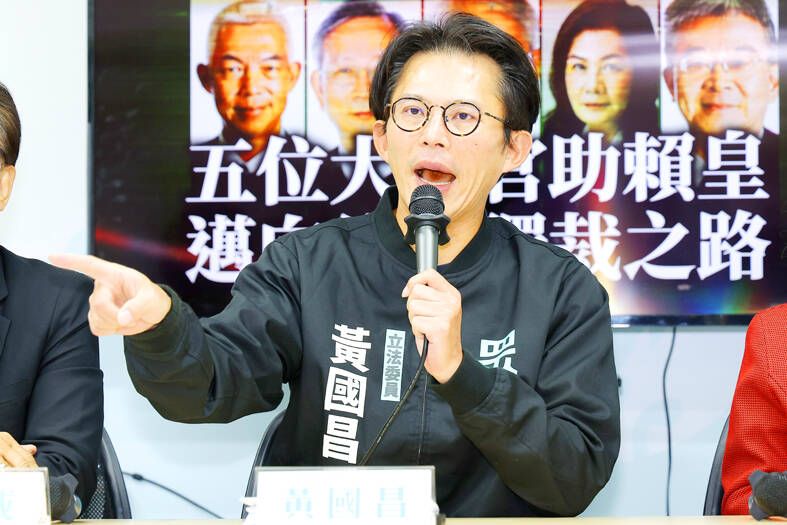
Photo: CNA
DPP caucus chief executive Chung Chia-pin (鍾佳濱) said it is gratifying that citizens’ constitutional rights would have protection again, now that the Constitutional Court could return to functioning properly.
“Its rulings are above partisan party politics, and can curtail the authority of the Executive Branch,” DPP deputy chief executive Fan Yun (范雲) said. “It is the last line of defense for Taiwan democracy.”
The KMT slammed the Constitutional Court for convening a session despite having only eight grand justices, saying it contravened the law.
“This has buried the independence of our judiciary,” it said, adding the that the Court aimed “to clear obstacles for Lai to realize a ‘green dictatorship’ where executive, legislative and judicial powers are consolidated.”
According to the revised and the original version of the constitutional litigation law, at least six justices are required to convene a session, the KMT said.
“The Constitutional Court session was therefore held illegally, and the ruling is, of course, illegal,” it added.
TPP Chairman Huang Kuo-chang (黃國昌) said the ruling effectively aligned with Lai, fostering the development of a “green dictatorship.”
As three of the grand judges did not participate in the court hearings and instead submitted legal opinions outside the court, rather than issuing dissenting opinions within the ruling, “this highlights the illegality of the Constitutional Court’s composition,” he said.
Additional reporting by Jason Pan and Shih Hsiao-kuan
NETWORK-MAPPING PROJECT: The database contains 170 detailed files of Taiwanese politicians and about 23 million records of household registration data in Taiwan China has developed a network-mapping project targeting political figures and parties in Taiwan to monitor public opinion during elections and to craft tailored influence campaigns aimed at dividing Taiwanese society, according to documents leaked by Chinese technology firm GoLaxy (中科天璣). The documents, collected by Taipei-based Doublethink Lab, showed a database was specifically created to gather detailed information on Taiwanese political figures, including their political affiliations, job histories, birthplaces, residences, education, religion and a brief biography about them. Several notable Taiwanese politicians are in the database, including President William Lai (賴清德), former president Tsai Ing-wen (蔡英文), Minister of Foreign Affairs Lin Chia-lung (林佳龍),
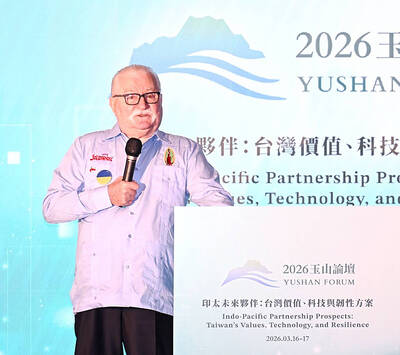
RECOGNITION: Former Fijian prime minister Mahendra Chaudhry said that Taiwan’s New Southbound Policy serves as a stabilizing force in the Indo-Pacific region Taiwan can lead the unification of the Chinese people, Nobel Peace Prize laureate and former Polish president Lech Walesa said in Taipei yesterday, adding that as the world order is changing, peaceful discussion would find good solutions, and that the use of force and coercion would always fail. Walesa made the remarks during his keynote address at a luncheon of the Yushan Forum in Taipei, titled “Indo-Pacific Partnership Prospects: Taiwan’s Values, Technology and Resilience,” organized by the Taiwan-Asia Exchange Foundation with the Ministry of Foreign Affairs. Walesa said that he had been at the forefront of a big peaceful revolution and “if
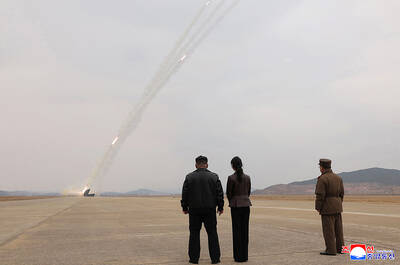
North Korea tested nuclear-capable rocket launchers, state media reported yesterday, a day after Seoul detected the launch of about 10 ballistic missiles. The test comes after South Korean and US forces launched their springtime military drills, due to run until Thursday. North Korean leader Kim Jong-un on Saturday oversaw the testing of the multiple rocket launcher system (MRLS), the Korean Central News Agency (KCNA) said. The test involved 12 600mm-caliber ultra-precision multiple rocket launchers and two artillery companies, it said. Kim said the drill gave Pyongyang’s enemies, within the 420km striking range, a sense of “uneasiness” and “a deep understanding

North Korea yesterday fired about 10 ballistic missiles to the sea toward Japan, the South Korean Joint Chiefs of Staff (JCS) said, days after Pyongyang warned of “terrible consequences” over ongoing South Korea-US military drills. Pyongyang recently dashed hopes of a diplomatic thaw with Seoul, Washington’s security ally, describing its latest peace efforts as a “clumsy, deceptive farce.” Seoul’s military detected “around 10 ballistic missiles launched from the Sunan area in North Korea toward the East Sea [Sea of Japan] at around 1:20pm,” JCS said in a statement, referring to South Korea’s name for the body of water. The missiles


 RSS
RSS