


The Tainan branch of the Taiwan High Court yesterday annulled the election victory of Chinese Nationalist Party (KMT) legislator Chang Sho-wen (張碩文).
The ruling is final. Chang may not appeal.
Chang won a regional legislative seat in Yunlin County in January last year, but his defeated opponent, Liu Chien-kuo (劉建國) of the Democratic Progressive Party, accused him of vote-buying and filed a lawsuit seeking to invalidate the election result.
After the Yunlin District Court annulled his election victory in November last year, Chang appealed the case to the Taiwan High Court.
The High Court’s ruling upheld the Yunlin District Court’s ruling to annul the election result, and confirms that Chang was aware of and had taken part in a vote-buying scheme organized by his father, Chang Hui-yuan (張輝元), the head of a local irrigation association, to solicit votes by offering cash bribes to voters.
Democratic Progressive Party (DPP) spokesman Cheng Wen-tsang (鄭文燦) said that the party would choose a candidate for the by-election in Yunlin within a week, adding that the party was confident of winning the legislative seat.
Cheng said that former KMT legislator Lee E-tin (李乙廷) from Miaoli County and Chang had both lost their seats because of vote-buying charges, and some KMT legislators’ vote-buying lawsuits were still pending in court.
He said the party asked that the courts rule on those cases soon and not delay them until the legislators in question had completed their terms.
Cheng criticized the KMT legislators for winning elections by bribing voters. Meanwhile, Yunlin County Deputy Commissioner Lee Ying-yuan (李應元), a DPP member, yesterday announced he was quitting his post to enter the race.
Chang issued a text message last night, saying that he had kept a low profile during the trial because he did not want to interfere in the judicial process, unlike his rivals.
Chang said he regretted the verdict but that he still believed in the judiciary.
He said that he felt wronged and could not agree with the court’s decision.
“Today marks a new beginning in my life. I will never give up,” he said.
ADDITIONAL REPORTING BY FLORA WANG
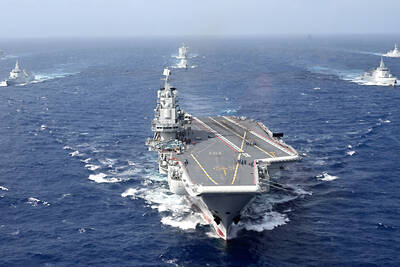
PROVOCATIVE: Chinese Deputy Ambassador to the UN Sun Lei accused Japan of sending military vessels to deliberately provoke tensions in the Taiwan Strait China denounced remarks by Japan and the EU about the South China Sea at a UN Security Council meeting on Monday, and accused Tokyo of provocative behavior in the Taiwan Strait and planning military expansion. Ayano Kunimitsu, a Japanese vice foreign minister, told the Council meeting on maritime security that Tokyo was seriously concerned about the situation in the East China and South China seas, and reiterated Japan’s opposition to any attempt to change the “status quo” by force, and obstruction of freedom of navigation and overflight. Stavros Lambrinidis, head of the EU delegation to the UN, also highlighted South China Sea
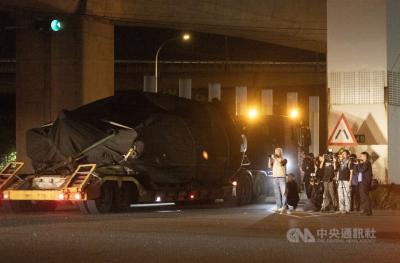
The final batch of 28 M1A2T Abrams tanks purchased from the US arrived at Taipei Port last night and were transported to the Armor Training Command in Hsinchu County’s Hukou Township (湖口), completing the military’s multi-year procurement of 108 of the tanks. Starting at 12:10am today, reporters observed more than a dozen civilian flatbed trailers departing from Taipei Port, each carrying an M1A2T tank covered with black waterproof tarps. Escorted by military vehicles, the convoy traveled via the West Coast Expressway to the Armor Training Command, with police implementing traffic control. The army operates about 1,000 tanks, including CM-11 Brave Tiger
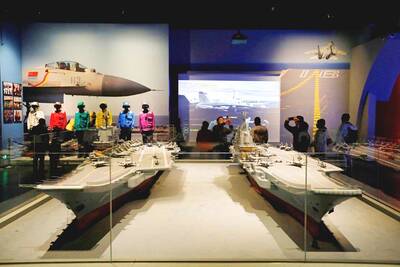
China on Wednesday teased in a video an aircraft carrier that could be its fourth, and the first using nuclear power, while making an allusion to Taiwan and vowing to further build up its islands, as it looks to boost maritime power, secure resources and bolster territorial claims. The video, issued on the eve of the 77th founding anniversary of the Chinese People’s Liberation Army Navy, featured fictional officers with names that are homophones of three commissioned aircraft carriers, the Liaoning (遼寧), Shandong (山東) and Fujian (福建). Titled Into the Deep, it showed a 19-year-old named “Hejian” (何劍) joining the group, sparking
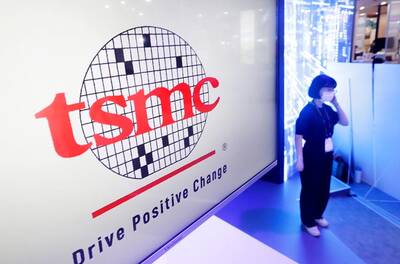
BIG YEAR: The company said it would also release its A12 chip the same year to keep a ‘reliable stream of new silicon technologies’ flowing to its customers Taiwan Semiconductor Manufacturing Co (TSMC, 台積電) yesterday said its newest A13 chip is to enter volume production in 2029 as the chipmaker seeks to hold onto its tech leadership and demand for next-generation chips used in artificial intelligence (AI), high-performance-computing (HPC) and mobile applications. TSMC, the world’s biggest contract chipmaker, also unveiled its A12 chip at its annual technology symposium in Santa Clara, California. The A12 chip, which features TSMC’s super-power-rail technology to provide backside power delivery for AI and HPC applications, is also to enter volume production in 2029, a year after the scheduled release of the A14 chip. The technology moves


 RSS
RSS