


The Taiwan High Court yesterday ordered the Taipei District Court to reconsider its Dec. 18 decision to release former president Chen Shui-bian (陳水扁) pending trial on corruption and money laundering charges. Following the ruling, a hearing will be held this afternoon to decide whether or not Chen will be detained.
The high court made the order at 1:50am yesterday following an appeal filed by the Supreme Prosecutors Office’s Special Investigation Panel (SIP) on Thursday against the Taiwan District Court’s previous decision to release Chen.
High court spokesman Wen Yao-yuan (溫耀源) told reporters that the decision by the lower district court was “a violation of justice. Therefore the high court decided to retract the ruling.”
“The Taipei District Court’s ruling disregarded evidence provided by the prosecutors who warned that the defendant could collude with other suspects and flee the country,” Wen said.
In the appeal presented to the Taiwan High Court, the prosecutors said they would soon begin investigating several other corruption cases allegedly involving Chen and his wife Wu Shu-jen (吳淑珍), and that if he were allowed to remain free, some of the witnesses, including three of his former close aides, might withold information.
It was the second time the SIP succeeded in having the Taiwan High Court throw out the Taipei District Court’s decision. The first time was when the SIP filed an appeal with the high court on Dec. 17 in which the latter ordered the district court to reconsider the release. The district court upheld its decision in its second ruling on Dec. 18, which led to the SIP’s second appeal on Thursday.
Chen was detained on Nov. 12 and indicted on Dec. 12 on charges of embezzling government funds, money laundering and forgery related to four cases along with 13 others, including his wife, son and daughter-in-law.
Chen has repeatedly said the charges against him were politically motivated, accusing the China-friendly government of his successor, President Ma Ying-jeou (馬英九), of leading a witchhunt.
SIP spokesman Chen Yun-nan (陳雲南) told reporters yesterday that “the SIP appreciated the high court’s ruling and prosecutors were working hard for tomorrow’s [today] hearing.”
Chinese Nationalist Party (KMT) Legislator Lee Ching-hua (李慶華) yesterday said the fact that the high court overruled the district court’s previous decision to release Chen without bail while asking it to reconsider its decision “is a slap in the face to [Presiding] Judge Chou Chan-chun (周占春) because the high court rebutted every reason why Chou believed the former president should be freed.”
KMT caucus secretary-general Chang Sho-wen (張碩文) urged the district court “to carefully assign” another judge to preside over Chen’s trials so that the public would not question the impartiality of the court.
Tsai Shou-hsun(蔡守訓)was voted to replace Presiding Judge Chou to handle Chen-related cases during a meeting held among the district court’s presiding judges on Thursday night, citing that Tsai had previously handled cases concerning Chen.
As a result, today’s hearing will be presided over by Tsai not Chou.
ADDITIONAL REPORTING BY FLORA WANG AND CNA

A signaling system malfunction disrupted high-speed rail (HSR) services beginning at 8am today, with trains temporarily reduced to three northbound and three southbound trains per hour as authorities conduct inspections. The malfunction occurred on a section of track in Miaoli County during pre-operation checks early this morning, forcing northbound and southbound trains to use a single track, the HSR operator said. The regular schedule has been replaced with three hourly trains offering only nonreserved seating in each direction, stopping at every station, it said, adding that business class cars would still have reserved seating. Departures from terminal stations are scheduled at the top

DRONE CENTRAL: Taiwan aims to become Asia’s democratic hub for drones, with most exports focused on high-quality military-grade models, an official said Taiwan’s drone industry is expected to expand significantly by 2030, producing 100,000 units per month and exporting half of them, the Ministry of Economic Affairs said yesterday. Current drone production capacity is about 15,000 units per month, but the industry can quickly scale up as demand increases, Industrial Development Administration Director-General Chiou Chyou-huey (邱求慧) told a news conference in Taipei. Taiwan’s drone output grew 2.5-fold last year to NT$12.9 billion (US$408.3 million) under a government program to develop the uncrewed vehicle sector, he said. The Executive Yuan in October last year approved plans to invest NT$44.2 billion into domestic production of uncrewed aerial

VERBOSE VESSELS: A CGA cutter and a China Coast Guard exchanged verbal barbs for more than a day in Taiwanese-controlled waters before the Chinese vessel left The Taiwanese and Chinese coast guards had a standoff near the strategically located Pratas Islands (Dongsha Islands, 東沙群島) in the north of the South China Sea, the Coast Guard Administration (CGA) said yesterday. The two sides engaged in intense radio exchanges over sovereignty claims during the 33-hour standoff. China Coast Guard vessel 3501 eventually left the restricted waters, 26.6 nautical miles (49.2km) west of the Pratas Islands, at 5pm yesterday, the CGA said. Lying approximately between southern Taiwan and Hong Kong, the Taiwan-controlled Pratas are seen by some security experts as vulnerable to Chinese attack due to their distance — more than
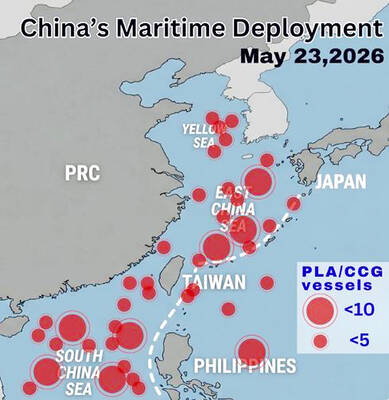
WARNING: China should stop engaging in actions that undermine regional peace and stability, as it would only build resentment among people across the Strait, the CGA said China has deployed more than 100 navy, coast guard and other vessels in waters from the Yellow Sea to the South China Sea and the western Pacific since US President Donald Trump and Chinese President Xi Jinping (習近平) met in Beijing, National Security Council Secretary-General Joseph Wu (吳釗燮) said yesterday. “In this part of the world, #China is the one & only PROBLEM wrecking the #StatusQuo & threatening regional peace & stability,” Wu wrote on X. In a separate post, he said Beijing was coercing Taiwan’s maritime domain, calling it illegal and provocative, after the Coast Guard Administration (CGA) expelled a


 RSS
RSS