


“We want human rights!” chanted students at National Taiwan Democracy Memorial Hall as they continued their sit-in for a third day, demanding an apology from the government over what they called the “rough” tactics used by police to deal with protesters during the visit by China’s Association for Relations Across the Taiwan Strait Chaiman Chen Yunlin (陳雲林) last week.
Despite the poor weather yesterday, more than 100 students wore simple raincoats and remained sitting in protest in the Taipei rain.
The first two days of the sit-in protest saw hot, humid weather. Yesterday, downpours began at around 10am.
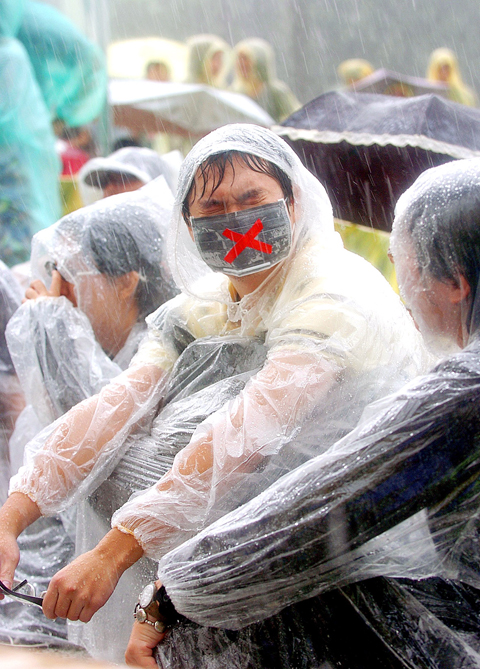
PHOTO: LO PEI-DER, TAIPEI TIMES
“The first trials of the weather have started, but despite our efforts, no one has stepped up to respond to our demands,” Hsu Ching-fang (許菁芳), president of the National Taiwan University Student Association, said to the crowd of students in the rain.
About 400 students, led by assistant professor of sociology at National Taiwan University Lee Ming-tsung (李明璁), started the sit-in in front of the Executive Yuan on Thursday at noon. The students believe that police, while protecting the safety of Chen and his delegation, acted improperly and that freedom of speech had been suppressed.
The student demonstrators were forcibly evicted by police from the front gate of the Executive Yuan on Friday night because they had not applied to conduct a protest there.
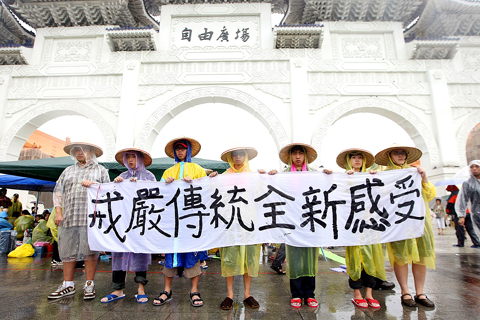
PHOTO: CNA
The students linked their arms together and refused to leave. Police had to take them away to nearby police vehicles, and then drove them to National Taiwan University.
Some students later reconvened in Liberty Square at National Taiwan Democracy Memorial Hall to continue the sit-in.
“Police officers have engaged in numerous abusive acts against peaceful protesters from various dissenting groups, under the guise of ‘keeping the peace,’” read an English statement issued by the students. “These acts have included arbitrary searches and prohibitions, seizure and destruction of property, physical assault, dispersion, and even arrest and detention.”
“Through reports in the media, we have come to realize the seriousness of the current situation. It is no longer a technical question of excessive law enforcement tactics, nor is it simply a partisan issue between supporters of various political parties. This is a proliferation of state-sponsored violence that is provoking and attacking civil society. All these oppressive acts, which ignore human rights and democratic values, are reminiscent of martial law,” the statement said.
The students yesterday insisted that they would continue with the sit-in protest until their three appeals were met: an open apology from President Ma Ying-jeou (馬英九) and Premier Liu Chao-shiuan (劉兆玄) to all citizens, the resignations of National Police Agency Director-General Wang Cho-chiun (王卓鈞) and National Security Bureau Director Tsai Chaoming (蔡朝明) and the swift amendment of the Assembly and Parade Law (集會遊行法).
Some observers compared the sit-in to the Wild Lily Student Movement (野百合學運) of 1990, which started as a student movement that eventually drew hundreds of thousands calling for political reforms, including the abolition of the National Assembly.
The protest this time not only brought students from different schools to the sit-in, but also redefined social movements as the students used the Internet to promote their appeal.
They have launched Internet petitions and set up live streaming videos with audiences all over Taiwan and in the US, Japan, Holland and Germany.
TAKE TURNS
The students have taken turns hosting the event in various languages. They also opened lines for call-ins during the night.
Sitting with the students, Lee said: “Taiwan’s youth still care about public issues, only nowadays, they are using new channels to voice their concerns.”
The Taipei City Government yesterday urged the student demonstrators to complete the legal processes for holding the protest.
Yang Hsiao-tung (羊曉東), the city government’s spokesman, said the sit-in protest, which was organized by students and has continued for more than one day, was an illegal demonstration.
He urged the students to apply with the city government for a rally permit to turn the sit-in into a legal protest.
“As the illegal protests during the past week have caused social instability, we urge the students to follow the law and apply for rally permits to prevent unnecessary confrontations between the police and protesters,” he said at Taipei City Hall.
Yang said the city government would grant the students a rally permit if they filed applications according to regulations.
Meanwhile, the Democratic Progressive Party yesterday lent support to the students, and urged Ma to deliver on his campaign promise to change the Assembly and Parade Law so that notification would be enough to stage a protest rather than having to apply first with authorities.
ADDITIONAL REPORTING BY MO YAN-CHIH, JIMMY CHUANG AND CNA
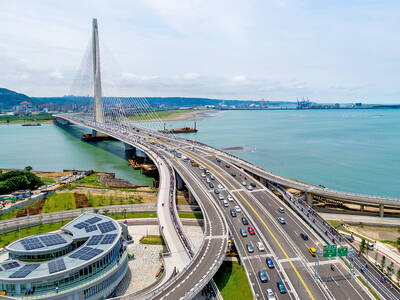
The Ministry of Transportation and Communications yesterday inaugurated the Danjiang Bridge across the Tamsui River in New Taipei City, saying that the structure would be an architectural icon and traffic artery for Taiwan. Feted as a major engineering achievement, the Danjiang Bridge is 920m long, 211m tall at the top of its pylon, and is the longest single-pylon asymmetric cable-stayed bridge in the world, the government’s Web site for the structure said. It was designed by late Iraqi-British architect Zaha Hadid. The structure, with a maximum deck of 70m, accommodates road and light rail traffic, and affords a 200m navigation channel for boats,
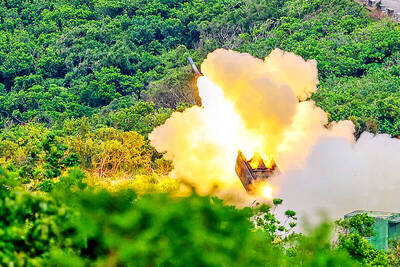
PRECISION STRIKES: The most significant reason to deploy HIMARS to outlying islands is to establish a ‘dead zone’ that the PLA would not dare enter, a source said A High Mobility Artillery Rocket System (HIMARS) would be deployed to Penghu County and Dongyin Island (東引) in Lienchiang County (Matsu) to force the Chinese military to retreat at least 100km from the coastline, a military source said yesterday. Taiwan has been procuring HIMARS and Army Tactical Missile Systems (ATACMS) from the US in batches. Once all batches have been delivered, Taiwan would possess 111 HIMARS units and 504 ATACMS, which have a range of 300km. Considering that “offense is the best defense,” the military plans to forward-deploy the systems to outlying islands such as Penghu and Dongyin so that

Taiwan Semiconductor Manufacturing Co (TSMC, 台積電), the world’s largest foundry service provider, yesterday said that global semiconductor revenue is projected to hit US$1.5 trillion in 2030, after the figure exceeds US$1 trillion this year, as artificial intelligence (AI) demand boosts consumption of token and compute power. “We are still at the beginning of the AI revolution, but we already see a significant impact across the whole semiconductor ecosystem,” TSMC deputy cochief operating officer Kevin Zhang (張曉強) said at the company’s annual technology symposium in Hsinchu City. “It is fair to say that in the past decade, smartphones and other mobile devices were

‘CLEAR MESSAGE’: The bill would set up an interagency ‘tiger team’ to review sanctions tools and other economic options to help deter any Chinese aggression toward Taiwan US Representative Young Kim has introduced a bill to deter Chinese aggression against Taiwan, calling for an interagency “tiger team” to preplan coordinated sanctions and economic measures in response to possible Chinese military or political action against Taiwan. “[Chinese President] Xi Jinping [習近平] has directed the People’s Liberation Army to be ready to invade Taiwan by 2027. China has a plan. America should have one too,” Kim said in a news release on Thursday last week. She introduced the “Deter PRC [People’s Republic of China] aggression against Taiwan act” to “ensure the US has a coordinated sanctions strategy ready should


 RSS
RSS