


Thailand's parliament chose a pugnacious ally of ousted prime minister Thaksin Shinawatra as the new prime minister yesterday, taking a key step toward restoring democracy that was left in tatters following the 2006 coup.
Samak Sundaravej, 72-year-old head of the People's Power Party, easily beat the Democrat Party candidate Abhisit Vejjajiva by 310 votes to 163. His six-party coalition will meet tomorrow to discuss the rest of the Cabinet lineup -- a process that could take two weeks.
The selection of a candidate so closely linked to Thaksin, however, risks further dividing a country that has struggled to regain its footing and economic clout since the coup.
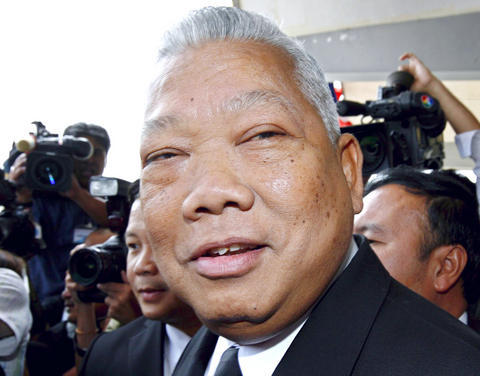
PHOTO: EPA
"It is likely to be a turbulent premiership ahead," Panithan Wattanayagorn, a political scientist at Bangkok's Chulalongkorn University, said of Samak's tenure.
"For many people, he doesn't have legitimacy to rule, given pending legal cases against him," Panithan said. "He is also seen as a nominee of Thaksin who is still very much prominent in Thai politics. Moreover, he has enemies on all sides because of his abrasive and divisive personality."
In the end, Samak benefited from his very public support of Thaksin. With a parliament dominated by pro-Thaksin lawmakers, Samak gambled correctly they would overlook his character flaws and be swayed by his promises to defend Thaksin should he return from self-imposed exile in May to face corruption charges.
"The appointment of Samak is mutually expedient for both Thaksin and himself," said Thitinan Pongsidhirak, a political scientist at Bangkok's Chulalongkorn University.
On the streets of Bangkok, some residents questioned the staying power of a politician facing so many legal problems and a record of making controversial statements.
Samak has appealed a two-year sentence for defaming a deputy Bangkok governor and is the subject of an ongoing corruption investigation stemming from the purchase of Austrian fire trucks and a waste management contract when he was Bangkok governor from 2001 to 2004.
"I don't like him. I don't like his history," said Thapanik Somburanakiat, 45, a drinks vendor. "The way he speaks, plus the scandals ... I don't want foreigners to look at Thailand in a bad way."
But others said they felt he was the right man for the job, someone who was willing to take on vested interests like the military and say what others were afraid to utter.
Bangkok-born and of Chinese descent, Samak began his own political career in 1968 when he joined the Democrat Party. With Bangkok as his power base, he has since held eight Cabinet posts and served more than 20 years as a member of parliament.
Early on, Samak established his trademarks -- a right wing ideology, a common touch which endeared him to the masses and penchant for speaking his mind.
He has called the press a hindrance to development and it was his vitriolic rhetoric on radio and at rallies which helped stoke anti-communist sentiment in 1976. That prompted mobs to storm a Bangkok university, killing and burning alive scores of leftist student activists.

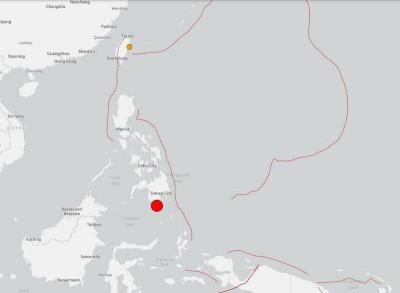
A magnitude 7.8 earthquake struck off the southern coast of Mindanao in the Philippines at 7:38am today, prompting the US Tsunami Warning System to issue an alert for neighboring countries, including Taiwan. The system issued a purple alert indicating a "tsunami threat." The potential threat zone includes Taiwan, the Philippines, Papua New Guinea, Yap and Palau. A spokesperson for Indonesia disaster mitigation agency said there were no reports of damage so far. Arlene Hollero, disaster chief of Maasim town in the Philippines' Sarangani Province, said their evacuation was underway in coastal villages and there were no reported casualties so far. DZBB radio, broadcasting from the

RESILIENCE: Taiwan plays a key role in semiconductors, energy, information infrastructure and advanced manufacturing, AIT Director Raymond Greene said Taiwan’s continued investment in deterrence and resilience remains vital, especially in uncrewed systems and other emerging technologies, American Institute in Taiwan (AIT) Director Raymond Greene said yesterday. Greene made the remarks at the annual National Strategic Summit on Supply Chain Resilience held by the Research Institute for Democracy, Society and Emerging Technology (DSET), a government-backed think tank. As Taiwan last year became the US’ fourth-largest trading partner and supply chain security is becoming more important, cooperation in emerging technologies continues to deepen between the two countries, he said. The US is committed to accelerating innovation, building key infrastructure, strengthening cooperation

The National Chungshan Institute of Science and Technology yesterday showcased its locally developed variants of the Vision 60 robotic patrol dog, which it plans to deploy on the nation’s outlying territories in the South China Sea. The variants were produced under the Joint Lab project — created by the institute and domestic companies — and assembled with domestically produced motors, lenses and artificial intelligence (AI) systems alongside licensed tech from the US, Missile and Rocket Systems Research Division deputy director Jen Kuo-kang (任國光) told the media event at a military base in Taipei’s Dazhi (大直) area. Taiwan has built up its strengths

RIGHT DIRECTION: Taiwan’s efforts to prevent forced labor include a proposal to ‘fully prohibit’ employers from withholding workers’ documents, an official said Taiwan is to establish a mechanism to restrict imports of goods linked to forced labor, the Executive Yuan said yesterday, after the US proposed imposing additional tariffs on Taiwanese goods over labor concerns. “The Ministry of Labor and the Ministry of Economic Affairs are to establish an interministerial review procedure,” Executive Yuan spokesperson Michelle Lee (李慧芝) said at a news briefing in Taipei. “The government is to use the Foreign Trade Act [貿易法] as the legal basis to restrict imports of goods produced with forced labor” and bring its supply chain governance more in line with international standards on human rights, resilience


 RSS
RSS