

The US Justice Department and the CIA's internal watchdog have announced a joint inquiry into the spy agency's destruction of videotaped interrogations of two suspected terrorists as the latest scandal to rock US intelligence gathered steam.
The review will determine whether a full investigation is warranted.
"I welcome this inquiry and the CIA will cooperate fully," CIA Director Mike Hayden said on Saturday. "I welcome it as an opportunity to address questions that have arisen over the destruction back in 2005 of videotapes."
The House of Representative Intelligence Committee is launching its own inquiry next week. It will investigate not only why the tapes were destroyed and Congress was not notified, but also the interrogation methods that "if released, had the potential to do such grave damage to the United States of America," Committee Chairman Representative Silvestre Reyes said on Saturday.
The Senate Intelligence committee is also investigating.
Hayden told agency employees on Thursday that the recordings were destroyed out of fear the tapes would be leaked and reveal the identities of interrogators. He said the sessions were videotaped to provide an added layer of legal protection for interrogators using new, harsh methods authorized by US President George W. Bush.
The CIA's acting general counsel, John Rizzo, is preserving all remaining records related to the videotapes and their destruction. Kenneth Wainstein, an assistant attorney general, asked that they be handed over along with any relevant internal reviews.
Justice Department officials, lawyers from the CIA general counsel's office and CIA Inspector General John Helgerson will meet early this week to begin the preliminary inquiry.
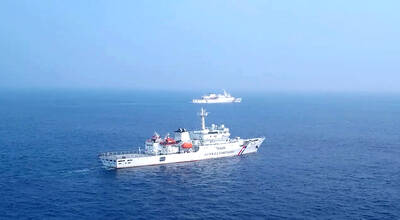
PATROL PARTNERS: The ‘Chiayi’ and the ‘Penghu’ departed for a two-day joint patrol of Palau’s exclusive economic zone, the CGA’s second diplomatic visit to the country The Coast Guard Administration (CGA) set a record for its southernmost deployment of a coast guard vessel as the vessels Chiayi and the Penghu reached Palau’s Pulo Anna Island on Saturday in a cooperative exercise between the two countries. The island, about 217 nautical miles (401km) southwest of Koror in the Palauan state of Sonsorol and 1,220 nautical miles from Taiwan’s southernmost point, Oluanpi (鵝鑾鼻), is the furthest south a CGA vessel has sailed. The two vessels are in Palau for the coast guard’s second diplomatic visit to the country. They docked at Malakal Harbor on Tuesday last week. The coast guard
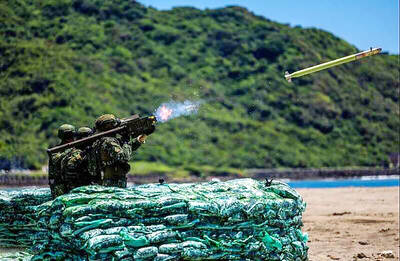
BATCH 1: The military has plans to assign the weapons to the army to defend Taiwan proper, as well as outlying islands and the navy for the Marine Corps, the official said Taiwan is to receive 500 Stinger missiles and 178 launchers from the US by the end of the year, the first batch under a planned two-stage acquisition totaling 2,621 missiles and 763 launchers, a defense official said yesterday on condition of anonymity. The portable missiles would play a vital role in the nation’s air defense capabilities, the source said. The army plans to deploy 2,235 missiles and 657 launchers to defend Taiwan proper and outlying islands, they said, citing military documents. The navy is allotted 295 missiles and 85 launchers to arm the Marine Corps and some surface vessels that lack air defense

The European Parliament on Wednesday adopted a recommendation on EU-China political relations that rejected China’s efforts to restrict Taiwan’s participation in international organizations and exchanges. The recommendation, addressed to the European Council, the European Commission and EU High Representative for Foreign Affairs and Security Policy Kaja Kallas, includes several references to EU-Taiwan relations and expresses support for closer ties, saying they would bring positive benefits and have strategic importance. Describing Taiwan as a valuable partner in trade and technology, the European Parliament said it “rejects China’s attempts to coerce international organizations, third countries and other actors into restricting Taiwan’s international participation and

Former president Tsai Ing-wen (蔡英文) on Monday arrived in San Francisco, receiving a warm welcome from hundreds of overseas Taiwanese as she launched a week-long visit. Accompanied by Representative to the US Alexander Yui (俞大?), and head of Taiwan’s San Francisco office Wu Chih-hsiang (伍志翔), Tsai arrived at her hotel, waving, smiling and giving high-fives to Taiwanese compatriots amid cheers of “Taiwan’s democracy involves you and me” to welcome her to the San Francisco Bay Area. It is Tsai’s first visit to the US since she left office in May 2024 after serving two four-year terms as president. Tsai is today to deliver


 RSS
RSS