


A powerful earthquake struck Japan yesterday, killing at least one person and injuring 162 as it damaged buildings and triggered a small tsunami along the coast, officials said.
The magnitude 6.9 quake struck at 9.42am off the north coast of Ishikawa prefecture, Japan's Meteorological Agency said. The agency issued a tsunami warning urging people near the sea to move to higher land.
A small tsunami measuring 10cm hit the shore 36 minutes later, the agency said. The warning was lifted after about an hour.
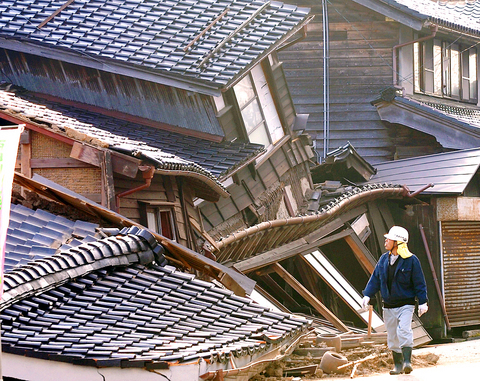
PHOTO: AP
Lower intensity temblors continued to strike the region throughout the afternoon. A strong temblor with a preliminary magnitude of 5.3 struck at 6.14pm, but there was no tsunami danger, the agency said. Public broadcaster NHK said the quake appeared to be an aftershock.
The morning quake toppled buildings, triggered landslides, cut power, interfered with phone service, broke water mains and snarled public transportation. The casualties were suffered along the country's Sea of Japan coast, according to the Fire and Disaster Management Agency (FDMA).
Fear of aftershocks and more landslides caused by the loosening of soil waterlogged by overnight rains continued to plague the quake zone.
Television footage of the quake showed buildings shaking violently for about 30 seconds. Other shots showed collapsed buildings and shops with shattered windows, streets cluttered with roof tiles and roads with cracked pavement.
At least 146 people were injured in Ishikawa, 11 seriously, the FDMA said.
Another 16 people were injured in neighboring prefectures, three seriously, it said.
Many of the injured were knocked down by the shaking or hurt by falling objects and broken glass, media reports said.
Chief Cabinet Secretary Yasuhisa Shiozaki confirmed the death of a 52-year-old woman. NHK said she was crushed by a falling stone lantern.
"We are doing our best to rescue the victims," he said. "We are also doing our best to assess the extent of the damage."
Kyodo News agency reported about 30 soldiers had arrived to help with disaster relief, and military aircraft were examining the damage. Some 375 firefighters from seven other prefectures were also dispatched to help, the FDMA said.
"We felt violent shaking. My colleagues say the insides of their houses are a mess, with everything smashed on the floor," Wataru Matsumoto, deputy mayor of the town of Anamizu near the epicenter, told NHK.
The quake also knocked down at least 45 homes in Ishikawa, and partially destroyed another 227, the FDMA said. Most of the injuries and damage were concentrated in the city of Wajima, it added.
Takeshi Hachimine, seismology and tsunami section chief at the Meteorological Agency, said the affected area was not considered earthquake-prone. The last major quake to cause casualties there was in 1933, when three people died.
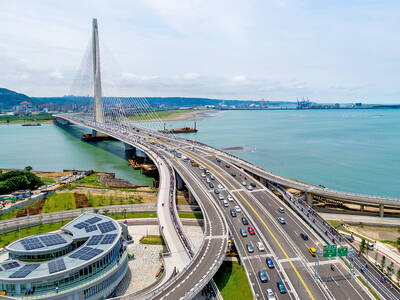
The Ministry of Transportation and Communications yesterday inaugurated the Danjiang Bridge across the Tamsui River in New Taipei City, saying that the structure would be an architectural icon and traffic artery for Taiwan. Feted as a major engineering achievement, the Danjiang Bridge is 920m long, 211m tall at the top of its pylon, and is the longest single-pylon asymmetric cable-stayed bridge in the world, the government’s Web site for the structure said. It was designed by late Iraqi-British architect Zaha Hadid. The structure, with a maximum deck of 70m, accommodates road and light rail traffic, and affords a 200m navigation channel for boats,
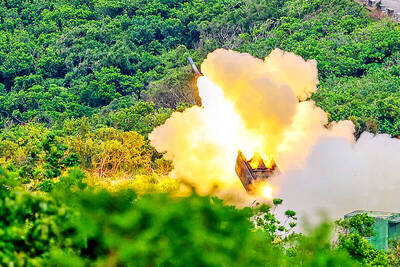
PRECISION STRIKES: The most significant reason to deploy HIMARS to outlying islands is to establish a ‘dead zone’ that the PLA would not dare enter, a source said A High Mobility Artillery Rocket System (HIMARS) would be deployed to Penghu County and Dongyin Island (東引) in Lienchiang County (Matsu) to force the Chinese military to retreat at least 100km from the coastline, a military source said yesterday. Taiwan has been procuring HIMARS and Army Tactical Missile Systems (ATACMS) from the US in batches. Once all batches have been delivered, Taiwan would possess 111 HIMARS units and 504 ATACMS, which have a range of 300km. Considering that “offense is the best defense,” the military plans to forward-deploy the systems to outlying islands such as Penghu and Dongyin so that

Taiwan Semiconductor Manufacturing Co (TSMC, 台積電), the world’s largest foundry service provider, yesterday said that global semiconductor revenue is projected to hit US$1.5 trillion in 2030, after the figure exceeds US$1 trillion this year, as artificial intelligence (AI) demand boosts consumption of token and compute power. “We are still at the beginning of the AI revolution, but we already see a significant impact across the whole semiconductor ecosystem,” TSMC deputy cochief operating officer Kevin Zhang (張曉強) said at the company’s annual technology symposium in Hsinchu City. “It is fair to say that in the past decade, smartphones and other mobile devices were

‘CLEAR MESSAGE’: The bill would set up an interagency ‘tiger team’ to review sanctions tools and other economic options to help deter any Chinese aggression toward Taiwan US Representative Young Kim has introduced a bill to deter Chinese aggression against Taiwan, calling for an interagency “tiger team” to preplan coordinated sanctions and economic measures in response to possible Chinese military or political action against Taiwan. “[Chinese President] Xi Jinping [習近平] has directed the People’s Liberation Army to be ready to invade Taiwan by 2027. China has a plan. America should have one too,” Kim said in a news release on Thursday last week. She introduced the “Deter PRC [People’s Republic of China] aggression against Taiwan act” to “ensure the US has a coordinated sanctions strategy ready should


 RSS
RSS