


Nicaraguan president-elect Daniel Ortega on Tuesday promised to continue diplomatic relations with Taiwan, amid speculation that the Central American ally might switch allegiance to China.
"After the change of government [late yesterday], I hope to continue all kinds of relationships with the people and government of Taiwan," Ortega said.
"I'd like to reiterate my warm welcome to all the officials and businesspeople of the Republic of China, Taiwan, at a time when we have committed ourselves to fighting poverty," he said.
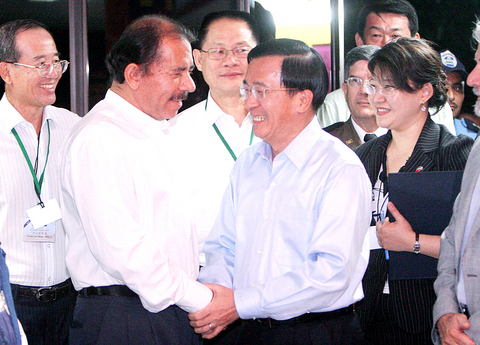
PHOTO: CNA
Ortega made the remarks on Tuesday evening while meeting with President Chen Shui-bian (
Chen arrived in the Nicaraguan capital on Tuesday afternoon. He was to attend the inauguration of Ortega late yesterday and was greeted with military honors at the airport.
Ortega had said before the election that if he won, he would switch recognition from Taiwan to China to meet the needs of the Nicaraguan business sector.
Nicaragua recognized Beijing in 1985 after Ortega's first election. However, former president Violeta Chamorro broke with Beijing and re-established ties with Taiwan after defeating Ortega in 1990.
Chen met Ortega and Nicaraguan vice president-elect Jaime Morales Carazo in the evening before having dinner with Taiwanese expatriates, embassy personnel and agricultural mission members.
Ortega yesterday told Chen that his new government would continue diplomatic relations with Taiwan, while developing exchanges with China. While Oretega has invited China to establish trade offices in his country, Beijing has not yet responded.
When asked by the Taipei Times during Tuesday night's press conference whether Taiwan could accept Nicaragua's recognition of Taiwan and China at the same time, Chen said that his government has never opposed such a situation.
However, such a scenario would not be an issue, Chen said, because what the Nicaraguan government wants is to maintain economic ties with Beijing rather than diplomatic.
"The crux of the problem lies in China's unwillingness, rather than Taiwan's," he said.
Regarding Taiwan-US relations, Chen said that he realized the US government needs China's help in tackling problems in Iran, Iraq and North Korea, but he did not want to see cooperation between Washington and Beijing sacrifice Taiwan's interests.
Chen said that his administration values the hard-earned mutual trust and long-term friendship between the two countries.
The president also thanked the US government for giving him a "comfortable, convenient, safe and dignified" transit stay in San Francisco, emphasizing that such a foundation of mutual trust should not be easily impaired.
Chen said that he would keep the promises he made to the US government and US President George W. Bush.
Meanwhile, Chen said that he was following the recommendation of the Ministry of Foreign Affairs to personally attend the inauguration with the aim of consolidating ties with Nicaragua.
During his meeting with Morales, Chen said that the vice president told him that they plan to relocate the presidential office and turn the old one into the "Home of Taiwan" dedicated to the care of the underprivileged.
also see stories:
AIT chairman poised for New Year visit
Taiwan's Congress friends plan early push
No rest for president during US stop
DPP decries Chiang relative's criticism during Chen's visit

‘NO SECURITY RISK’: The Railway Bureau reassured the public that the technicians’ activities were limited to technical guidance and did not involve sensitive systems The Railway Bureau yesterday said it had invited eight Chinese technicians to assist with an airport MRT construction project. The bureau issued the confirmation after an Internet user said Chinese nationals had entered the construction zone of Taiwan Taoyuan International Airport’s Terminal 3 project. They asked why “individuals from an enemy state” were allowed access to such a major national infrastructure project, which raised serious concerns over Taiwan’s industrial safety, sensitive systems and information security. The bureau’s Northern Region Engineering Branch Office said subcontractor Taiwan Handle Industrial Co (台灣手把工業) of the Taoyuan airport MRT’s “Contract No. CU05 Project A14 Station Civil, MEP &

The National Chungshan Institute of Science and Technology yesterday showcased its locally developed variants of the Vision 60 robotic patrol dog, which it plans to deploy on the nation’s outlying territories in the South China Sea. The variants were produced under the Joint Lab project — created by the institute and domestic companies — and assembled with domestically produced motors, lenses and artificial intelligence (AI) systems alongside licensed tech from the US, Missile and Rocket Systems Research Division deputy director Jen Kuo-kang (任國光) told the media event at a military base in Taipei’s Dazhi (大直) area. Taiwan has built up its strengths

NOT IMMEDIATE: Taiwan has a chance to appeal the proposed 10 percent tariff before it starts, while other countries face a 12.5 percent tariff from the trade office Taiwan is among 60 economies determined by the US to have failed to impose or enforce a ban on the importation of goods produced with forced labor, according to a notice released on Tuesday by the Office of the US Trade Representative (USTR), which proposed imposing an additional 10 percent or more tariff on them. The USTR in a statement said that following an investigation, it had determined under Section 301 of the Trade Act of 1974 that the failure of the 60 economies to impose and effectively enforce a prohibition on the importation of goods produced with forced labor is

TIT-FOR-TAT: The US allegedly revoked the visa of a Chinese national working at Xinhua News Agency in the US in response to Beijing’s expulsion of Vivian Wang The Presidential Office yesterday condemned China for expelling a New York Times correspondent from Beijing following the newspaper’s interview with President William Lai (賴清德), saying the move highlighted Beijing’s suppression of press freedom and its threat to international news media. Taiwan has noted a series of recent incidents in which Beijing used similar tactics to “threaten and pressure international media outlets and journalists,” Presidential Office spokeswoman Karen Kuo (郭雅慧) said in a statement. “This concerns not only press freedom and freedom of expression, but also the safety of journalists, and Taiwan and relevant partners are paying close attention to the situation,” she


 RSS
RSS