


Attacking at dawn, Ethiopian and Somali government troops yesterday drove Islamic movement fighters out of the last major town on the road to the capital.
A former warlord, who ruled the town of Jowhar before it was captured by the Council of Islamic Courts in June, led the Somali government troops as they drove into the city, residents said.
"Ethiopian troops and Mohammed Dheere have entered the city," Abshir Ali Gabre said.
Dheere, who was wearing a white "I Love Jowhar" T-shirt, shook hands with residents and handed out dozens of the shirts to residents.
Government spokesman Abdirahman Dinari said his troops were heading toward the small village of Balad, about 30km away. A resident there, Mohammed Abdi Hassan, said by telephone that the Islamists had left and that no one was in control.
But fighting could still be heard at a military camp south of Jowhar, and an Islamic movement official said his troops were simply entering a new phase in their battle.
"Our snakes of defense were let loose, now they are ready to bite the enemy everywhere in Somalia," Sheik Mohamoud Ibrahim Suley said.
He did not elaborate, but some Islamic leaders have threatened a guerrilla war to include suicide bombings in Addis Ababa.
Ethiopian forces entered the country in large numbers on Saturday, and Ethiopian fighter jets crossed the border on Sunday to help Somalia's UN-backed government push back the Islamists.
Government forces attacked Jowhar yesterday with artillery, mortars and heavy machine guns, and Islamic fighters used irrigation canals as fortifications, witnesses said. The militia, which wants to rule Somalia according to Islamic law, had stopped what their leaders earlier called a tactical retreat to defend Jowhar.
Hundreds of people have been fleeing Jowhar, anticipating major fighting, but others seemed resigned to it.
"We do not know where to escape, we are already suffering from floods, hunger and disease," said Abdale Haji Ali in Jowhar. "We are awaiting death."
Ethiopian Prime Minister Meles Zenawi said on Tuesday that he had received unconfirmed reports that as many as 1,000 people had died and 3,000 were wounded since the fighting began on Saturday.
"Some of them are Somalis, but a very significant proportion of them are not Somalis," Meles told reporters in the Ethiopian capital, Addis Ababa, referring to foreign Islamic radicals who reportedly joined the fighting.
The International Committee of the Red Cross reported that 850 people, now at hospitals supported by the relief agency in Mogadishu and Baidoa, had been injured since the fighting began, but there was no figure for fatalities.
Meles said his forces had completed about half of their mission. He said there were 3,000 to 4,000 Ethiopian troops in Somalia -- "but no more."
Meles said he aimed to severely damage the courts' military capabilities and allow both sides to return to peace talks on an even footing. He said he would not send troops into Mogadishu, which the Islamic movement has held since June.
At the UN on Tuesday, the secretary-general's special representative to Somalia told an emergency meeting of the Security Council that fighting had expanded across a 400km-wide area.

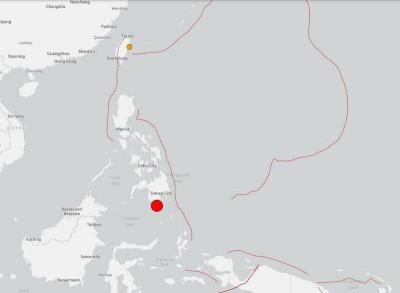
A magnitude 7.8 earthquake struck off the southern coast of Mindanao in the Philippines at 7:38am today, prompting the US Tsunami Warning System to issue an alert for neighboring countries, including Taiwan. The system issued a purple alert indicating a "tsunami threat." The potential threat zone includes Taiwan, the Philippines, Papua New Guinea, Yap and Palau. A spokesperson for Indonesia disaster mitigation agency said there were no reports of damage so far. Arlene Hollero, disaster chief of Maasim town in the Philippines' Sarangani Province, said their evacuation was underway in coastal villages and there were no reported casualties so far. DZBB radio, broadcasting from the
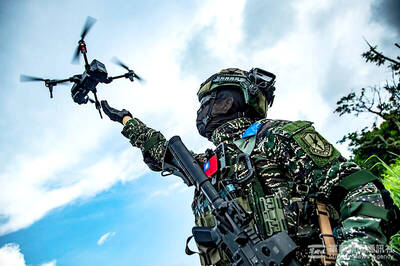
RESILIENCE: Taiwan plays a key role in semiconductors, energy, information infrastructure and advanced manufacturing, AIT Director Raymond Greene said Taiwan’s continued investment in deterrence and resilience remains vital, especially in uncrewed systems and other emerging technologies, American Institute in Taiwan (AIT) Director Raymond Greene said yesterday. Greene made the remarks at the annual National Strategic Summit on Supply Chain Resilience held by the Research Institute for Democracy, Society and Emerging Technology (DSET), a government-backed think tank. As Taiwan last year became the US’ fourth-largest trading partner and supply chain security is becoming more important, cooperation in emerging technologies continues to deepen between the two countries, he said. The US is committed to accelerating innovation, building key infrastructure, strengthening cooperation

The National Chungshan Institute of Science and Technology yesterday showcased its locally developed variants of the Vision 60 robotic patrol dog, which it plans to deploy on the nation’s outlying territories in the South China Sea. The variants were produced under the Joint Lab project — created by the institute and domestic companies — and assembled with domestically produced motors, lenses and artificial intelligence (AI) systems alongside licensed tech from the US, Missile and Rocket Systems Research Division deputy director Jen Kuo-kang (任國光) told the media event at a military base in Taipei’s Dazhi (大直) area. Taiwan has built up its strengths

RIGHT DIRECTION: Taiwan’s efforts to prevent forced labor include a proposal to ‘fully prohibit’ employers from withholding workers’ documents, an official said Taiwan is to establish a mechanism to restrict imports of goods linked to forced labor, the Executive Yuan said yesterday, after the US proposed imposing additional tariffs on Taiwanese goods over labor concerns. “The Ministry of Labor and the Ministry of Economic Affairs are to establish an interministerial review procedure,” Executive Yuan spokesperson Michelle Lee (李慧芝) said at a news briefing in Taipei. “The government is to use the Foreign Trade Act [貿易法] as the legal basis to restrict imports of goods produced with forced labor” and bring its supply chain governance more in line with international standards on human rights, resilience


 RSS
RSS