


Five early runs by Japan in the first three innings put Taiwan in a hole too deep to overcome as it dropped a 14-3 decision after seven innings in Game 2 of the 2006 World Baseball Classic at the Tokyo Dome in Tokyo, Japan, last night.
The loss virtually eliminated Taiwan, now 0-2, from advancing to the next round as they head into today's third and final game of the Asian tournament against China.
Taiwanese starter Hsu Chu-jien allowed three first-inning runs on one deadly swing by Japanese left-fielder Hitoshi Tamura that sent the ball over the left field wall for a three-run blast.
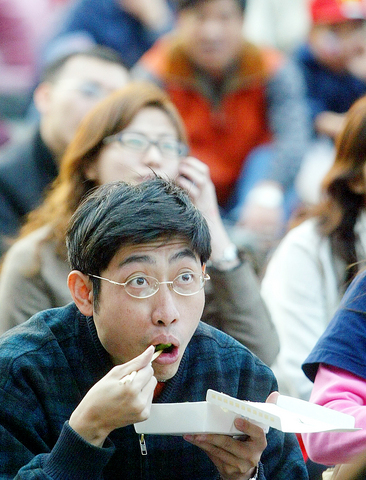
PHOTO: WANG YI-SUNG, TAIPEI TIMES
After Japan put up another run in the second inning on a sacrifice fly by center-fielder Kosuke Fukudome, Taiwan finally got on the board on a balk issued by Japanese starter Daisuke Matsuzaka that advanced the runner on third for Taiwan's first run of the tournament.
Japan then erupted for six decisive runs on five hits, three walks, and a balk by reliever Tseng Sung-wei in the top of the fifth to blow the game wide open at 11-1.
Trailing 12-1, Taiwan finally managed to score a pair of runs on its own in the bottom of the sixth with back-to-back singles by center-fielder Hsieh Jia-shien and shortstop Hu Jin-lung off Japanese reliever Hiroyuki Kobayashi to make it 12-3.
Japan would answer with two more runs in the top of the seventh against Taiwan's Kuo Hong-chih, the only current Major League pitcher on its staff (Los Angeles Dodgers), when a double by Japan's Nobuhiko Matsunaka and a subsequent wild pitch by Taiwanese reliever Yang Jien-fu brought home two more runners to make it 14-3.
A scoreless seventh by the Taiwanese hitters, despite right fielder Chang Jien-ming's clean double off Japan's Kyuji Fujikawa made it 14-3 after seven complete innings of play, inducing the mercy rule that ended the game two innings early.
Matsuzaka was credited with the win for his four innings of one-run ball on three scattered singles and as many strikeouts, while his counterpart Hsu was tagged with the loss for surrendering the three first-inning runs in the game.
As for the winless Taiwanese, the expected loss came with a steep price tag of the mercy rule that might have caused some embarrassment as four different Japanese hitters had two-hit games off eight Taiwanese pitchers in the 15-hit slugfest, clearly demonstrating the huge gap that still exists in the overall level of play between the two countries.

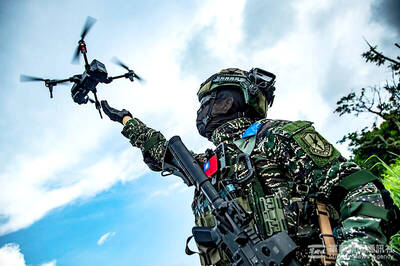
RESILIENCE: Taiwan plays a key role in semiconductors, energy, information infrastructure and advanced manufacturing, AIT Director Raymond Greene said Taiwan’s continued investment in deterrence and resilience remains vital, especially in uncrewed systems and other emerging technologies, American Institute in Taiwan (AIT) Director Raymond Greene said yesterday. Greene made the remarks at the annual National Strategic Summit on Supply Chain Resilience held by the Research Institute for Democracy, Society and Emerging Technology (DSET), a government-backed think tank. As Taiwan last year became the US’ fourth-largest trading partner and supply chain security is becoming more important, cooperation in emerging technologies continues to deepen between the two countries, he said. The US is committed to accelerating innovation, building key infrastructure, strengthening cooperation

The National Chungshan Institute of Science and Technology yesterday showcased its locally developed variants of the Vision 60 robotic patrol dog, which it plans to deploy on the nation’s outlying territories in the South China Sea. The variants were produced under the Joint Lab project — created by the institute and domestic companies — and assembled with domestically produced motors, lenses and artificial intelligence (AI) systems alongside licensed tech from the US, Missile and Rocket Systems Research Division deputy director Jen Kuo-kang (任國光) told the media event at a military base in Taipei’s Dazhi (大直) area. Taiwan has built up its strengths

RIGHT DIRECTION: Taiwan’s efforts to prevent forced labor include a proposal to ‘fully prohibit’ employers from withholding workers’ documents, an official said Taiwan is to establish a mechanism to restrict imports of goods linked to forced labor, the Executive Yuan said yesterday, after the US proposed imposing additional tariffs on Taiwanese goods over labor concerns. “The Ministry of Labor and the Ministry of Economic Affairs are to establish an interministerial review procedure,” Executive Yuan spokesperson Michelle Lee (李慧芝) said at a news briefing in Taipei. “The government is to use the Foreign Trade Act [貿易法] as the legal basis to restrict imports of goods produced with forced labor” and bring its supply chain governance more in line with international standards on human rights, resilience

NOT IMMEDIATE: Taiwan has a chance to appeal the proposed 10 percent tariff before it starts, while other countries face a 12.5 percent tariff from the trade office Taiwan is among 60 economies determined by the US to have failed to impose or enforce a ban on the importation of goods produced with forced labor, according to a notice released on Tuesday by the Office of the US Trade Representative (USTR), which proposed imposing an additional 10 percent or more tariff on them. The USTR in a statement said that following an investigation, it had determined under Section 301 of the Trade Act of 1974 that the failure of the 60 economies to impose and effectively enforce a prohibition on the importation of goods produced with forced labor is


 RSS
RSS