


Premier Su Tseng-chang (
"The guidelines and the council exist for the purpose of promoting unification with China. This is against the people's will and reality," Su said.
The premier made the remarks in response to questions from Chinese Nationalist Party (KMT) Legislators Pan Wei-kang (潘維剛) and Chiu Yi (邱毅), who asked whether Su supported President Chen Shui-bian's (
The council is a symbolic institution that has not met in several years, and has a budget of only NT$1,000 (US$31).
Taiwan is an independent country whose sovereignty belongs to its 23 million citizens, Su said, adding that what that means is that only these citizens have the right to decide the country's future.
However, he noted, the goal of the guidelines and the council is to facilitate unification with China, thereby circumventing the freedom of the Taiwanese people to determine a course for the country.
Su added that the National Security Council is currently examining the issue.
Supporting chen
The premier was also questioned about whether he would support Chen's new approach on cross-strait policy, which advocates a harder stance on cross-strait relations and has been dubbed "active management, effective opening." Su said he will not only carry out the policy, but that he will also do his best in ensuring its implementation.
Yesterday was Su's first administrative report to the Legislative Yuan.
He told lawmakers that "fairness, hard work and honesty" will be his motto as he carries out his duties.
When asked whether relations between the US and Taiwan have suffered as a result of the president's speech about scrapping the NUC, and the US' subsequent open rebuke, Su said that Taiwan-US relations have not changed.
But KMT legislators did not share his view, and Chiu asked the Cabinet if Taiwan's top envoy to the US, David Lee (
Minister of Foreign Affairs James Huang (
"Lee is doing a good job. The president does not intend to recall him," Huang added.
Bribery-free pledge
Su was then asked about his attitude toward the investigation into the Kaohsiung Rapid Transportation Corp scandal and other instances of alleged graft by government officials. He said he was determined to maintain a bribery-free government.
"I fully support prosecutors. Also, I shall not allow politics to interfere with justice, either," Su said. "Any government officials who commit crimes will be removed from my team for sure. No question about it. And these cases should be handled as fast as possible."
Su then addressed economic issues. He said his Cabinet will pay equal attention to the business, industrial, agricultural and fishery sectors, and will deal with various infrastructure and economic development projects.
Su said he had invited Vice Premier Tsai Ing-wen (
Democratic Progressive Party Legislator Lee Chun-yee (李俊毅) asked Su whether the president had allowed him to decide who to designate as his Cabinet members. Su said that the president simply asked him to "do his best for all to see."
"According to the Constitution, the authority to designate ministers responsible for foreign affairs, cross-strait relations and national defense belongs to the president. But he fully respected my opinions and my authority as well," Su said.
The premier told Lee that he would follow his own principle of "doing more and talking less."
"I am here to serve the people," he said.

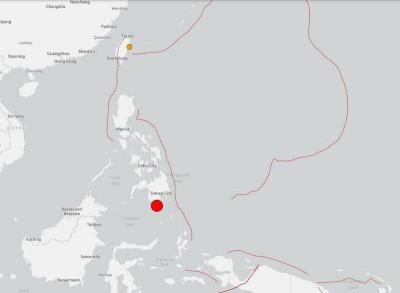
A magnitude 7.8 earthquake struck off the southern coast of Mindanao in the Philippines at 7:38am today, prompting the US Tsunami Warning System to issue an alert for neighboring countries, including Taiwan. The system issued a purple alert indicating a "tsunami threat." The potential threat zone includes Taiwan, the Philippines, Papua New Guinea, Yap and Palau. A spokesperson for Indonesia disaster mitigation agency said there were no reports of damage so far. Arlene Hollero, disaster chief of Maasim town in the Philippines' Sarangani Province, said their evacuation was underway in coastal villages and there were no reported casualties so far. DZBB radio, broadcasting from the
RESILIENCE: Taiwan plays a key role in semiconductors, energy, information infrastructure and advanced manufacturing, AIT Director Raymond Greene said Taiwan’s continued investment in deterrence and resilience remains vital, especially in uncrewed systems and other emerging technologies, American Institute in Taiwan (AIT) Director Raymond Greene said yesterday. Greene made the remarks at the annual National Strategic Summit on Supply Chain Resilience held by the Research Institute for Democracy, Society and Emerging Technology (DSET), a government-backed think tank. As Taiwan last year became the US’ fourth-largest trading partner and supply chain security is becoming more important, cooperation in emerging technologies continues to deepen between the two countries, he said. The US is committed to accelerating innovation, building key infrastructure, strengthening cooperation

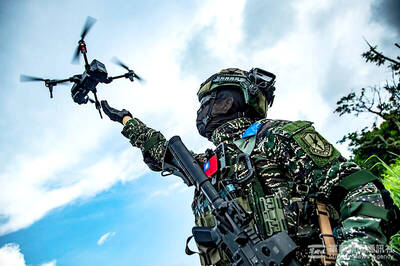
The National Chungshan Institute of Science and Technology yesterday showcased its locally developed variants of the Vision 60 robotic patrol dog, which it plans to deploy on the nation’s outlying territories in the South China Sea. The variants were produced under the Joint Lab project — created by the institute and domestic companies — and assembled with domestically produced motors, lenses and artificial intelligence (AI) systems alongside licensed tech from the US, Missile and Rocket Systems Research Division deputy director Jen Kuo-kang (任國光) told the media event at a military base in Taipei’s Dazhi (大直) area. Taiwan has built up its strengths
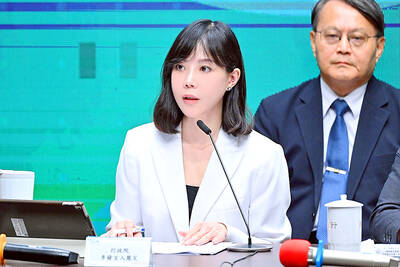
RIGHT DIRECTION: Taiwan’s efforts to prevent forced labor include a proposal to ‘fully prohibit’ employers from withholding workers’ documents, an official said Taiwan is to establish a mechanism to restrict imports of goods linked to forced labor, the Executive Yuan said yesterday, after the US proposed imposing additional tariffs on Taiwanese goods over labor concerns. “The Ministry of Labor and the Ministry of Economic Affairs are to establish an interministerial review procedure,” Executive Yuan spokesperson Michelle Lee (李慧芝) said at a news briefing in Taipei. “The government is to use the Foreign Trade Act [貿易法] as the legal basis to restrict imports of goods produced with forced labor” and bring its supply chain governance more in line with international standards on human rights, resilience


 RSS
RSS