


A Taiwanese citizen was charged in the US on Thursday with being a covert agent for Beijing, and accused together with a French-man of trying to illegally export an F-16 jet engine, Blackhawk helicopter engines and cruise missiles to China.
US prosecutors in Miami said a federal grand jury had returned a nine-count indictment against Moo Ko-suen (
The indictment alleged that the defendants violated the US' Arms Export Control Act by trying to export controlled items without a license to China, including the engines, the cruise missiles and air-to-air missiles, the prosecutors said.
The case follows repeated US expressions of concern about Beijing's strategic intentions as China increasingly pours proceeds from its rapidly expanding economy into its military.
Chinese war capabilities are growing at a pace expected to soon upset a delicate military balance between China and Taiwan, which relies on US weaponry to help defend itself.
"This case highlights the national security threat posed when agents of a foreign government seek to illegally acquire and export American military weaponry," said US Attorney R. Alexander Acosta.
"We will continue to aggressively investigate and prosecute foreign agents whose motives and actions are, by definition, detrimental do the US and our national security," he said in a statement released by the Justice Department.
A Pentagon spokesman refused to comment specifically on the Miami case, saying it was a Justice Department matter.
But the spokesman, Navy Lieutenant Commander Greg Hicks, told reporters "We are aware that there are continuing efforts on the part of China to obtain US technology."
A spokesman for the Chinese embassy in Washington was not immediately available for comment.
A spokesman for Taiwan, which has an unofficial economic office in the US capital in the absence of formal diplomatic ties with the US, declined to comment.
Last week, the Pentagon, in a new long-range strategy blueprint, called China the rising power with the greatest potential to compete militarily with the US. The strategy calls for new long-range weapons and a greater US naval presence in the Pacific.
Moo was arrested in November, but Voros remains at large, his whereabouts unknown.

‘NO SECURITY RISK’: The Railway Bureau reassured the public that the technicians’ activities were limited to technical guidance and did not involve sensitive systems The Railway Bureau yesterday said it had invited eight Chinese technicians to assist with an airport MRT construction project. The bureau issued the confirmation after an Internet user said Chinese nationals had entered the construction zone of Taiwan Taoyuan International Airport’s Terminal 3 project. They asked why “individuals from an enemy state” were allowed access to such a major national infrastructure project, which raised serious concerns over Taiwan’s industrial safety, sensitive systems and information security. The bureau’s Northern Region Engineering Branch Office said subcontractor Taiwan Handle Industrial Co (台灣手把工業) of the Taoyuan airport MRT’s “Contract No. CU05 Project A14 Station Civil, MEP &

The National Chungshan Institute of Science and Technology yesterday showcased its locally developed variants of the Vision 60 robotic patrol dog, which it plans to deploy on the nation’s outlying territories in the South China Sea. The variants were produced under the Joint Lab project — created by the institute and domestic companies — and assembled with domestically produced motors, lenses and artificial intelligence (AI) systems alongside licensed tech from the US, Missile and Rocket Systems Research Division deputy director Jen Kuo-kang (任國光) told the media event at a military base in Taipei’s Dazhi (大直) area. Taiwan has built up its strengths
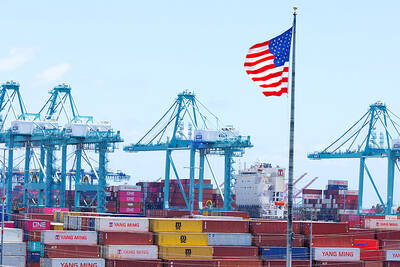
NOT IMMEDIATE: Taiwan has a chance to appeal the proposed 10 percent tariff before it starts, while other countries face a 12.5 percent tariff from the trade office Taiwan is among 60 economies determined by the US to have failed to impose or enforce a ban on the importation of goods produced with forced labor, according to a notice released on Tuesday by the Office of the US Trade Representative (USTR), which proposed imposing an additional 10 percent or more tariff on them. The USTR in a statement said that following an investigation, it had determined under Section 301 of the Trade Act of 1974 that the failure of the 60 economies to impose and effectively enforce a prohibition on the importation of goods produced with forced labor is
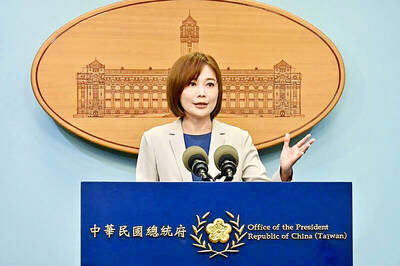
TIT-FOR-TAT: The US allegedly revoked the visa of a Chinese national working at Xinhua News Agency in the US in response to Beijing’s expulsion of Vivian Wang The Presidential Office yesterday condemned China for expelling a New York Times correspondent from Beijing following the newspaper’s interview with President William Lai (賴清德), saying the move highlighted Beijing’s suppression of press freedom and its threat to international news media. Taiwan has noted a series of recent incidents in which Beijing used similar tactics to “threaten and pressure international media outlets and journalists,” Presidential Office spokeswoman Karen Kuo (郭雅慧) said in a statement. “This concerns not only press freedom and freedom of expression, but also the safety of journalists, and Taiwan and relevant partners are paying close attention to the situation,” she


 RSS
RSS