


The Legislative Yuan yesterday passed legal revisions to the election code to increase punishments for vote-buying, and agreed to go into recess three days before the Dec. 3 local government polls.
After the amendments are signed into law by the president, they will be implemented in time for next month's elections.
After almost three hours haggling behind closed doors, lawmakers agreed to endorse draft amendments to the Public Officials Election and Recall Law (公職人員選舉罷免法), after Legislative Speaker Wang Jin-pyng (王金平) ordered a recess to conduct cross-party negotiations on the proposal, which was moved forward from 18th to first place on the order of discussion.
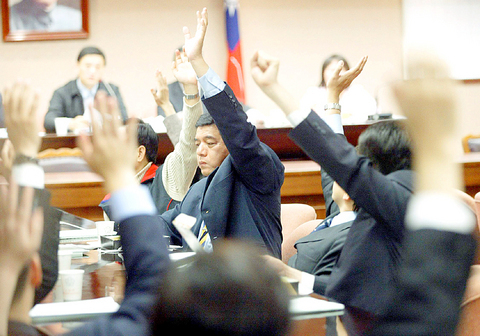
PHOTO: CNA
Under the amendments, candidates convicted of bribing their rivals to drop out of the race will be subject to a prison sentence of three to 10 years and a fine of between NT$2 million (US$59,492) and NT$20 million.
The current maximum jail sentence is five years and a fine of up to NT$6 million.
Those convicted of bribing eligible voters to cast their vote for a particular candidate or to relinquish their right to vote will face a jail term of three to 10 years or a fine of between NT$1 million and NT$10 million.
At present, the maximum jail sentence is five years or a fine of between NT$400,000 and NT$4 million.
Lawmakers also agreed to impose a prison sentence of one to seven years and a fine of between NT$1 million and NT$10 million for those convicted of bribing voters belonging to a group or institution to cast their vote for a particular candidate or relinquish their right to vote, as well as to launch or drop a signature drive to impeach an elected candidate.
The current maximum jail sentence is five years and a fine of between NT$500,000 and NT$5 million.
A new clause will also be added to the legislation, which will impose a jail term of between three and 10 years and/or a fine of NT$2 million to NT$20 million on those convicted of vote-buying in speaker or vice-speaker elections for city, county or municipality councils, as well as chairman or vice-chairman elections for township and village representatives.
In addition, legal revisions to the Futures Transaction Tax Act (期貨交易稅條例) also cleared the legislature yesterday, which will lower futures transaction tax rates, a move expected to spur more futures trading.
Also passed by the legislature yesterday were amendments to the Road Traffic Management and Punishment Law (道路交通管理處罰條例), which will relax the restrictions on drivers who have had their license suspended.
Currently, drivers of automobiles who have their driver's license suspended must have all their licenses for other kinds of motor vehicles revoked.
The Coroner's Law (法醫師法) was also passed into law, while the Soldier's Marriage Act (軍人婚姻條例) was abolished.
The legislature also gave the go-ahead to amendments to the Law on Local Government Systems (

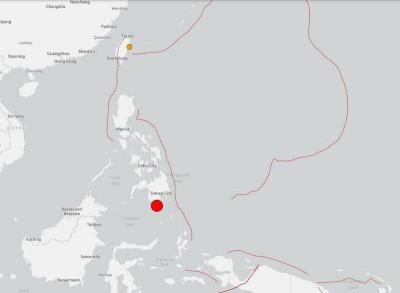
A magnitude 7.8 earthquake struck off the southern coast of Mindanao in the Philippines at 7:38am today, prompting the US Tsunami Warning System to issue an alert for neighboring countries, including Taiwan. The system issued a purple alert indicating a "tsunami threat." The potential threat zone includes Taiwan, the Philippines, Papua New Guinea, Yap and Palau. There were no immediate reports of major damage in the Philippines or Indonesia. The quake struck at a depth of 10km, said the German Research Centre for Geosciences, which had earlier pegged the earthquake at magnitude 8.2. Phivolcs, the Philippine agency, said the quake was magnitude 7 and

RESILIENCE: Taiwan plays a key role in semiconductors, energy, information infrastructure and advanced manufacturing, AIT Director Raymond Greene said Taiwan’s continued investment in deterrence and resilience remains vital, especially in uncrewed systems and other emerging technologies, American Institute in Taiwan (AIT) Director Raymond Greene said yesterday. Greene made the remarks at the annual National Strategic Summit on Supply Chain Resilience held by the Research Institute for Democracy, Society and Emerging Technology (DSET), a government-backed think tank. As Taiwan last year became the US’ fourth-largest trading partner and supply chain security is becoming more important, cooperation in emerging technologies continues to deepen between the two countries, he said. The US is committed to accelerating innovation, building key infrastructure, strengthening cooperation

The National Chungshan Institute of Science and Technology yesterday showcased its locally developed variants of the Vision 60 robotic patrol dog, which it plans to deploy on the nation’s outlying territories in the South China Sea. The variants were produced under the Joint Lab project — created by the institute and domestic companies — and assembled with domestically produced motors, lenses and artificial intelligence (AI) systems alongside licensed tech from the US, Missile and Rocket Systems Research Division deputy director Jen Kuo-kang (任國光) told the media event at a military base in Taipei’s Dazhi (大直) area. Taiwan has built up its strengths

RIGHT DIRECTION: Taiwan’s efforts to prevent forced labor include a proposal to ‘fully prohibit’ employers from withholding workers’ documents, an official said Taiwan is to establish a mechanism to restrict imports of goods linked to forced labor, the Executive Yuan said yesterday, after the US proposed imposing additional tariffs on Taiwanese goods over labor concerns. “The Ministry of Labor and the Ministry of Economic Affairs are to establish an interministerial review procedure,” Executive Yuan spokesperson Michelle Lee (李慧芝) said at a news briefing in Taipei. “The government is to use the Foreign Trade Act [貿易法] as the legal basis to restrict imports of goods produced with forced labor” and bring its supply chain governance more in line with international standards on human rights, resilience


 RSS
RSS