


US Deputy Assistant Secretary of Defense for East Asia Richard Lawless yesterday issued a blunt statement on Taiwan's blocked arms-procurement bill, implying that the Chinese Nationalist Party (KMT) and the People First Party were threatening Taiwan's security and urging Taiwanese to have the determination to defend themselves and hold lawmakers to account.
The comments, delivered in a speech by Defense Security Cooperation Agency Director Edward Ross, which sources said relayed Lawless' original speech, were an appeal to the Taiwanese public and included some of the strongest criticisms of the pan-blue camp by a senior Bush administration official.
The comments were in a keynote speech at a US-Taiwan Business Council defense industry conference in San Diego, California.
Lawless was unable to personally deliver the speech on Monday as he was in Beijing for talks on the North Korean nuclear program.
After acknowledging President Chen Shui-bian (
The special budget has become a "political football," Ross said.
"In fact, a neutral observer could draw the conclusion that this battered ball has been kept in play more to entertain the players -- the politicians -- than to serve the real needs of Taiwan," he said.
The speech then urged the people of Taiwan to understand that national security is not simply a political platform and that no specific defense issue should become a football for partisan purposes.
"Rather, national security is a political responsibility and the people of Taiwan should hold elected officials accountable for what they are doing, or more correctly, not doing," he said.
The speech argued that Taiwan could take several steps to improve the efficiency and effectiveness of its defense posture "without breaking the bank."
"Taiwan is particularly vulnerable because it is an island in close proximity to a threat, possesses limited resources and relies heavily on advanced technology to meet its defense needs," he said. "For these reasons alone, it is important Taiwan minimizes its vulnerabilities and maximizes its strength."
He said that under the Taiwan Relations Act (TRA), the US is "obligated to `enable' Taiwan to maintain a sufficient self-defense."
"[B]ut the reality is, it is Taiwan that is obligated to have a sufficient self-defense," he added.
Taiwan has to "fulfill its unwritten, but clearly evident obligations under the [TRA] by appropriately providing for its own defense while not simply relying on the US' capacity to address a threat in the Strait," he added.
He also stressed that "the people of Taiwan and their elected officials [must] understand that when it comes to defense, they ... are in the first instance accountable," and not the US or anyone else.
"We cannot help defend you, if you cannot defend yourself," the speech concluded. "We encourage our Taiwan friends both Blues and Greens, and more importantly I urge the people of Taiwan to think very hard about the future of Taiwan -- how should it look, how should it feel, and what is it worth?"
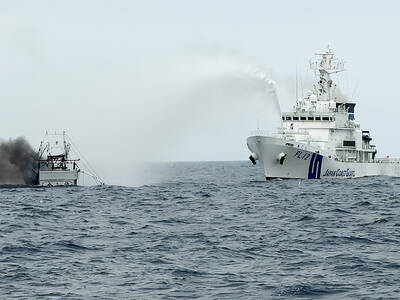
CREDIT-GRABBER: China said its coast guard rescued the crew of a fishing vessel that caught fire, who were actually rescued by a nearby Taiwanese boat and the CGA Maritime search and rescue operations do not have borders, and China should not use a shipwreck to infringe upon Taiwanese sovereignty, the Coast Guard Administration (CGA) said yesterday. The coast guard made the statement in response to the China Coast Guard (CCG) saying it saved a Taiwanese fishing boat. The Chuan Yu No. 6 (全漁6號), a fishing vessel registered in Keelung, on Thursday caught fire and sank in waters northeast of Diaoyutai Islands (釣魚台). The vessel left Keelung’s Badouzih Fishing Harbor (八斗子漁港) at 3:35pm on Sunday last week, with seven people on board — a 62-year-old Taiwanese captain surnamed Chang (張) and six
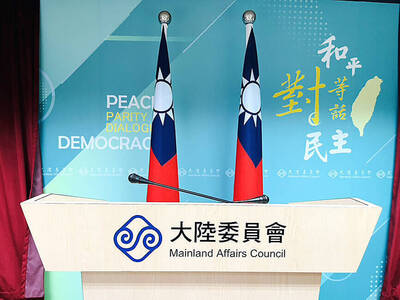
RISKY BUSINESS: The ‘incentives’ include initiatives that get suspended for no reason, creating uncertainty and resulting in considerable losses for Taiwanese, the MAC said China’s “incentives” failed to sway sentiment in Taiwan, as willingness to work in China hit a record low of 1.6 percent, a Ministry of Labor survey showed. The Directorate-General of Budget, Accounting and Statistics (DGBAS) also reported that the number of Taiwanese workers in China has nearly halved from a peak of 430,000 in 2012 to an estimated 231,000 in 2024. That marked a new low in the proportion of Taiwanese going abroad to work. The ministry’s annual survey on “Labor Life and Employment Status” includes questions respondents’ willingness to seek employment overseas. Willingness to work in China has steadily declined from

The Legislative Yuan’s Finance Committee yesterday approved proposed amendments to the Amusement Tax Act (娛樂稅法) that would abolish taxes on films, cultural activities and competitive sporting events, retaining the fee only for dance halls and golf courses. The proposed changes would set the maximum tax rate for dance halls and golf courses at 50 and 20 percent respectively, with local governments authorized to suspend the levies. Article 2 of the act says that “amusement tax shall be levied on tickets sold or fees charged by amusement places, facilities or activities” in six categories: “Cinema; professional singing, story-telling, dancing, circus, magic show, acrobatics
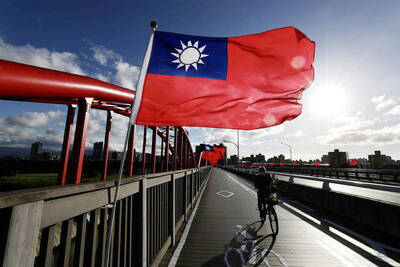
INFLATION UP? The IMF said CPI would increase to 1.5 percent this year, while the DGBAS projected it would rise to 1.68 percent, with GDP per capita of US$44,181 The IMF projected Taiwan’s real GDP would grow 5.2 percent this year, up from its 2.1 percent outlook in January, despite fears of global economic disruptions sparked by the US-Iran conflict. Taiwan’s consumer price index (CPI) is projected to increase to 1.5 percent, while unemployment would be 3.4 percent, roughly in line with estimates for Asia as a whole, the international body wrote in its Global Economic Outlook Report published in the US on Monday. The figures are comparatively better than the IMF outlook for the rest of the world, which pegged real GDP growth at 3.1 percent, down from 3.3 percent


 RSS
RSS