


Vowing to continue reform efforts so the Chinese Nationalist Party (KMT) will win the 2008 presidential election, Taipei Mayor Ma Ying-jeou (馬英九) took over the helm of the party yesterday, while his supporters pushed through proposals to reform the KMT's power structure.
Accepting the party's flag from predecessor Lien Chan (
"Today's society depends on the KMT to monitor the government as a strong opposition party and to maintain peaceful cross-strait relations," Ma said in his inauguration speech to the 1,600 delegates gathered at the Sun Yat-sen Memorial Hall in Taipei.
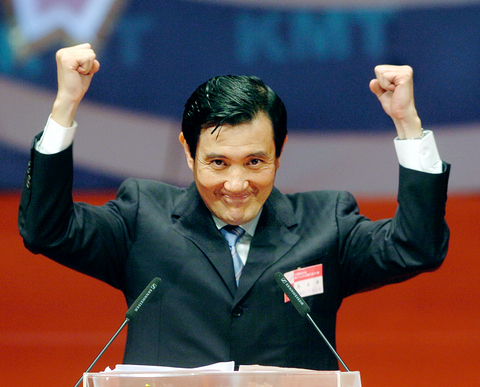
PHOTO: FANG PING-CHAO, TAIPEI TIMES
"It is the KMT's mission and my challenge to transform the party into a clean and decent party," he said.
Ma outlined seven reform goals in his speech, including cleaning up the party's asset problems by 2008, pushing for pan-blue unity, expanding the party's base and grassroots connections, and deepening democracy within the party.
Ma praised Lien for the contributions he made to the party as chairman, including allowing a direct election for his successor, and for working to improve cross-strait relations.
He also thanked Legislative Speaker Wang Jin-pyng (王金平) for running "a gentlemen's race" in the KMT chairmanship election last month.
In his farewell address, Lien thanked party members for their support during his five-year tenure, during which he said he was devoted to reviving the party's soul and spirit. He encouraged his fellow cadres to rejuvenate and reform the party.
"Our popularity among the public had risen to more than 60 percent in a recent survey. I urge all of you to keep the torch passed down by Sun Yat-sen (孫中山), offer voters a different choice, and hopefully win back power in 2008," Lien said.
Many of the delegates, including Lien's son Lien Sheng-wen (
The KMT's "Chairman Ma era" got underway yesterday afternoon when the delegates passed a proposal to allow them to directly elect the party's 31 Central Standing Committee (CSC) members. The motion was carried by more than 856 delegates. The CSC vote will be held today.
The delegates also gave their approval to Ma's nominees for four vice-chairperson posts: incumbents Taichung Mayor Wu Po-hsiung (吳伯雄) and Chiang Pin-kung (江丙坤), as well as Lin Cheng-chi (林澄枝) and John Kuan (關中). A total of 952 delegates raised their hands to support the appointments.
A proposal to amend the KMT's constitution to extend the terms of CSC members from one year to two was rejected. Other constitutional amendments that passed included abolishing an article which stipulates that members who are disciplined or expelled cannot be candidates for the Central Standing Committee or party chairman.
The article is generally considered to be aimed at People First Party Chairman James Soong (宋楚瑜), who was expelled by the KMT for running as an independent against Lien in the 2000 presidential election. The amendment was designed to help push for integration of the pan-blue alliance.
As most of the motions put forward by Ma's supporters were passed -- the direct election of CSC members and keeping CSC tenure at one year -- it is believed that the Taipei mayor has enhanced his power within the party.
Today the delegates will elect the 210 members of the party's Central Committee and then elect the 31 CSC members from among those 210 people.
Meanwhile, the Central Committee of the Chinese Communist Party (CCP) sent a congratulatory message Ma yesterday, according to a Beijing-based Xinhuanet report.
The message expressed hope that both sides will also oppose Taiwan independence to safeguard peace in the Strait and create a win-win situation for both sides across the Strait.
Chinese President Hu Jintao (胡錦濤), the CCP's secretary-general, also sent a message to Lien to congratulate him for serving as the KMT's honorary chairman, the report said.
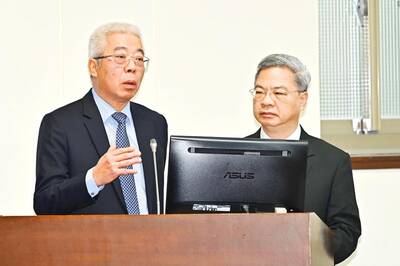
Taiwan has arranged for about 8 million barrels of crude oil, or about one-third of its monthly needs, to be shipped from the Red Sea this month to bypass the Strait of Hormuz and ease domestic supply pressures, CPC Corp, Taiwan (CPC, 台灣中油) said yesterday. The state-run oil company has worked with Middle Eastern suppliers to secure routes other than the Strait of Hormuz, through which about 20 percent of the world’s oil and liquefied natural gas typically passes, CPC chairman Fang Jeng-zen (方振仁) said at a meeting of the legislature’s Economics Committee in Taipei. Suppliers in Saudi Arabia have indicated they
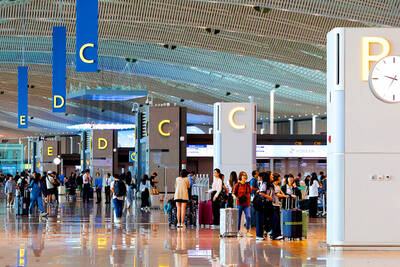
South Korea has adjusted its electronic arrival card system to no longer list Taiwan as a part of China, a move that the Ministry of Foreign Affairs said would help facilitate exchanges between the two sides. South Korea previously listed “Taiwan” as “Taiwan (China)” in the drop-down menus of its online arrival card system, where people had to fill out where they came from and their next destination. The ministry had requested South Korea make a revision and said it would change South Korea’s name on Taiwan’s online immigration system from “Republic of Korea” to “Korea (South),” should the issue not be
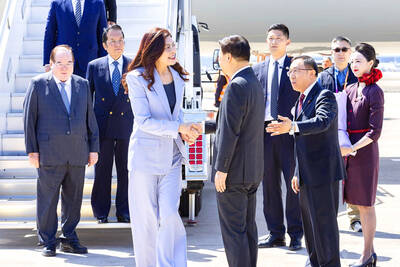
CCP ‘PAWN’? Beijing could use the KMT chairwoman’s visit to signal to the world that many people in Taiwan support the ‘one China’ principle, an academic said Chinese Nationalist Party (KMT) Chairwoman Cheng Li-wun (鄭麗文) yesterday arrived in China for a “peace” mission and potential meeting with Chinese President Xi Jinping (習近平), while a Taiwanese minister detailed the number of Chinese warships currently deployed around the nation. Cheng is visiting at a time of increased Chinese military pressure on Taiwan, as the opposition-dominated Legislative Yuan stalls a government plan for US$40 billion in extra defense spending. Speaking to reporters before going to the airport, Cheng said she was going on a “historic journey for peace,” but added that some people felt uneasy about her trip. “If you truly love Taiwan,

Tainan, Taipei and New Taipei City recorded the highest fines nationwide for illegal accommodations in the first quarter of this year, with fines issued in the three cities each exceeding NT$7 million (US$220,639), Tourism Administration data showed. Among them, Taipei had the highest number of illegal short-term rental units, with 410. There were 3,280 legally registered hotels nationwide in the first quarter, down by 14 properties, or 0.43 percent, from a year earlier, likely indicating operators exiting the market, the agency said. However, the number of unregistered properties rose to 1,174, including 314 illegal hotels and 860 illegal short-term rental


 RSS
RSS