


Malaysia lifted a state of emergency in two areas near the capital yesterday after air pollution levels fell well below the danger mark, easing the country's worst pollution crisis in eight years.
Changing winds have helped to disperse smog that has shrouded central Malaysia for a week, dis-persing smoke blown in from forest fires in Indonesia to northern regions, officials said.
The sky over Kuala Lumpur was clear for the first time in days and the weather bureau predicted weekend rains to further wash away the haze that has threatened public health.
"We thank God, and this is through the effort of everybody regardless of religion," Prime Minister Abdullah Badawi told reporters during a visit to a pollution monitoring center near the capital.
Badawi had urged citizens of all faiths to beg for divine intervention to banish the haze that had grounded some flights, disrupted shipping, and forced the closure of hundreds of schools.
The National Security Council said pollution readings were well below the 500-level mark which had triggered the emergency in Kuala Selangor and Port Klang, the country's biggest port, following choking smoke from forest fires in Indonesia.
Only 12 places in the country registered a reading classed in the category of "unhealthy" and most of them were in the northern states of Penang and Perak, it said.
A reading of 101-200 on the Air Pollutant Index (API) is classed as "unhealthy," 201-300 "very unhealthy" and 300 and above is "hazardous."
The latest reading put Kuala Lumpur at 103, Port Klang at 105 and Kuala Selangor at 117, it said.
Visibility at an airport in Penang, a major tourist spot and a hub for electronics firms, dropped to 500m early yesterday, but recovered to about 1km by afternoon.
The airport would be shut if visibility fell below 300m, an airport official said. Most of Penang's electronics exports go by air to the US, Japan and Taiwan.
Environment Minister Adenan Satem was quoted as saying by the Star newspaper that Indonesia has asked for Malaysia's assistance in cloud-seeding operations to douse the fires burning on Sumatra.
Meanwhile, Indonesia's leading environmental watchdog yesterday urged Jakarta to declare a state of emergency and criticized officials' slow handling of the haze crisis.
"The most important thing that the government should do is to declare a state of emergency, take action to extinguish the fires and tell the public what to do because this concerns the safety of many people," said Chalid Muhammad, executive director of environmental group Walhi, in a statement.
"These fires should push the government to ... reform its policing of forest management in Indonesia, which in Walhi's view has never been given serious thought, even though forest fires have occurred annually since 1997," the statement said.

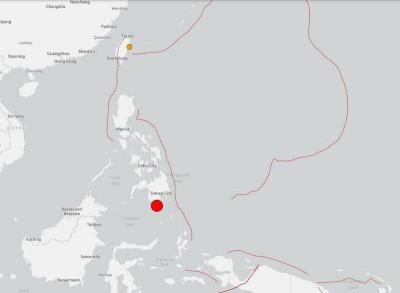
A magnitude 7.8 earthquake struck off the southern coast of Mindanao in the Philippines at 7:38am today, prompting the US Tsunami Warning System to issue an alert for neighboring countries, including Taiwan. The system issued a purple alert indicating a "tsunami threat." The potential threat zone includes Taiwan, the Philippines, Papua New Guinea, Yap and Palau. Philippine authorities were assessing the damage from the quake, with the office of civil defense seeking to verifying initial reports that 15 people had been killed and 129 injured in the region, mostly from falling debris. Arlene Hollero, disaster chief of Maasim town in the Philippines' Sarangani Province,

RESILIENCE: Taiwan plays a key role in semiconductors, energy, information infrastructure and advanced manufacturing, AIT Director Raymond Greene said Taiwan’s continued investment in deterrence and resilience remains vital, especially in uncrewed systems and other emerging technologies, American Institute in Taiwan (AIT) Director Raymond Greene said yesterday. Greene made the remarks at the annual National Strategic Summit on Supply Chain Resilience held by the Research Institute for Democracy, Society and Emerging Technology (DSET), a government-backed think tank. As Taiwan last year became the US’ fourth-largest trading partner and supply chain security is becoming more important, cooperation in emerging technologies continues to deepen between the two countries, he said. The US is committed to accelerating innovation, building key infrastructure, strengthening cooperation

The National Chungshan Institute of Science and Technology yesterday showcased its locally developed variants of the Vision 60 robotic patrol dog, which it plans to deploy on the nation’s outlying territories in the South China Sea. The variants were produced under the Joint Lab project — created by the institute and domestic companies — and assembled with domestically produced motors, lenses and artificial intelligence (AI) systems alongside licensed tech from the US, Missile and Rocket Systems Research Division deputy director Jen Kuo-kang (任國光) told the media event at a military base in Taipei’s Dazhi (大直) area. Taiwan has built up its strengths

RIGHT DIRECTION: Taiwan’s efforts to prevent forced labor include a proposal to ‘fully prohibit’ employers from withholding workers’ documents, an official said Taiwan is to establish a mechanism to restrict imports of goods linked to forced labor, the Executive Yuan said yesterday, after the US proposed imposing additional tariffs on Taiwanese goods over labor concerns. “The Ministry of Labor and the Ministry of Economic Affairs are to establish an interministerial review procedure,” Executive Yuan spokesperson Michelle Lee (李慧芝) said at a news briefing in Taipei. “The government is to use the Foreign Trade Act [貿易法] as the legal basis to restrict imports of goods produced with forced labor” and bring its supply chain governance more in line with international standards on human rights, resilience


 RSS
RSS