


A Russian mini-submarine with seven sailors aboard got caught on a fishing net and was stuck on the sea floor off Russia's Pacific Coast, navy officials said yesterday.
Navy authorities were racing to try to figure out how to raise the vessel from a depth of some 190m, and a navy spokesman said the air supply on the craft was only enough to last one more day.
"There is air remaining on the underwater apparatus for a day -- one day," Captain Igor Dygalo said on state-run Rossiya TV.
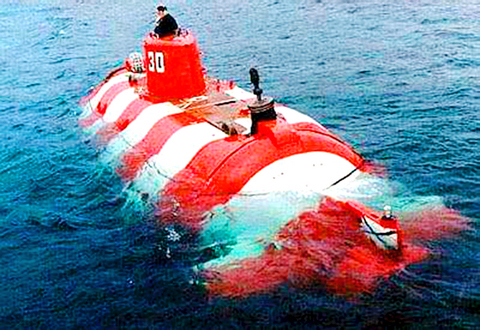
PHOTO: EPA
"The operation continues. We have a day, and intensive, active measures will be taken to rescue the AS-28 vessel and the people aboard," he said.
The US Navy was scrambling to send an unmanned underwater vehicle to help rescue efforts at Russia's request, and Britain and Japan also rushed to help.
Dygalo said the US Navy agreed to send a US plane with a robotic underwater rescue vehicle to the accident area off the Kamchatka Peninsula, but he did not say when it was expected to arrive. He said a British plane carrying unspecified rescue equipment was not expected before today.
Japan dispatched four naval vessels yesterday to help in the rescue, but the ships aren't expected to arrive at the scene until early next week, Marine Self Defense Force spokesman Hidetsubu Iwamasa said.
There was contact with the sailors, who were not hurt, Pacific Fleet spokesman Captain Alexander Kosolapov said in televised comments.
The mini-sub, called the AS-28, was too deep to allow the sailors to swim to the surface on their own or for divers to reach it, officials said.
The vessel's propeller became entangled in a fishing net on Thursday, trapping the craft, Dygalo said.
His comments on the amount of air remaining, which he said came after "all the information was checked," followed conflicting statements from officials who said there was enough air for anything from one day to five days. The range of estimates may have been the result of confusion because there were seven people aboard the vessel, whose usual crew is three.
The accident occurred early Thursday when the vessel was launched from a rescue ship during a combat training exercise, Kosolapov said. He said the navy was examining ways to bring the vessel, also called a bathyscaph, to the surface and that nine warships were in the area to aid the rescue operation.
Two surface ships were sweeping the area with nets in the hope of wresting the trapped vessel from the sea floor, adding that the rescue effort would continue into the night, Dygalo said.
The accident occurred almost exactly five years after the nuclear submarine Kursk sank to the bottom of the Barents Sea after explosions on board, killing all 118 seamen aboard in a painful blow to the Russian navy.
The AS-28, which looks like a small submarine, was built in 1989. They are about 13.5m long and 5.7m high and can dive to depths below 500m.
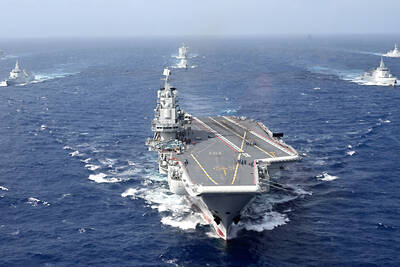
PROVOCATIVE: Chinese Deputy Ambassador to the UN Sun Lei accused Japan of sending military vessels to deliberately provoke tensions in the Taiwan Strait China denounced remarks by Japan and the EU about the South China Sea at a UN Security Council meeting on Monday, and accused Tokyo of provocative behavior in the Taiwan Strait and planning military expansion. Ayano Kunimitsu, a Japanese vice foreign minister, told the Council meeting on maritime security that Tokyo was seriously concerned about the situation in the East China and South China seas, and reiterated Japan’s opposition to any attempt to change the “status quo” by force, and obstruction of freedom of navigation and overflight. Stavros Lambrinidis, head of the EU delegation to the UN, also highlighted South China Sea

SILENCING CRITICS: In addition to blocking Taiwan, China aimed to prevent rights activists from speaking out against authoritarian states, a Cabinet department said The Ministry of Foreign Affairs (MOFA) yesterday condemned transnational repression by Beijing after RightsCon, a major digital human rights conference scheduled to be held in Zambia this week, was abruptly canceled due to Chinese pressure over Taiwanese participation. This year’s RightsCon, the world’s largest conference discussing issues “at the intersection of human rights and technology,” was scheduled to take place from tomorrow to Friday in Lusaka, and expected to draw 2,600 in-person attendees from 150 countries, along with 1,100 online participants. However, organizers were forced to cancel the event due to behind-the-scenes pressure from China, the ministry said, expressing its “strongest condemnation”
Taiwan Semiconductor Manufacturing Co (TSMC, 台積電), the world’s largest contract chipmaker, said it expects its 2-nanometer (2nm) chip capacity to grow at a compound annual rate of 70 percent from this year to 2028. The projection comes as five fabs begin volume production of 2-nanometer chips this year — two in Hsinchu and three in Kaohsiung — TSMC senior vice president and deputy cochief operating officer Cliff Hou (侯永清) said at the company’s annual technology symposium in Silicon Valley, California, last week. Output in the first year of 2-nanometer production, which began in the fourth quarter of last year, is expected to
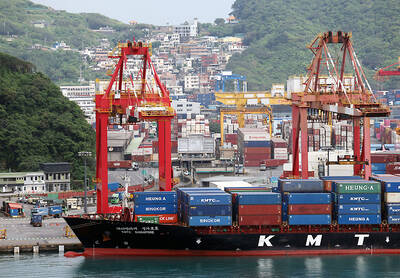
Taiwan’s economy grew far faster than expected in the first quarter, as booming demand for artificial intelligence (AI) applications drove a surge in exports, spilling over into investment and consumption, the Directorate-General of Budget, Accounting and Statistics (DGBAS) said yesterday. GDP growth was 13.69 percent year-on-year during the January-to-March period, beating the DGBAS’ February forecast by 2.23 percentage points and marking the most robust growth in nearly four decades, DGBAS senior official Chiang Hsin-yi (江心怡) told a news conference in Taipei. The result was powered by exports, which remain the backbone of Taiwan’s economy, Chiang said. Outbound shipments jumped 51.12 percent year-on-year to


 RSS
RSS