


Veteran civil servant Donald Tsang (
Tsang trounced his two rivals by collecting 710 of the nominations from the election panel of about 800 people. The other candidates -- both lawmakers -- conceded days ago they were unable to win the minimum 100 nominations they needed to be placed on the July 10 ballot.
Tsang announced his nomination count shortly after filing with election officials, who would verify the endorsements and were to announce results today.
"The process was very smooth," Tsang said at his campaign office.
"I feel very excited. I feel I have more responsibilities," he added.
The race was never really a contest for Tsang because his campaign had the biggest advantage: support from Chinese leaders. The election committee is dominated by members loyal to Beijing.
Hong Kong voters were never allowed to directly elect their leaders when the territory was a British colony. Beijing continued to deny them the right when the city returned to Chinese rule in 1997 under a "one country, two systems" formula designed to allow a wide-degree of autonomy.
Yesterday, radical lawmaker Leung Kwok-hung (
Tsang was the right-hand man to former chief executive Tung Chee-hwa (
Tsang's rivals in the leadership race were pro-democracy Legislator Lee Wing-tat (李永達) and ex-convict Legislator Chim Pui-chung (詹培忠). Both have complained that the race was unfair because Tsang refused to debate them. But the front-runner said that he would only debate candidates who collected enough nominations to be on the final ballot.
Lee told reporters yesterday that he only collected 51 endorsements. He alleged that people who showed interest in supporting him were targeted by pro-Beijing organizations that urged them to support Tsang.
"If they show any intention to nominate me, they'll receive many phone calls," he said.
Chim conceded the election was over. "I have no chance of beating my opponent, Mr. Tsang," he said.
The flamboyant, bowtie-wearing Tsang seems like an unlikely success story. A policeman's son, he never went to college. He briefly worked as a pharmaceutical salesman before joining the civil service, where he has worked for nearly 40 years.
He became financial secretary in 1995, the first ethnic Chinese to hold the job in 150 years of British rule. He was named a knight of the British Empire in the final days of British rule -- an honor that many thought would doom him if he stayed in government after the handover to China.
During Tung's eight years of rule, Tsang was reputed to be a loyal official who efficiently carried out orders. When Tung resigned, Tsang was the No. 2 ranking official responsible for running the government.
Tsang has had cordial ties with the pro-democracy camp, but it's unlikely he'll push hard for bold political reforms -- a move that would quickly sour relations with Beijing. He acknowledged in a recent TV interview that a Hong Kong leader could not be successful without the support of China's central government.

A signaling system malfunction disrupted high-speed rail (HSR) services beginning at 8am today, with trains temporarily reduced to three northbound and three southbound trains per hour as authorities conduct inspections. The malfunction occurred on a section of track in Miaoli County during pre-operation checks early this morning, forcing northbound and southbound trains to use a single track, the HSR operator said. The regular schedule has been replaced with three hourly trains offering only nonreserved seating in each direction, stopping at every station, it said, adding that business class cars would still have reserved seating. Departures from terminal stations are scheduled at the top
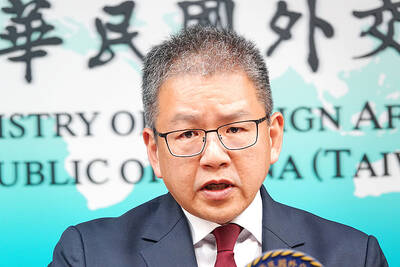
Taiwan is still in the process of assessing the possibility of recruiting workers from Eswatini, the Ministry of Foreign Affairs said yesterday, adding that its goal is to help Eswatini upgrade its vocational training centers. If there are plans to recruit workers from Eswatini, safeguarding national security, protecting public health and ensuring the employment rights of Taiwanese would be prerequisites, Department of West Asian and African Affairs Director-General Yen Chia-liang (顏嘉良) told a news conference. Key considerations would also include filling labor shortages in specific industries, and fostering bilateral professional and technical exchanges, he said. Yen was asked about the progress of labor

VERBOSE VESSELS: A CGA cutter and a China Coast Guard exchanged verbal barbs for more than a day in Taiwanese-controlled waters before the Chinese vessel left The Taiwanese and Chinese coast guards had a standoff near the strategically located Pratas Islands (Dongsha Islands, 東沙群島) in the north of the South China Sea, the Coast Guard Administration (CGA) said yesterday. The two sides engaged in intense radio exchanges over sovereignty claims during the 33-hour standoff. China Coast Guard vessel 3501 eventually left the restricted waters, 26.6 nautical miles (49.2km) west of the Pratas Islands, at 5pm yesterday, the CGA said. Lying approximately between southern Taiwan and Hong Kong, the Taiwan-controlled Pratas are seen by some security experts as vulnerable to Chinese attack due to their distance — more than
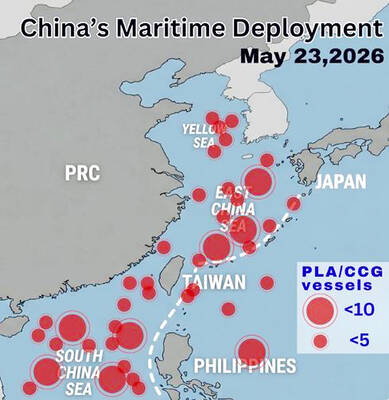
WARNING: China should stop engaging in actions that undermine regional peace and stability, as it would only build resentment among people across the Strait, the CGA said China has deployed more than 100 navy, coast guard and other vessels in waters from the Yellow Sea to the South China Sea and the western Pacific since US President Donald Trump and Chinese President Xi Jinping (習近平) met in Beijing, National Security Council Secretary-General Joseph Wu (吳釗燮) said yesterday. “In this part of the world, #China is the one & only PROBLEM wrecking the #StatusQuo & threatening regional peace & stability,” Wu wrote on X. In a separate post, he said Beijing was coercing Taiwan’s maritime domain, calling it illegal and provocative, after the Coast Guard Administration (CGA) expelled a


 RSS
RSS