


Chanting "Japanese pigs get out!," protesters threw stones and broke windows at Japan's consulate and Japanese restaurants in Shanghai as tens of thousands of people defied government warnings and staged demonstrations yesterday against Tokyo's bid for a permanent UN Security Council seat.
Protests were reported in two other cities. But Beijing remained calm as police stood guard on Tiananmen Square to block a planned protest in the capital, a day ahead of a visit by Japan's foreign minister. Paramilitary police surrounded the Japanese Embassy, where protesters smashed windows last weekend.
The third weekend of protests erupted despite government demands for calm. Communist leaders apparently worry that the protests might do more damage to relations with Tokyo, which are at their lowest point in decades, or encourage others to take to the street to protest corruption or demand political reforms.
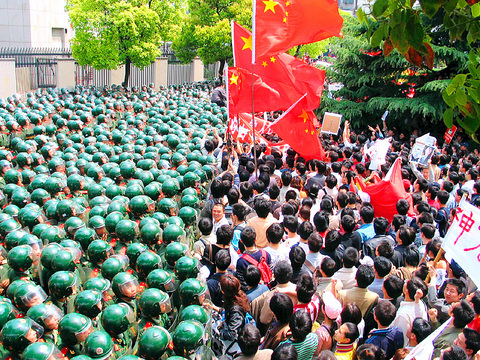
PHOTO: EPA
In Shanghai, as many as 20,000 protesters gathered around the Japanese Consulate. Police in riot helmets kept them away from the building but let protesters throw eggs and rocks. A group of young men broke the windows of a Nissan sedan and flipped it onto its roof.
In a nearby street, protesters broke windows at about 10 Japanese-style noodle shops and bars, many of them Chinese-owned. Others broke the windows of a police car, chanting "Kill the Japanese!," after a rumor spread that a man sitting inside was Japanese. The car drove away before the crowd could grab him.
The violence followed a march from City Hall to the consulate by about 5,000 people. They carried banners saying in English, "Say No to Japan in the Security Council" and chanted "Japanese pigs get out!"
A sign outside the consulate said, "Be Vicious Toward Japanese Devils."
"We have protested to the Foreign Ministry many times today, asking them to stop this violence," said Keiji Ide, spokesman for the Japanese Embassy in Beijing. "They promised to do their best."
A protest march in Hangzhou, southwest of Shanghai, attracted 10,000 people who shouted "slogans condemning Japanese militarism," the official Xinhua News Agency reported. In Tianjin, east of Beijing, about 2,000 protesters held a peaceful one-hour march.
Police also blocked a protest in the southern city of Guangzhou, shooing away people who tried to gather at a stadium.
Japan's foreign minister was preparing to fly to Beijing on Sunday for talks aimed at defusing the tensions. Japan warned its citizens in China about possible danger in advance of the protests. The US issued a similar warning.
Some suggested Beijing permitted the protests last weekend to support a campaign to block Tokyo's Security Council bid.
In Shanghai, police didn't try to stop the protest, though state newspapers said no one had received permission to hold one. At one point, police posted a sign saying, "March route this way."
Also see stories:

‘NO SECURITY RISK’: The Railway Bureau reassured the public that the technicians’ activities were limited to technical guidance and did not involve sensitive systems The Railway Bureau yesterday said it had invited eight Chinese technicians to assist with an airport MRT construction project. The bureau issued the confirmation after an Internet user said Chinese nationals had entered the construction zone of Taiwan Taoyuan International Airport’s Terminal 3 project. They asked why “individuals from an enemy state” were allowed access to such a major national infrastructure project, which raised serious concerns over Taiwan’s industrial safety, sensitive systems and information security. The bureau’s Northern Region Engineering Branch Office said subcontractor Taiwan Handle Industrial Co (台灣手把工業) of the Taoyuan airport MRT’s “Contract No. CU05 Project A14 Station Civil, MEP &

A US uncrewed surface vessel (USV) encountered multiple Chinese warships during an autonomous transit of the Taiwan Strait, US defense company Seasats said in a statement on Wednesday. Seasats announced that a Lightfish USV had completed the first autonomous transit of the Taiwan Strait. Over five days, the USV traversed the entire length of the Strait while constantly monitoring surface vessel traffic, the company said. The Lightfish encountered multiple Chinese warships, one of which was a Chinese People’s Liberation Army Navy (PLAN) Type 056 corvette, it said. The Chinese vessels were operating “well within Taiwan’s exclusive economic zone without transmitting their identity via the
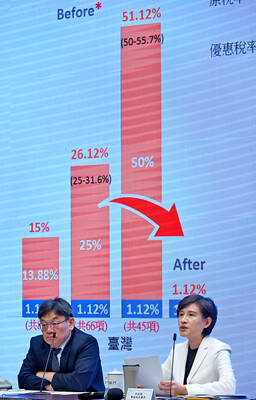
GREATER REACH? Auto parts and wood products would face tariffs of up to 15%, matching those targeting the EU, Japan and South Korea, Vice Premier said The US has announced that preferential tariff treatment for Taiwan’s non-semiconductor Section 232 goods would take effect retroactively from May 1, the Executive Yuan said yesterday. The US government yesterday posted a notice on the Federal Register’s public inspection Web site previewing tariff concessions for Taiwan under a memorandum of understanding (MOU) on Taiwan-US investment after two months of negotiations. The MOU signed on Jan. 15 stipulated three major preferential tariff arrangements: a 15 percent “reciprocal” tariff rate for Taiwan without stacking most-favored nation (MFN) rates; preferential Section 232 treatment for semiconductors and related products; and preferential Section 232 treatment for non-semiconductor

TIT-FOR-TAT: The US allegedly revoked the visa of a Chinese national working at Xinhua News Agency in the US in response to Beijing’s expulsion of Vivian Wang The Presidential Office yesterday condemned China for expelling a New York Times correspondent from Beijing following the newspaper’s interview with President William Lai (賴清德), saying the move highlighted Beijing’s suppression of press freedom and its threat to international news media. Taiwan has noted a series of recent incidents in which Beijing used similar tactics to “threaten and pressure international media outlets and journalists,” Presidential Office spokeswoman Karen Kuo (郭雅慧) said in a statement. “This concerns not only press freedom and freedom of expression, but also the safety of journalists, and Taiwan and relevant partners are paying close attention to the situation,” she


 RSS
RSS