


Cabinet Spokesman Chou Jung-tai (卓榮泰) said yesterday that Chinese Nationalist Party (KMT) Vice Chairman Chiang Pin-kun's (江丙坤) 10-point agreement with Chinese officials may have been illegal.
"Chiang may have violated Article 113 of the Criminal Code and Articles 5-1 and 33-1 of the Act Governing Relations Between Peoples of the Taiwan Area and the Mainland Area (兩岸人民關係條例)," Chou said.
Chou made his remarks during a press conference after the weekly Cabinet meeting yesterday.
Violators of Article 113 of the Criminal Code face a jail sentence of seven years to life. For the two articles of the Act Governing Relations Between Peoples of the Taiwan Area and the Mainland Area, violators face a potential sentence of no more than five years.
On Tuesday the Presidential Office, Cabinet and Democratic Progressive Party (DPP) headquarters came up a "seven-point agreement" which reaffirmed Taiwan's policy toward cross-strait relations.
"We did not change our policy at all," Chou said. "The `seven-point agreement' is only a clearer statement of it."
When he heard about the "seven-point agreement" yesterday morning, KMT Chairman Lien Chan's (
In response to Lien's comment, Chou urged Lien not to make light of the will of the Taiwanese government and people.
"We will strictly enforce the laws and protect the legal rights of Taiwanese citizens," Chou said. "There is no question about that."
Meanwhile, Minister of Justice Morley Shih (施茂林) confirmed that an anonymous plaintiff has filed suit against Chiang regarding his "10-point agreement" with Chinese officials, so prosecutors have officially begun their investigation.
Chou once again said that the government will not interfere with any private meetings or trips to China. However, any contract or agreement between Taiwan and a foreign government must be authorized by the government before it is signed.
Chiang yesterday said in response that he is not concerned, because he did nothing wrong.
"I believe what I did is in accordance with the law," he said. "I will squarely face whatever means the government uses against me."
Chiang said that his party took the initiative to lay down the foundation for a cross-strait agreement and work out technical problems, and is willing to let the DPP government take the credit. While his effort was criticized by the DPP government as unauthorized collaboration with the Chinese Communist Party, Chiang said that he thinks of it as "collaboration between [Taiwan's] governing and opposition party."
"The government should encourage cooperation between the governing and opposition parties instead of thwarting or criticizing it," he said, adding that his party will continue its efforts to improve cross-strait relations and the nation's economy.
(additional reporting by Ko Shu-ling)
also see story:
Define China as foreign country: lawmaker
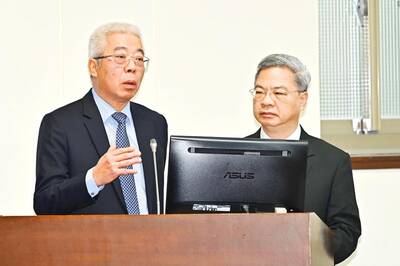
Taiwan has arranged for about 8 million barrels of crude oil, or about one-third of its monthly needs, to be shipped from the Red Sea this month to bypass the Strait of Hormuz and ease domestic supply pressures, CPC Corp, Taiwan (CPC, 台灣中油) said yesterday. The state-run oil company has worked with Middle Eastern suppliers to secure routes other than the Strait of Hormuz, through which about 20 percent of the world’s oil and liquefied natural gas typically passes, CPC chairman Fang Jeng-zen (方振仁) said at a meeting of the legislature’s Economics Committee in Taipei. Suppliers in Saudi Arabia have indicated they

South Korea has adjusted its electronic arrival card system to no longer list Taiwan as a part of China, a move that the Ministry of Foreign Affairs said would help facilitate exchanges between the two sides. South Korea previously listed “Taiwan” as “Taiwan (China)” in the drop-down menus of its online arrival card system, where people had to fill out where they came from and their next destination. The ministry had requested South Korea make a revision and said it would change South Korea’s name on Taiwan’s online immigration system from “Republic of Korea” to “Korea (South),” should the issue not be
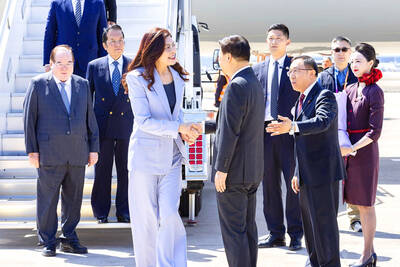
CCP ‘PAWN’? Beijing could use the KMT chairwoman’s visit to signal to the world that many people in Taiwan support the ‘one China’ principle, an academic said Chinese Nationalist Party (KMT) Chairwoman Cheng Li-wun (鄭麗文) yesterday arrived in China for a “peace” mission and potential meeting with Chinese President Xi Jinping (習近平), while a Taiwanese minister detailed the number of Chinese warships currently deployed around the nation. Cheng is visiting at a time of increased Chinese military pressure on Taiwan, as the opposition-dominated Legislative Yuan stalls a government plan for US$40 billion in extra defense spending. Speaking to reporters before going to the airport, Cheng said she was going on a “historic journey for peace,” but added that some people felt uneasy about her trip. “If you truly love Taiwan,
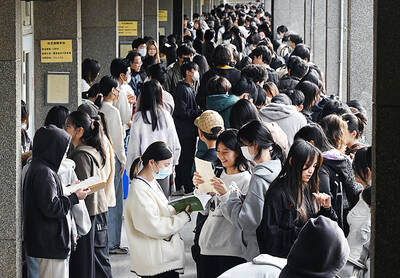
A global survey showed that 60 percent of Taiwanese had attained higher education, second only to Canada, the Ministry of the Interior said. Taiwan easily surpassed the global average of 43 percent and ranked ahead of major economies, including Japan, South Korea and the US, data from the Organisation for Economic Co-operation and Development (OECD) for 2024 showed. Taiwan has a high literacy rate, data released by the ministry showed. As of the end of last year, Taiwan had 20.617 million people aged 15 or older, accounting for 88.5 percent of the total population, with a literacy rate of 99.4 percent, the data


 RSS
RSS