


Hong Kong Chief Executive Tung Chee-hwa (董建華) yesterday warned lawmakers against backing a legislative motion calling for a referendum on direct elections, saying it would damage the territory's "harmonious atmosphere."
China ruled in April that Hong Kong can't have universal suffrage by 2008 as was sought by pro-democracy campaigners, but their camp has pressed ahead with demands for quick democratic reform, recently pushing for a referendum on the matter.
China has opposed the idea, and Tung also rejected the move earlier, but he made the rare move of restating his opposition yesterday ahead of a meeting to discuss a motion backing a referendum.
Tung said lawmakers should abide by China's April ruling "no matter what opinions or views they personally hold."
He said the referendum "doesn't comply with set legal procedures" and called it "an inappropriate approach that is unrealistic and misleads citizens."
Tung warned "not only will it severely hurt the harmonious atmosphere that has emerged in society and affect good relations between the central government and the Hong Kong special region, but it doesn't help the healthy development of democracy in Hong Kong."
Tung was elected by an 800-member committee loyal to Bei-jing. Rank-and-file voters picked half of the 60 sitting lawmakers, while special interest groups that also tend to side with China chose the remaining 30 legislators.
Also yesterday, a newspaper reported that a Web site called for the territory's independence from China, a demand that a senior pro-Beijing figure said borders on treason.
The "Hong Konger Frontline" site describes its mission as "promoting Hong Kongers' consciousness of local identity, refusing collaboration with China, building a country that belongs to Hong Kongers," the Ming Pao Daily News reported.
However, reporters in Hong Kong and Bangkok were not able yesterday to access the Web page identified by the paper as http://new.nnsol.com/hongkonger, registered in India.
It wasn't immediately clear why the Web page wasn't accessible. The Hong Kong government declined comment on whether it had blocked the site, while the Chinese government's liaison office in Hong Kong didn't immediately respond to a faxed query seeking comment on the Web site and whether it had sought to have it shut down.
The site also reportedly urges locals to "adamantly refuse to travel to China, boycott Chinese products and discriminate against Chinese tourists."
Ip Kwok-him (葉國謙), the vice-chairman of the Democratic Alliance for the Betterment of Hong Kong, said the Web site borders on treason, which carries a life sentence in Hong Kong. "It's very borderline," he said by telephone.
But Hong Kong's government suggested the site is protected by freedom of expression.
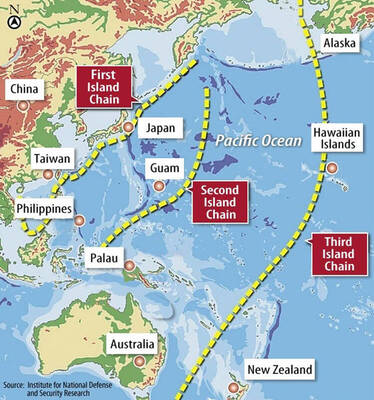
The US government has signed defense cooperation agreements with Japan and the Philippines to boost the deterrence capabilities of countries in the first island chain, a report by the National Security Bureau (NSB) showed. The main countries on the first island chain include the two nations and Taiwan. The bureau is to present the report at a meeting of the legislature’s Foreign Affairs and National Defense Committee tomorrow. The US military has deployed Typhon missile systems to Japan’s Yamaguchi Prefecture and Zambales province in the Philippines during their joint military exercises. It has also installed NMESIS anti-ship systems in Japan’s Okinawa

TRAGEDY STRIKES TAIPEI: The suspect died after falling off a building after he threw smoke grenades into Taipei Main Station and went on a killing spree in Zhongshan A 27-year-old suspect allegedly threw smoke grenades in Taipei Main Station and then proceeded to Zhongshan MRT Station in a random killing spree that resulted in the death of the suspect and two other civilians, and seven injured, including one in critical condition, as of press time last night. The suspect, identified as a man surnamed Chang Wen (張文), allegedly began the attack at Taipei Main Station, the Taipei Fire Department said, adding that it received a report at 5:24pm that smoke grenades had been thrown in the station. One man in his 50s was rushed to hospital after a cardiac arrest

‘WIN-WIN’: The Philippines, and central and eastern European countries are important potential drone cooperation partners, Minister of Foreign Affairs Lin Chia-lung said Minister of Foreign Affairs Lin Chia-lung (林佳龍) in an interview published yesterday confirmed that there are joint ventures between Taiwan and Poland in the drone industry. Lin made the remark in an exclusive interview with the Chinese-language Liberty Times (the Taipei Times’ sister paper). The government-backed Taiwan Excellence Drone International Business Opportunities Alliance and the Polish Chamber of Unmanned Systems on Wednesday last week signed a memorandum of understanding in Poland to develop a “non-China” supply chain for drones and work together on key technologies. Asked if Taiwan prioritized Poland among central and eastern European countries in drone collaboration, Lin

ON ALERT: Taiwan’s partners would issue warnings if China attempted to use Interpol to target Taiwanese, and the global body has mechanisms to prevent it, an official said China has stationed two to four people specializing in Taiwan affairs at its embassies in several democratic countries to monitor and harass Taiwanese, actions that the host nations would not tolerate, National Security Bureau (NSB) Director-General Tsai Ming-yen (蔡明彥) said yesterday. Tsai made the comments at a meeting of the legislature’s Foreign Affairs and National Defense Committee, which asked him and Minister of National Defense Wellington Koo (顧立雄) to report on potential conflicts in the Taiwan Strait and military preparedness. Democratic Progressive Party (DPP) Legislator Michelle Lin (林楚茵) expressed concern that Beijing has posted personnel from China’s Taiwan Affairs Office to its


 RSS
RSS